This page was translated automatically using artificial intelligence (DeepL). The German version is binding. More information about automatic translation
Facts and figures

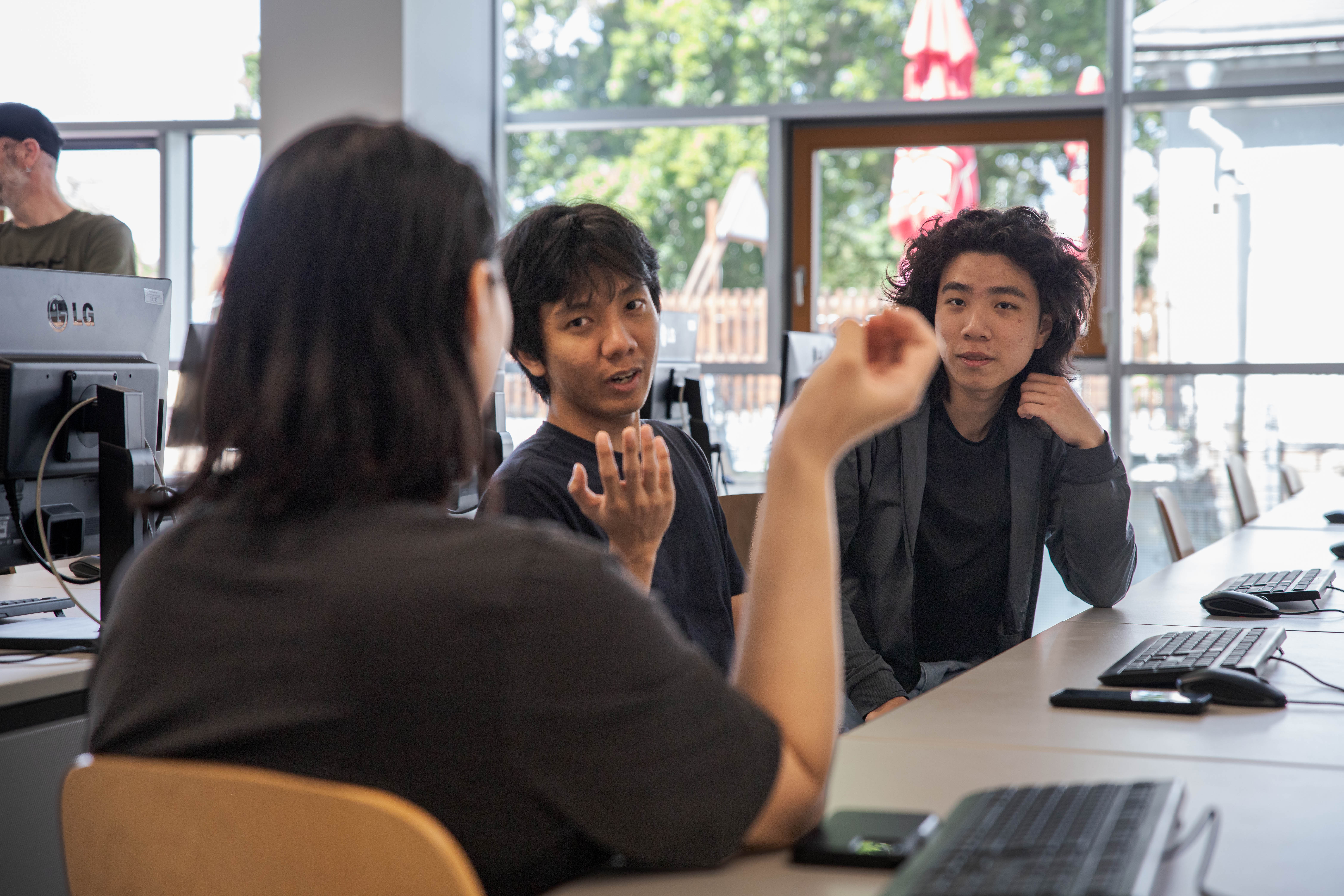
You will study Applied Mathematics entirely in English, which means you’ll be immersed in an international environment right from the start, providing you with the best possible preparation for the global job markets in Data Science and AI. The programme’s close links to Mittweida’s research activities in the field of interpretable artificial intelligence ensure that you gain insights into cutting-edge developments that are relevant to both academia and industry.
What makes Applied Mathematics at Mittweida special is its clear focus on practical application and current fields of research. You won’t just be working with abstract models; you’ll learn how mathematical methods are applied in real-world contexts – such as analysing large volumes of data or developing intelligent systems. To this end, you’ll learn to model complex relationships, analyse data and make informed decisions based on mathematical insights.
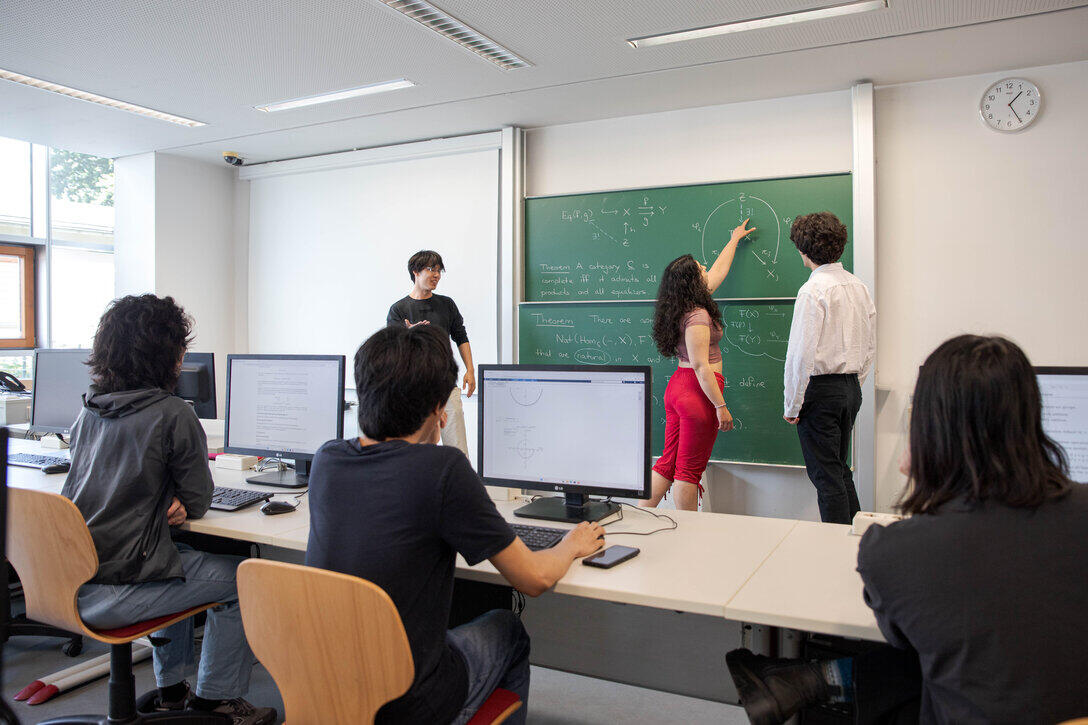
An overview of the course content
Analysis and linear algebra, as key tools of modern mathematics, form the foundation of your degree programme. This is complemented by subjects such as discrete mathematics, graph theory and algebra, which show you how complex structures and relationships can be described mathematically. At the same time, you will develop an understanding of algorithmic thinking and work with digital tools to solve mathematical problems with the aid of computers. In doing so, you will develop a confident grasp of mathematical models – in the technical language used internationally in science and business: English.
From the third semester onwards, you will increasingly tailor your degree programme to your own interests. You will delve deeper into probability theory, statistics and optimisation. Building on this, you will engage intensively with mathematical modelling and stochastic models – in other words, precisely the methods used to describe and analyse real-world systems. This is complemented by subjects such as numerical mathematics, computer algebra and pattern recognition, which form an important foundation for applications in Data Science and artificial intelligence.
Analysis I
Linear Algebra I
Discrete Mathematics
Interdisciplinary Skills
Analysis II
Linear Algebra II
Graph Theory
Introduction to Programming
Analysis III
Algebra
Probability Theory
Optimisation
Numerical Mathematics
Number Theory
Statistics
Computer Algebra
Mathematical Seminar
Mathematical Modelling
Theoretical Computer Science
Stochastic Models
Pattern Recognition
Practical module
: Independent scientific and practical work within a company
Duration: 12 weeks
Bachelor’s
thesis: Final, independent academic thesis
Duration: 12 weeks
From the 3rd to the 5th semester, you will choose three optional modules to create your own specialised focus. The options are:
- Selected Topics in Pure Mathematics
- Selected Topics in Applied Mathematics
- Selected Topics in Computer Science
- Selected Topics in Engineering Science
- Mathematical Project
- Intercultural Competence
- Interdisciplinary Modules


Applied Mathematics in Mittweida
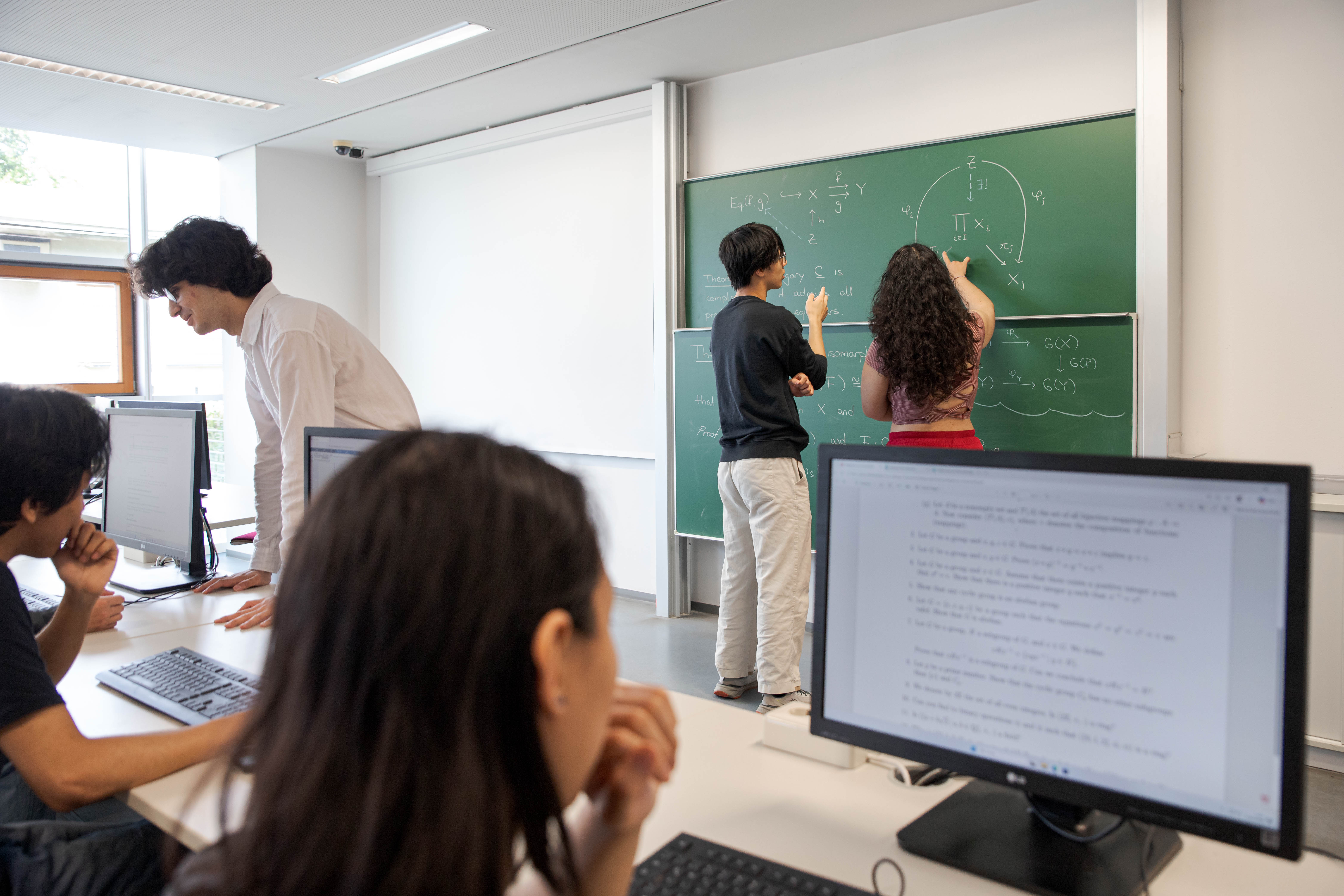

In summary – Applied Mathematics in Mittweida

Full-time Bachelor’s degree programme in Mathematics taught in English

(180 Credits)







With a Bachelor’s degree in Applied Mathematics, you could, for example, work as a data analyst, data scientist or in the field of business analytics, helping companies to make data-driven decisions. Roles in the field of artificial intelligence, financial analysis or within technology-focused companies are also typical areas of work. Your ability to structure complex problems mathematically and communicate them in an international context is a key advantage here.
Applied Mathematics
Application and Admission
Applicants must hold a general university entrance qualification, a university of applied sciences entrance qualification, a subject-specific university entrance qualification or an equivalent recognised qualification. Applicants who have completed vocational training and have at least three years’ professional experience may also be admitted following a consultation and a successful entrance examination.
Language skills:
Anyone who has not obtained their university entrance qualification through the German Abitur, including a basic English course with an average mark of 2, must demonstrate English language proficiency at level B2 of the Common European Framework of Reference for Languages. This can be demonstrated, for example, by a TOEFL test (iBT or iBT Home Edition) with a score of at least 76 points, the Duolingo English Test with a score of at least 110 points, or by an equivalent certificate.
The application period for the winter semester begins on 15 October of the preceding year and ends on 15 July. You can register at hs-mittweida.de/bewerben. Once you have submitted all your documents, you can enrol. Once you have enrolled, your place at Mittweida is secured. For international applicants, the application deadline is 15 May, to allow sufficient time to apply for a visa.
Excellent study conditions, modern facilities and some of the most affordable rent prices in Germany for a university town mean you can focus fully on your studies. Tutorials are on hand to help with subject-specific queries, the SAXEED start-up network guides you on your journey towards developing your own business idea, and the Social Support Service provides assistance with specific life situations, such as childcare or caring for relatives. The campus also has plenty to offer: two music festivals a year, an active esports team and a vibrant student community. International students, for example, are closely connected through the Cosmopolitan Club.



Related degree programmes



Frequently Asked Questions
During your degree, you can choose your own areas of focus, for example in fields such as data analysis, optimisation or financial mathematics. There is no traditional specialisation on this course, but you can tailor your studies to your own interests through your choice of modules.
There are no school-style holidays during your degree. Instead, there are lecture-free periods. During these, you can study, write assignments, undertake work placements – and treat yourself to a bit of a break now and then.
In the 2026/2027 winter term, in addition to public holidays, the following periods are lecture- and exam-free:
- 21 December to 3 January,
- from 22 February. Exception: The Faculty of Social Sciences begins its lecture-free period on 29 February.
In the 2027 summer term, with lectures starting on 22 March, the dates are:
- 25 March to 2 April,
- 7 May,
- 17 May,
- from 2 August. The Faculty of Social Sciences will also hold an examination week from 23 to 27 August.
Whilst classical mathematics often remains deeply rooted in pure theory and proof, applied mathematics uses these tools to solve specific problems in engineering, economics or data analysis. It is therefore less about the ‘why’ behind an abstract formula, and more about how mathematical models can be used to make the real world more predictable and efficient.
You should have a solid grasp of the fundamentals of A-level mathematics, particularly calculus and linear algebra, as the degree programme builds directly on this knowledge. However, far more important than having perfect prior knowledge is your ability to think logically and the perseverance to get to grips with complex structures – the university also offers helpful preparatory courses to ensure a smooth start.
As much of the specialist literature and many modern software tools are in English, you should have a solid B2 level to be able to follow the content. You do not need to be a native speaker, but a willingness to navigate the English-speaking academic world with confidence is very important for your success in your studies and your future career.
Mathematics is regarded as a demanding subject that requires a great deal of discipline; however, at Mittweida, it is taught in a much more accessible way than at traditional universities, thanks to its strong practical focus. Here, theory always serves as a tool for practical application, which makes the subject matter challenging, but also highly motivating due to its direct practical application.
Your prospects are excellent, as mathematicians – as versatile problem-solvers – are in high demand worldwide across sectors such as IT, finance, logistics and research. As the language of mathematics is international and, during your degree, you’ll learn to present complex data in a way that’s understandable worldwide, every career door is open to you.