This page was translated automatically using artificial intelligence (DeepL). The German version is binding. More information about automatic translation
Facts and figures
Computing meets Engineering
In a world where software and electronics form the basis of technical products, the ability to develop high-performance and reliable systems is a key skill. Sensors, electronics, software and embedded computing platforms must work together reliably by adapting to one another and responding in a controlled manner, even in the event of faults. This is exactly what you’ll learn in ‘Computing meets Engineering’ – from the design of embedded systems through to software development and the application of AI techniques.
Robotics, cyber security and AI: that’s Computing meets Engineering
An overview of the course content
During your degree, you’ll combine computer science, electrical engineering and IT security to gain a comprehensive, interdisciplinary understanding. You’ll learn how embedded systems are structured, how sensors, microcontrollers and networks interact, and how this gives rise to intelligent technical applications. At the same time, you’ll explore cybersecurity, AI, robotics and the security of technical systems. Rather than simply developing software or examining individual circuits, you’ll gain an understanding of complete systems – from the hardware right through to intelligent control.
Software Technologies for Networked and Embedded Systems
Fundamentals of Electrical Engineering I
Electronic Systems Development
Mathematics I
Fundamentals of Physics
English
Complex Practical Course 1 (Part 1)
Software Development tools and technologies
Operating Systems
Analogue and Digital Technology
Fundamentals of Electrical Engineering II
Mathematics II – Specialising in Analysis
General Studies (Studium Generale)
Complex Practical Course 1 (Part 2)
Introduction to IT security
Computer Networks and Cloud Applications
Microcontroller Technology
Control Engineering: Signals and Systems
Mathematics III – Probability and Statistics
Complex Practical Course 2
AI: Fundamentals and Applications
Reliability and Safety of Technical Systems
Trends in Software Engineering
Applied Technology Assessment in Engineering
Measurement and Sensor Technology
Complex Practical Course 3
Robotics
Virus technology/antivirus software
Corruption of electronic systems
Electromagnetic compatibility
Risk management
Complex Practical Course 4
Practical module
: Independent scientific and practical work within a company
Duration: 12 weeks
Bachelor’s
thesis: Final, independent academic thesis
Duration: 12 weeks

Computing meets Engineering in Mittweida


In summary – Computing meets Engineering in Mittweida

Full-time Bachelor’s degree programme at the intersection of IT security and technology

(180 Credits)





After graduating with a degree in Computing meets Engineering, you could work, for example, as an embedded systems engineer, a security engineer for networked systems, a developer of intelligent automation technology, or in the field of industrial cybersecurity. Roles in robotics, smart manufacturing, IoT system development or safety-critical infrastructure are also typical areas of work. Your expertise will be particularly in demand in areas where intelligent technical systems need to operate reliably and securely.
Application and Admission
Applicants must hold a general university entrance qualification, a university of applied sciences entrance qualification, a subject-specific university entrance qualification or an equivalent recognised qualification. Applicants who have completed vocational training and have at least three years’ professional experience may also be admitted following a consultation and a successful entrance examination.
Language skills:
Anyone who did not obtain their university entrance qualification at a German-speaking institution must demonstrate German language proficiency at level C1 of the Common European Framework of Reference for Languages. Proof of this can be provided, for example, by passing the ‘German as a Foreign Language’ (TestDaF) test at the Mittweida University Preparatory College with an average score of TDN 3 in all four sections, or by presenting an equivalent certificate.
The application period for the winter semester begins on 15 April and ends on 15 July. You can register online via the HSMW application portal. Once you have submitted all your documents, you can enrol. Once you have enrolled, your place at Mittweida is secured. For international applicants, the application deadline is 15 May, to allow sufficient time to apply for a visa.
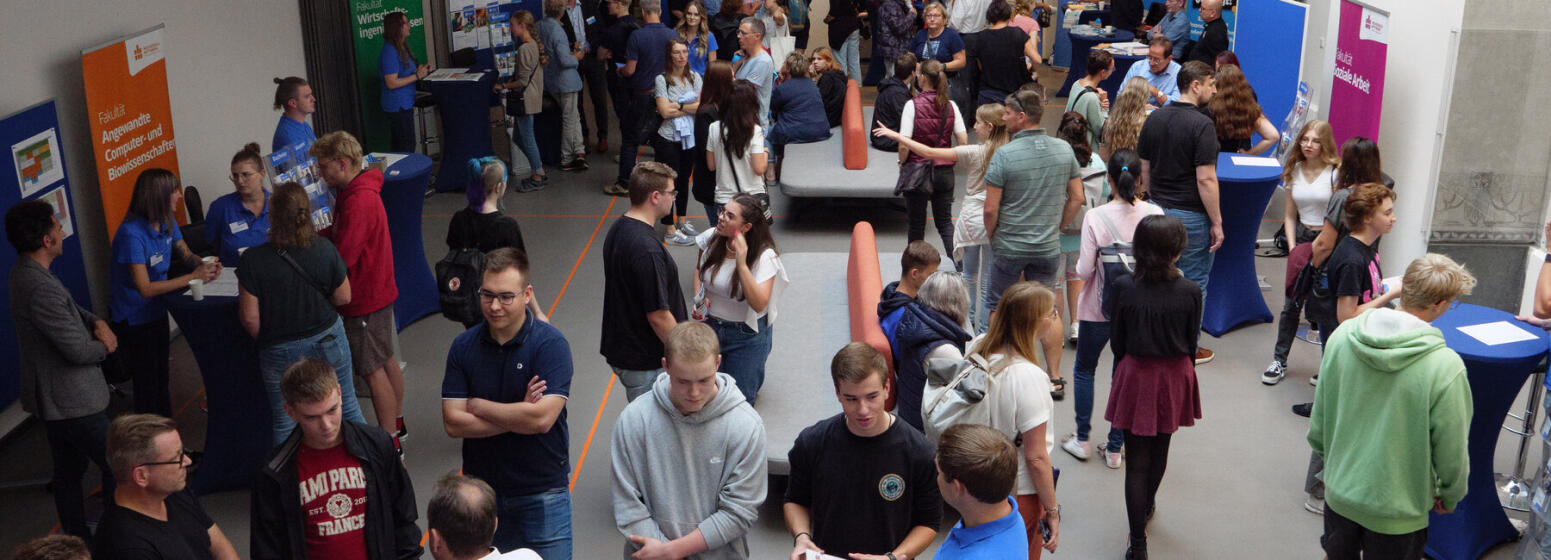
We’ve got you covered! Excellent study conditions, modern facilities and affordable rent allow you to focus fully on your studies. Tutorials are on hand to help with academic queries, the SAXEED start-up network supports you on your journey to developing your own business idea, and the Social Support Service offers assistance with specific life situations, such as childcare or caring for relatives. The campus also has plenty to offer: two music festivals a year, an active esports team and a vibrant student community. Discover just how diverse life in Mittweida is – at the Open Day or the Night of Science.


Related degree programmes

Frequently Asked Questions
No. Whether you’ve already soldered your first circuit boards or have never written a single line of code – we’ll start you off with the basics. A general interest in maths and logical relationships is all you need to get off to a good start.
For anyone who loves tinkering and for whom code only becomes truly exciting when it ultimately makes something happen in the real world. If you enjoy logic and want to understand how the technology in robots, wearables or smart devices works, you’ve come to the right place.
There are no school-style holidays during your degree. Instead, there are lecture-free periods. During these, you can study, write assignments, undertake work placements – and treat yourself to a bit of a break now and then.
In the 2026/2027 winter term, in addition to public holidays, the following periods are lecture- and exam-free:
- 21 December to 3 January,
- from 22 February. Exception: The Faculty of Social Sciences begins its lecture-free period on 29 February.
In the 2027 summer term, with lectures starting on 22 March, the dates are:
- 25 March to 2 April,
- 7 May,
- 17 May,
- from 2 August. The Faculty of Social Sciences will also hold an examination week from 23 to 27 August.
Here, software and hardware merge into a single entity. You’ll learn not only how to write code, but also how that code controls physical components, sensors and machines. The aim is to develop intelligent systems for the real world – from smart home technologies to industrial IoT (Internet of Things) applications.
Traditional computer science often remains confined to the purely digital world of software, whilst Mechanical Engineering and Electrical Engineering focus heavily on physical hardware. This degree programme is the perfect bridge between the two: you will be the expert who understands how to seamlessly integrate software architecture into modern engineering.