This page was translated automatically using artificial intelligence (DeepL). The German version is binding. More information about automatic translation
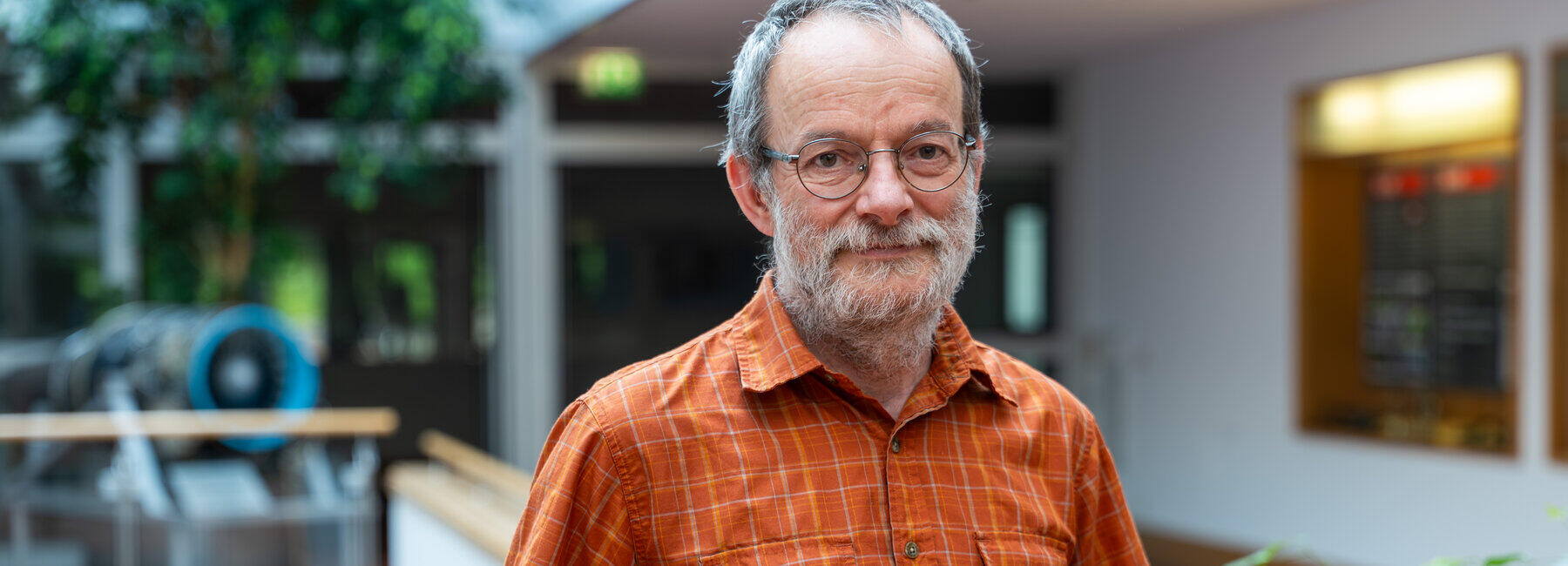
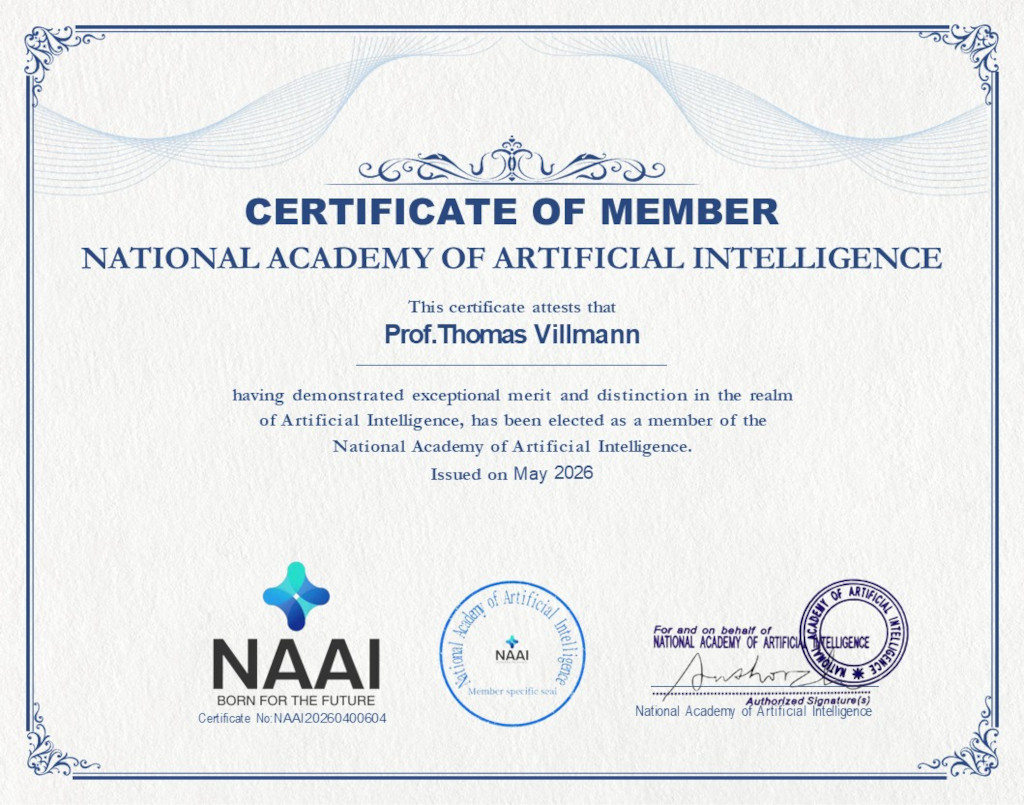
A significant milestone for AI research at Mittweida University of Applied Sciences: Professor Thomas Villmann, holder of the Chair in Computational Intelligence and Technomathematics at the Faculty of Applied Computer Sciences and Biosciences and Director of the SICIM (Saxon Institute for Computational Intelligence and Machine Learning), has been elected to the prestigious National Academy of Artificial Intelligence (NAAI) – an honour bestowed only upon a select few individuals worldwide. Membership is regarded as a true mark of quality for scientific excellence. With this honour, Professor Thomas Villmann now belongs to an exclusive circle of international experts who are playing a key role in shaping the development of artificial intelligence. In this interview, he explains what the NAAI is and what this honour means.
Professor Villmann, first of all, my warmest congratulations on your induction into the NAAI! What goes through your mind at a moment like this?
Thomas Villmann: Thank you very much. You do feel a bit like the famous sorcerer’s apprentice who is deemed worthy of being admitted to the school of magic. (laughs) But no, seriously: I’m grateful and also touched, and I feel honoured that my – that our – AI research at Mittweida University of Applied Sciences has received this recognition and is regarded as world-leading.
What is the NAAI and what are its objectives?
Thomas Villmann: The NAAI sees itself as an independent network of leading figures from the fields of science, business and technology. Its aim is to promote responsible progress in the field of artificial intelligence, to strengthen interdisciplinary exchange and to provide impetus for socially relevant innovations. It brings together leading figures from research, business and technology and creates a space for exchange at the highest level. Furthermore, the Academy sets thematic priorities, identifies future trends and helps to shape research and innovation agendas. Through guidelines and recommendations, it contributes to the discussion on ethical, societal and regulatory issues relating to AI.
How do you become a member, and who are the members?
Thomas Villmann:
Admission to the NAAI is not a routine honour, but a genuine ‘mark of distinction’. Admission follows a rigorous selection process and is subject to clear quality standards.
Particularly decisive factors include outstanding scientific achievements in the field of artificial intelligence, a demonstrable impact – for example, through groundbreaking publications, innovations or successful transfer projects – as well as practical relevance and collaboration across disciplinary boundaries. Furthermore, the selection process takes into account international visibility and recognition within the specialist community, as well as a commitment to responsible AI, for instance with regard to ethics, transparency and societal impact. It is not possible to simply apply for membership; instead, appointment is usually made on the recommendation of existing members (‘nomination’) and is reviewed by a selection committee, whose members must approve admission by a 70 per cent majority – admission is therefore a deliberate and exclusive decision. The NAAI brings together a select group of around 1,000 individuals worldwide – figures who are actively shaping the development of AI, such as leading scientists from universities and research institutions, innovation leaders from the business world, thought leaders from policy consultancy and civil society who work on strategic and ethical issues, and entrepreneurs and pioneers who have successfully translated AI into products, start-ups or new business models. Last but not least, four Nobel laureates are also members of the NAAI.
What do you personally gain from membership, and how does HSMW-KI research benefit from it?
Thomas Villmann: For me personally, membership first and foremost signifies recognition of our research excellence. As well as providing access to exclusive platforms and committees, it also entails greater responsibility and, consequently, higher expectations; one’s sphere of influence expands, and one plays a part in shaping societal developments. Admission also brings with it new responsibilities and opportunities. Members of the NAAI serve on international expert panels, provide strategic impetus for the further development of AI technologies and help to formulate ethical guidelines for their use. At the same time, the Academy provides access to a high-calibre network that intensifies exchange across national and disciplinary boundaries. Through this membership, the university enhances its visibility as a centre for cutting-edge applied research, both regionally and in an international context. We gain even more direct access to relevant topics, international networks and contacts in the professional world. Research achievements gain greater international recognition and new international partnerships are forged.
In short: appointment to the NAAI is both an honour and a mandate.
What happens next?
Thomas Villmann: My ‘debut’ with the NAAI will be the annual conference in October 2026, which will be almost a ‘home game’ for me, as it is expected to take place in Frankfurt am Main. That’s where I’ll be taking part in the committee for the first time and will be able to meet the other Academy members in person.
What are you currently researching?
Thomas Villmann: In my research group, we are currently developing an AI-based approach to analyse data intended for training AI models for bias, and, where necessary, to eliminate or at least reduce this influence. This is not only relevant from a socio-ethical perspective. In medicine, there is a growing realisation that men and women require distinctly different treatment approaches and methods. In order to nevertheless identify commonalities in the relevant patient data, such bias corrections in the data prior to the training of specific AI diagnostic tools are very important. Furthermore, AI should not only recognise diseases diagnostically, but, in the best-case scenario, also provide explanatory models as a causal AI, as is also being investigated in the KIMed project (https://www.kimed-netzwerk.de/de/).
Another area of focus is the economical use of data for AI training, as the provision or generation of suitable data is often costly. In agriculture, for example, the use of inexpensive and robust sensors for plant health monitoring and the detection of plant stress caused by drought or pests is of essential importance. Here, we are pursuing a mathematical approach aimed at ensuring that the relevant AI models can operate with the minimum possible data requirements whilst maintaining detection quality. In this context, plans are also in place to establish a Bio-Core Lab for practice-oriented teaching as part of the university’s ILEAS project, where, from next year onwards, students will be able to carry out their own measurements to generate data for AI models, thereby raising their awareness of and training them in AI-appropriate data generation. Furthermore, within the ILEAS project, we are also addressing a more strategic area of research, namely the use of AI in teaching and in teaching and learning analytics to improve academic success by identifying students’ individual strengths and weaknesses.
It is important to note that all AI models developed in my research group are characterised by relatively straightforward interpretability, deliver reliable results through mathematical verifiability, and alert users to uncertain decisions.
I am also proud of our current total of around 450 scientific publications, with approximately 9,000 citations worldwide.
I am particularly pleased that we are currently planning the launch of an inter-faculty Master’s programme in ‘AI/Machine Learning and Data Science’ at SICIM for next year, and that I am receiving a very positive response and a willingness to collaborate from many of our university’s teaching staff.
Professor Villmann, thank you very much for the insightful conversation. Once again, our warmest congratulations on your election to the National Academy of Artificial Intelligence – a thoroughly deserved honour and an impressive milestone.
We wish you every success in your new role as a ‘Member of the NAAI’, as well as exciting opportunities to network and continued energy to play an active part in shaping the future of AI. We look forward to seeing what lies ahead!
About the author
Thomas Villmann studied mathematics, specialising in theoretical physics, in Leipzig and Kiev, and was awarded a Dr. rer. nat. degree in 1996 at the University of Leipzig. In 2005, he completed his habilitation in theoretical computer science, also at the University of Leipzig. He has held the Chair of Technomathematics and Computational Intelligence at the HSMW since 2009 and has been Director of SICIM since 2017. His research focuses on interpretable AI and AI security.