This page was translated automatically using artificial intelligence (DeepL). The German version is binding. More information about automatic translation
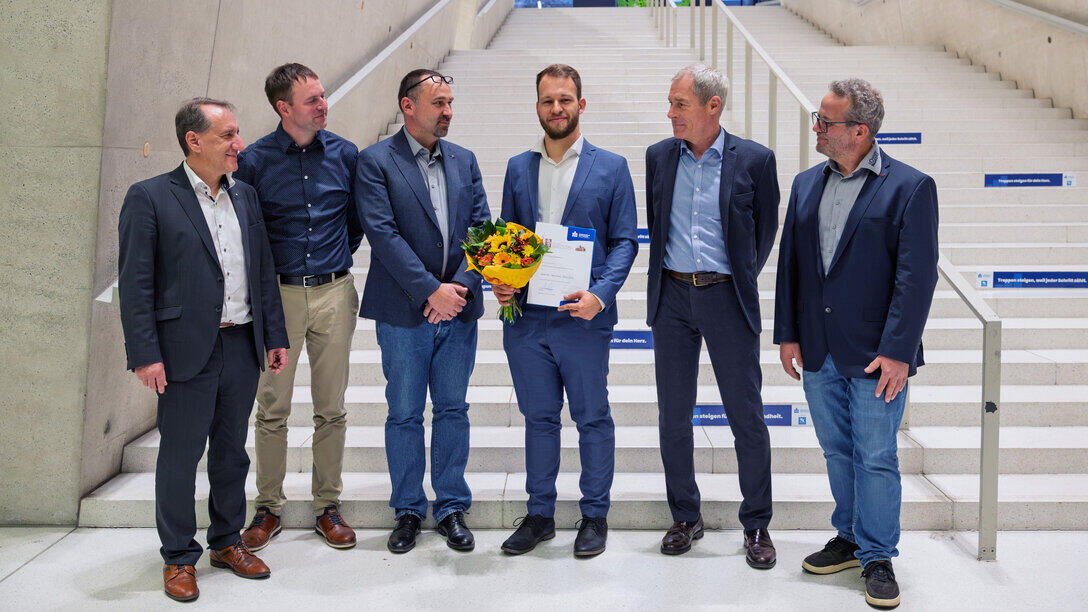
In recognition of his exceptional achievements whilst studying at Mittweida University of Applied Sciences, Mechanical Engineering graduate Philipp Goldammer is to receive this year’s Gerhard Neumann Prize from HSMW. The award is presented for outstanding technical innovations developed as part of projects, final-year dissertations or other academic work.
Curiosity, commitment, conscientiousness and professional dedication are qualities that run like a common thread through Goldammer’s career.
Now a design engineer and project manager at Sonnenberg GmbH, he found his way into the world of industry at an early stage. Around four and a half years ago, Andreas Petzold from the Faculty of Engineering Sciences established contact with the company following the ‘CAD Techniques’ module. That initial meeting developed into a long-standing collaboration: whilst studying, Goldammer worked at the company as a working student, completed his Master’s thesis there and was taken on immediately after successfully graduating.
Philipp Goldammer studied Mechanical Engineering, specialising in design. Even whilst still a student, he focused on gaining additional qualifications and, even before completing his Master’s degree, obtained the demanding additional qualification as a welding engineer. In addition, he was heavily involved in the university’s Formula Student team, contributing his expertise, time and passion.
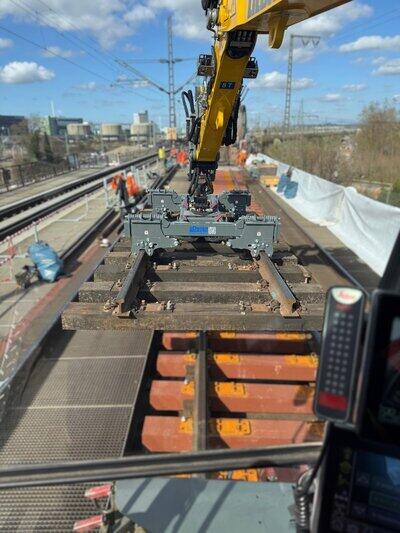
However, he reached a decisive milestone with his Master’s thesis under Professor Frank Weidermann. He successfully defended it in April 2026, achieving the top mark of 1.0. The thesis focused on the development of a hydraulic track-clamp crossbeam for use in track construction. This specially developed attachment enables an excavator to pick up, transport and lay track spans weighing up to eight tonnes.
The key feature of the design is self-adjusting hydraulic grippers, which compensate for any misalignment in the track panels and make the machine operator’s job significantly easier. At the same time, fewer workers are required, laying times are reduced and workplace safety is improved. The development thus not only contributes to more efficient construction processes but also supports the expansion of rail infrastructure in the context of the mobility transition.
Particularly noteworthy: the solution did not remain on paper. Following successful testing, the design was put into series production and is already being delivered to customers. Several units are now in active use.
The fact that a solution developed as part of a final-year project has found its way directly into industrial application is by no means a matter of course and underlines the exceptional quality of his work,
as stated in the nomination for the award. In particular, the nomination highlights Goldammer’s high degree of independence, his conscientious approach to work and his ability to translate scientific findings into concrete technical solutions.
Just as Gerhard Neumann once transformed technical visions into groundbreaking innovations, Philipp Goldammer has also demonstrated how scientific research can lead to a practical solution. Of course, different standards and times separate the two career paths. Yet the approach remains the same: tackling challenges with specialist knowledge, creativity and perseverance. The Gerhard Neumann Prize therefore honours not only an outstanding final-year project, but also a young engineer whose ideas are already making an impact today.