This page was translated automatically using artificial intelligence (DeepL). The German version is binding. More information about automatic translation
Facts and figures
Social Work: counselling, leadership, management, digitalisation
On the Master’s programme in Social Work at Mittweida University of Applied Sciences, you will develop into an expert at the interface between counselling, leadership and management, as well as the implications of social change, which is increasing the need for innovation in social work practice.
As the regional social economy is characterised by small and medium-sized organisations, and as every social worker covers a comparatively broad range of tasks, you will benefit directly from the breadth of topics covered by the Mittweida Master’s programme. With your focus on organisations, teams and processes, you will shape change in the social and service sectors as an integral part of your professional competence.
Introduction to the Master’s degree programme in Social Work
An overview of the course content
The Master’s programme in Social Work provides you with in-depth knowledge of counselling and management processes, organisational and quality management, governance and social policy, as well as the impact of digitalisation on communication, identities and work processes. Through practical projects carried out in collaboration with social organisations, you will put theory into practice and expand your professional network.
The focus on digitalisation sets the Master’s in Social Work at Mittweida apart from many other programmes. This is because, in order to keep pace with changes in society and to practise Social Work successfully, skills are required that go beyond the qualifications acquired in undergraduate programmes.
Counselling, Guidance and Management I:
- Counselling I: Counselling Theory, Counselling Practice
- Management I: Social Economy and Organisation
- Management I: Governance in Local Communities, Local Social Policy
Digitalisation in Social Work I: Fundamentals of Digitalisation
Practical Project I: Introduction to Empirical Social Research; Strategic, Organisational and Human Resources Development; Project Planning
Advising, Leading, Managing II:
- Counselling II: Counselling
- Management II: Financial and Human Resources; Leadership and Management in Social Service Organisations
- Management II: Social Work in the Community
Continuation of Digitalisation in Social Work I: Digitalisation in Discourse
Social Work in Discourse: Theories and the Social Work Profession; Social Change and Social Inequality in the Context of the Realities of a Society of Migration
Practical Project II: Introduction to data analysis; project implementation
Advising, Leading, Managing II:
- Consulting II: The Practice of Consulting
- Management II: Quality Management and Impact
- Management II: Social Planning
Practical specialisations, e.g. employment law for managers, professional teams
Social Work in Discourse: Reflection on Practice
Digitalisation in Social Work II: Data Protection; Law and Organisation
Continuation of Practical Project II: Social Work and Research; Project Evaluation
Master's thesis


Social Work in Mittweida


In summary – Social Work in Mittweida

Full-time degree programme in Social Work

(120 Credits)







After completing your Master’s degree, you will hold leading roles in Social Work: whether in middle or senior management within social organisations, in policy units within public administrations, as a policy officer in associations, or working independently in consultancy and research – your role will be wide-ranging and involve significant responsibility. The Master’s degree also qualifies you for a PhD and global career paths in the field of social science innovation.
Application and Admission
Applicants must hold a first professional university degree (Bachelor’s) in Social Work. Graduates of social science disciplines related to Social Work (e.g. educational sciences) may be admitted following a placement of at least one year in a Social Work organisation, completed after their degree, and subject to assessment by the admissions committee.
Language skills:
Applicants who did not obtain their university entrance qualification at a German-speaking institution must demonstrate German language proficiency at level C1 of the Common European Framework of Reference for Languages. This can be demonstrated, for example, by taking the ‘German as a Foreign Language’ (TestDaF) test at the Preparatory College of Mittweida University of Applied Sciences, achieving an average of TDN 3 in all four sections, or by providing an equivalent certificate.
The application period for the winter semester begins on 15 April and ends on 15 July. You can register at hs-mittweida.de/bewerben. Once you have submitted all your documents, you can enrol. Once you have enrolled, your place at Mittweida is secured. For international applicants, the application deadline is 15 May, to allow sufficient time to apply for a visa.
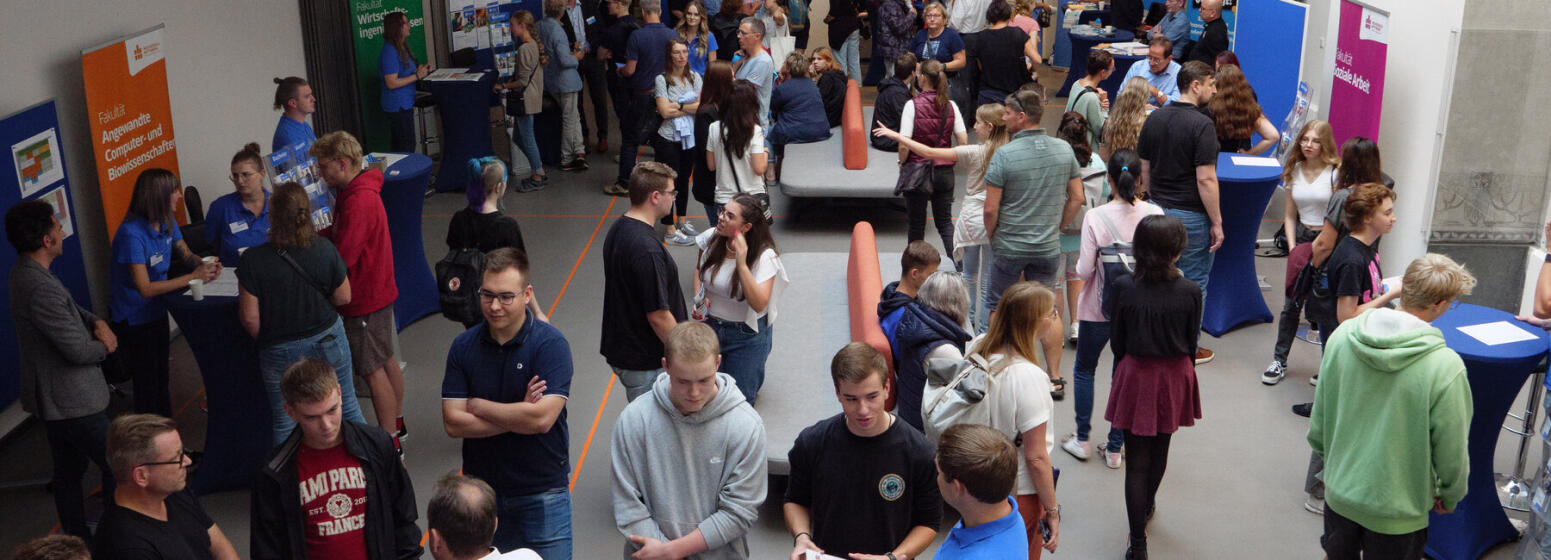
Because you’re not just continuing your studies here – you’re setting an example. Unlike many Master’s programmes in Social Work, which focus purely on counselling, here you’ll combine leadership, management and digitalisation – at a university that places great emphasis on practical relevance and innovation. The Faculty of Social Sciences at Mittweida University of Applied Sciences offers you small groups and personalised support at a university with a clear focus on practical and reflective skills. Tutorials support you with subject-specific questions, the SAXEED start-up network guides you through your own projects, and the Social Support Centre helps you balance your studies and personal life, for example if you’re looking after a child or caring for a relative. On campus, you can look forward to two major music festivals a year, an active esports team and a strong sense of community. Mittweida is different from what you might expect. Come and see for yourself at the Open Campus Day (Studieninformationstag) or the Night of Sciences (Nacht der Wissenschaften)!


Related degree programmes



Frequently Asked Questions
Yes, definitely. The Master’s programme not only trains you to become a manager, but also a highly specialised academic. If you want to analyse complex case scenarios, develop innovative concepts for organisations, or work at the highest level in clinical social work and counselling, this Master’s programme will provide you with the necessary depth of knowledge.
Yes, specialisation is achieved primarily through your choice of project workshops, your own research focus areas and the topic of your Master’s thesis. This allows you to focus specifically on particular life situations, social contexts or counselling approaches that interest you most for your future career.
As the full-time degree programme involves a packed timetable with regular seminars and in-depth discussion sessions on campus, living in or near Mittweida saves a lot of stress. Anyone wishing to commute should be able to adjust their journey times flexibly, as classes may be spread throughout the week.
There are no school-style holidays during your degree. Instead, there are lecture-free periods. During these, you can study, write assignments, undertake work placements – and treat yourself to a bit of a break now and then.
In the 2026/2027 winter term, in addition to public holidays, the following periods are lecture- and exam-free:
- 21 December to 3 January,
- from 22 February. Exception: The Faculty of Social Sciences begins its lecture-free period on 29 February.
In the 2027 summer term, with lectures starting on 22 March, the dates are:
- 25 March to 2 April,
- 7 May,
- 17 May,
- from 2 August. The Faculty of Social Sciences will also hold an examination week from 23 to 27 August.
The Master’s programme is worthwhile if you wish to deepen your theoretical and methodological knowledge, embark on a research career, or obtain the formal qualifications required for senior civil service roles in the public sector and for management and leadership positions. It enhances your profile for complex, conceptual tasks in the social services sector.
The Master’s programme in Mittweida is research- and reflection-oriented. Management and organisational theory play an important role in understanding and managing social systems. Nevertheless, equal emphasis is placed on related disciplines (such as social policy, law and ethics) and the critical analysis of social issues, ensuring a balance between practice and theory.
The full-time programme is designed to be completed within a standard duration of four semesters and is structured as a traditional on-campus programme. It requires your full attention during the week. The part-time option spreads the same content over six semesters, offers significantly more flexibility in terms of time for work or family commitments, and concentrates the on-campus periods.