This page was translated automatically using artificial intelligence (DeepL). The German version is binding. More information about automatic translation
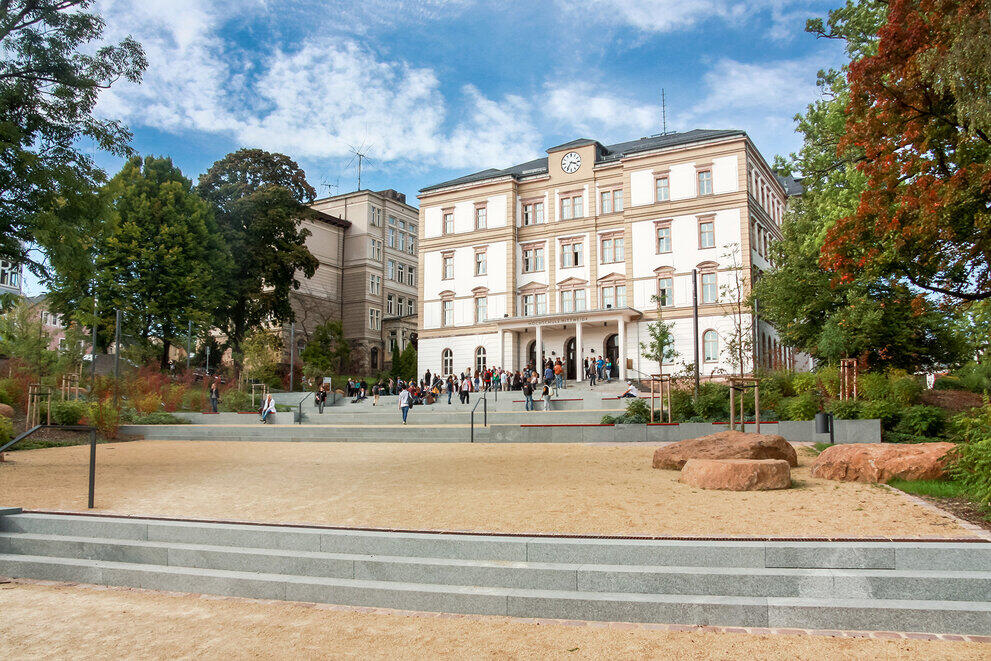
A success for Mittweida University of Applied Sciences: as part of the Free State of Saxony’s call for proposals for STEP early-career research groups (Platform for Strategic Technologies for Europe), several early-career research groups at HSMW were successful. These funding approvals ensure that young researchers have excellent conditions in which to develop innovative solutions to the challenges of tomorrow and to further advance Saxony, with Mittweida at its heart, as a centre for science and innovation.
Mittweida University of Applied Sciences is delighted that several STEP early-career research groups have been approved. Through this programme, the Free State of Saxony will, from this autumn, provide targeted support to outstanding academic talents working on forward-looking and socially relevant topics. The young researchers at Mittweida University of Applied Sciences place particular emphasis on interdisciplinary collaboration.
IRMA develops solutions for hybrid working models
The IRMA Early-Career Research Group – Interdisciplinary Development of Hybrid Manufacturing Systems: Mixed Reality for Assisted Planning, Programming and Operation – led by Professor Leif Goldhahn (Chair of Production Informatics), the aim is to develop innovative solutions for hybrid work systems through interdisciplinary collaboration between researchers in the fields of robotics, welding, ergonomics and virtual technologies at HSMW. Through virtual planning, technological preparation, training and the hybrid-automated operation of welding processes, innovative reference examples will be created and new qualifications developed for employees in Saxony. The following chairs are involved: Automated Joining Processes and Simulation (Professor Julia Zähr), Manufacturing Automation (Professor Alexander Winkler), Virtual Technologies (Professor Philipp Klimant) and the Chair of VR/AR Technologies and Human-Technology Interaction (Professor Tobias Czauderna).
futurRNA-Sax – Paving the way for the future of RNA-based diagnostics and medicine in Saxony
The futuRNA-Sax early-career research group was established as an interdisciplinary project in the STEM fields of artificial intelligence, Laser Technology/(bio)photonics, Biotechnology/medicine and 3D visualisation/human-computer interaction, with the aim of exploring novel possibilities in RNA-based medicine and pharmacy for health research, incorporating key technologies such as AI and digital realities on the one hand, and high-tech biotechnological processes on the other, whilst developing appropriate process methods. A key focus is also on training early-career researchers to become future specialists in these innovative technologies of the future. Under the leadership of Professor Thomas Villmann (Chair of Computational Intelligence and Technomathematics), Professor Röbbe Wünschiers (Chair of Biochemistry / Molecular Biology), Professor Marc Ritter (Chair of Media Informatics) and Professor Richard Börner, (Chair of Biophotonics / Physical Engineering) are collaborating on an interdisciplinary basis.
HUMKIT develops telepresence technologies for maintenance
Professor Philipp Klimant (Chair of Virtual Technologies) and Professor Thomas Villmann (Chair of Computational Intelligence and Techno-Mathematics) are participating in the HUMKIT early-career research group (telepresence platform for human-centred AI-supported maintenance technologies) led by Chemnitz University of Technology. The aim of the project is to train early-career researchers in the field of human-centred telepresence technologies for the remote maintenance and remote diagnosis of production machinery. To this end, relevant technologies are being developed, tested and scientifically evaluated in a practical context. To this end, the Chair of Virtual Technologies is investigating, amongst other things, suitable sensor technology for various industrial operating environments, as well as communication solutions for challenging environmental conditions. It is also taking the lead in developing the telepresence platform demonstrator, which is used by all partners. The Chair of Computational Intelligence and Techno-Mathematics develops AI-based methods for detecting obstacles and environmental features, with the aim of making the remote navigation of the telepresence system safer and more efficient. The aim is to support maintenance and service processes more efficiently across multiple sites and to make expert knowledge available in a more targeted manner.

About the STEP programme
Early-career research groups form part of the ‘ESF Plus Guidelines 2021–2027: Higher Education and Research’ issued by the Saxon State Ministry of Science, Culture and Tourism (SMWK) and are funded by the EU and the state. In this way, the SMWK supports projects at universities in response to the growing shortage of skilled workers. The current funding, based on the EU’s STEP Regulation (Strategic Technologies for Europe Platform), also helps to reduce Europe’s strategic dependencies and to strengthen Saxony as a centre for science and business in the long term. Funding is provided for STEP early-career research groups, each comprising between 4 and 12 members, which are specifically designed to strengthen the European Union’s competitiveness and technological autonomy and to ensure that qualified specialists are available for Saxony.