This page was translated automatically using artificial intelligence (DeepL). The German version is binding. More information about automatic translation
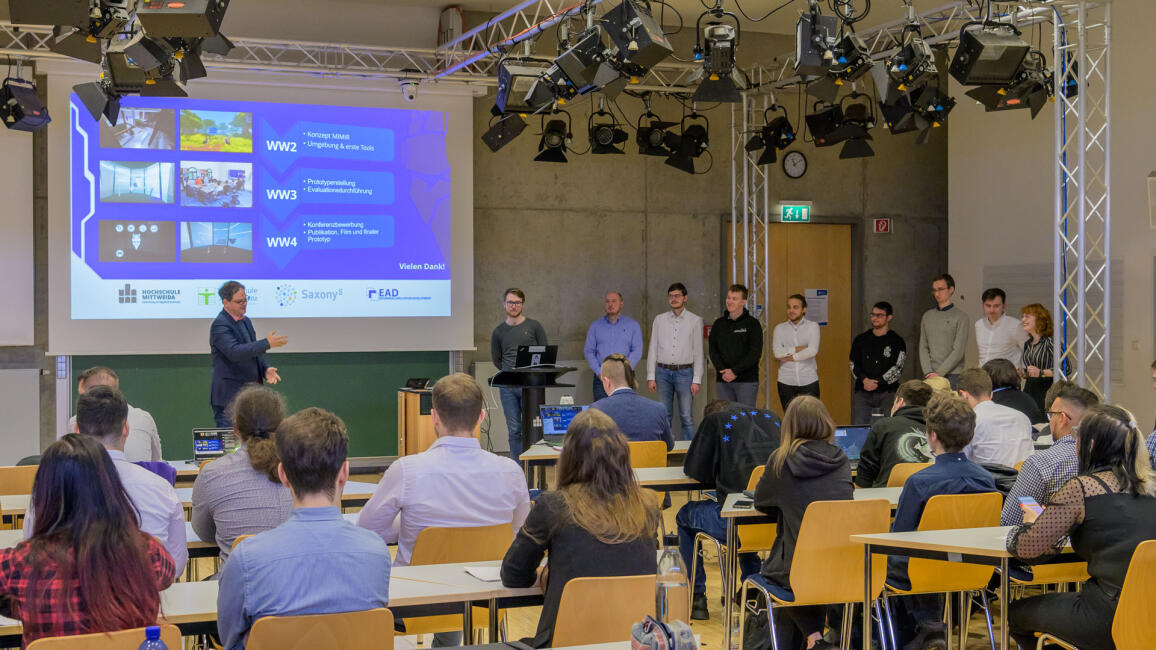
However different the events may have been, in both cases students from the ‘Media Informatics and Interactive Entertainment’ programme took the opportunity to put what they had learnt into practice. On 2 February, they presented their new game, ‘Lumien’, on which they had been working for around a year. The teaching projects in the “Science and Business 2 to 4” learning field module series are even longer in duration – spanning over three semesters – and their results were presented as early as 17 January.

Talent from Mittweida for the gaming industry
For a year, over 60 Bachelor’s students from the current graduating cohort of the “Media Informatics and Interactive Entertainment” programme worked on a new game called “Lumien”. The “beta 2023” event provided the platform for the game’s release.
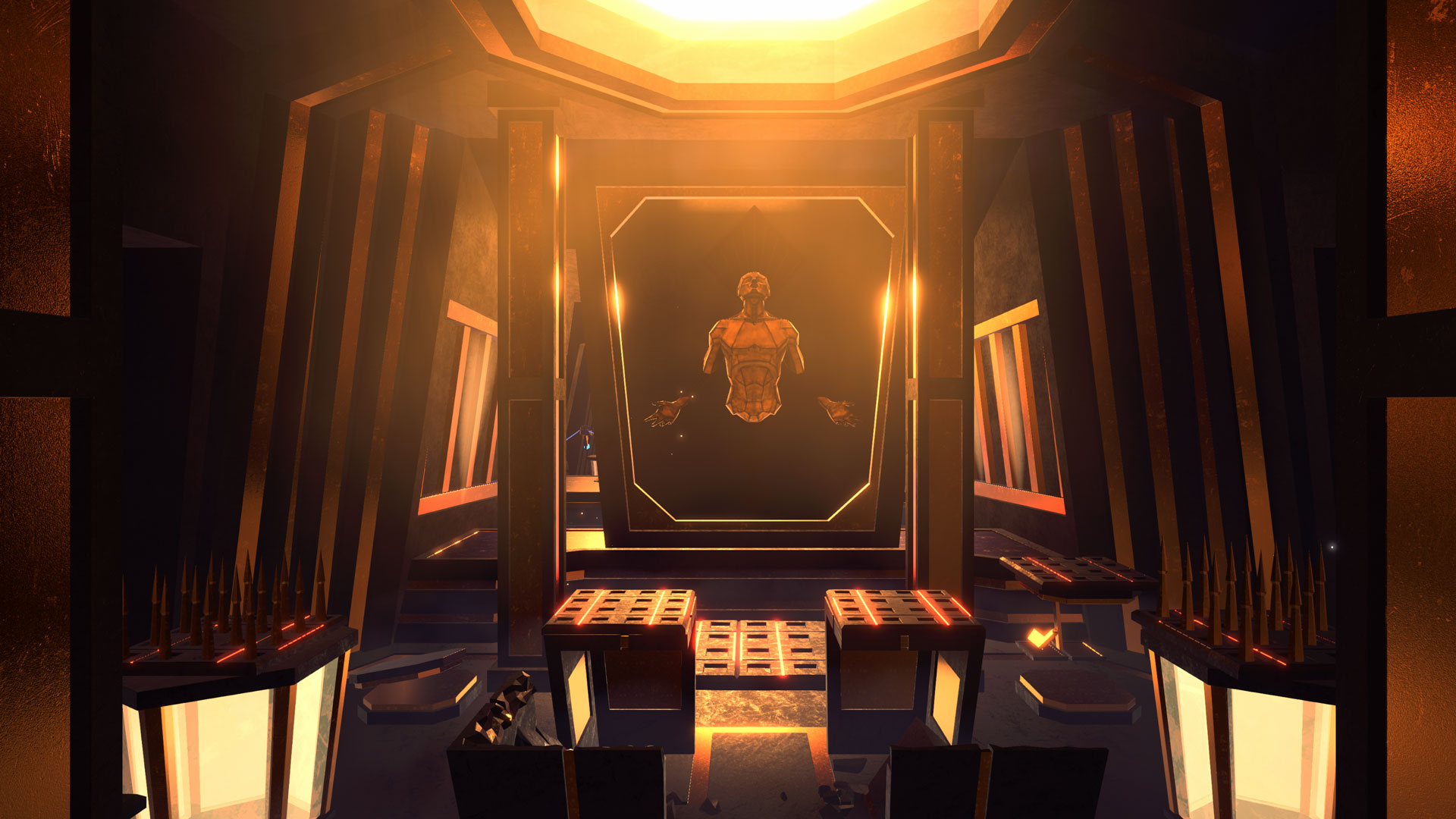
The announcement on the Steam platform reads: “Lumien is a fast-paced third-person platformer in which you explore the ruins of an ancient civilisation to breathe new life into it. As you make your way past the various defences, the orbs – fuelled by the civilisation’s mysterious powers – will help you.”
The evening presentation was preceded by a full day of talks, including one on ‘Mental Health in Esports’, and a recruitment event. The students had invited alumni and guests from the games and software industries to attend.
beta2023 was streamed live on Twitch from the TV studio at Mittweida University of Applied Sciences.
Alexander Marbach, Professor of Game Design and Creative Content Design at Mittweida University of Applied Sciences, is delighted: “Every year, it’s exciting and impressive to see how 60 young people, over the course of a tough year, have transformed into a close-knit community of allies and, in doing so, have unleashed incredible potential! Once again this year, the university’s Media Informatics and Interactive Entertainment students are demonstrating their talent and innovative flair for the gaming industry.”
The new game “Lumien” is now the ninth final-year project and joins a successful series that has already recorded over 15,000 downloads on Steam. The game was released on the platform as an Early Access version at the end of the event and can be downloaded there free of charge.
Award-winning teaching concept: Digital Skills and Products
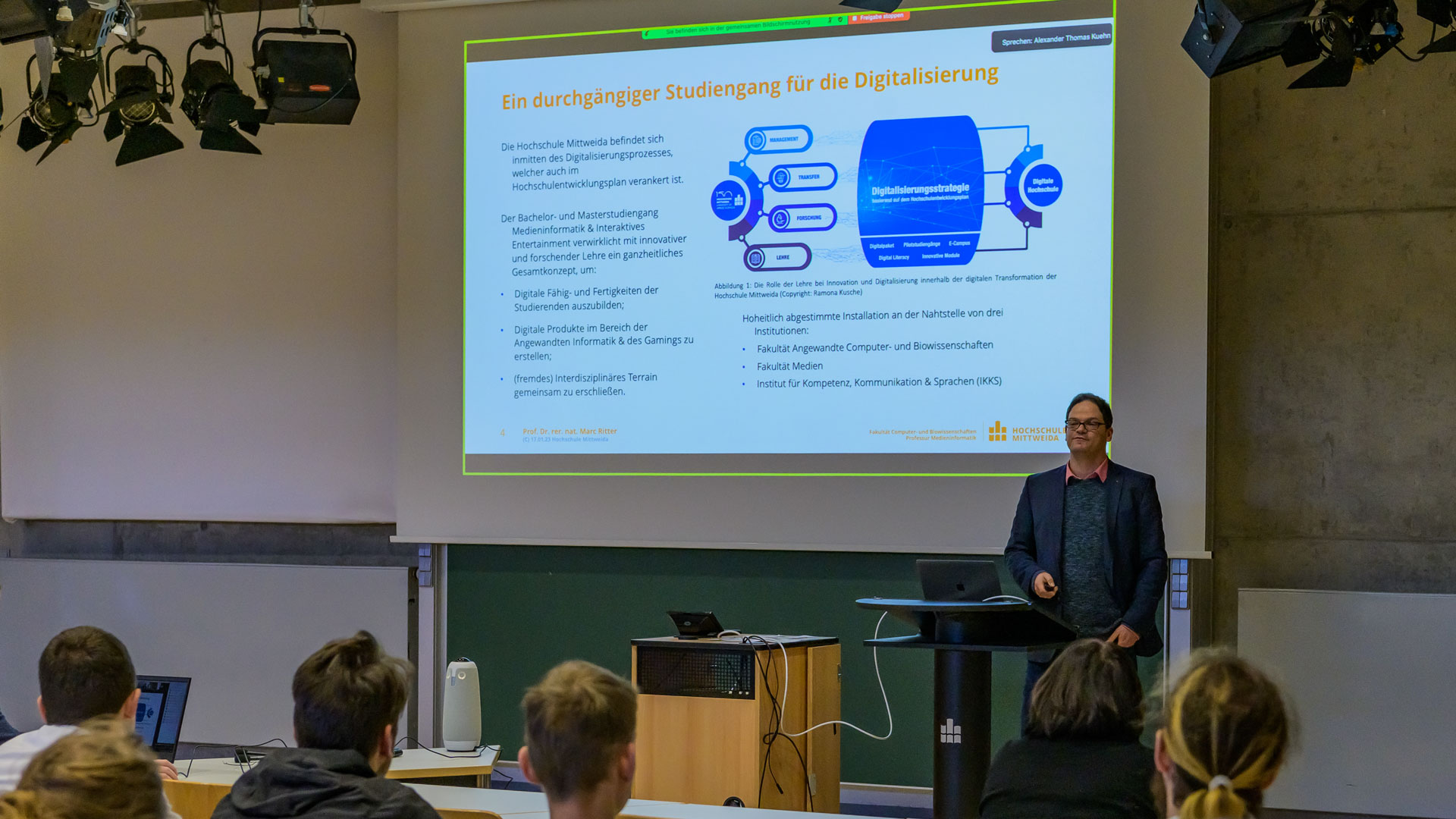
In the projects within the ‘Science and Business 2 to 4’ learning module series, students work in groups to develop interactive software products. They present the results in multimedia format in preparation for an academic publication. What makes this special is that, just as in their future careers, the topics are provided by partners from the worlds of academia and business. Experienced internal and external stakeholders and lecturers support the students throughout the entire process. In this way, they undertake fundamental project steps within interdisciplinary tasks and learn from the outset to address the requirements of their clients.
At the start of the group projects in the winter semester 2021/2022, the groups described the respective requirements for the product to be developed following interviews with their stakeholders and derived concepts. They further developed the initial prototypes from that semester during the summer term 2022 and evaluated their usability with the help of volunteer testers. In the 2022/2023 winter semester, which is now drawing to a close, they finalised the prototypes and documented the key findings of the teaching projects in short explanatory videos and academic papers.
The structured programme includes regular consultations, during which students present their progress and receive feedback, as well as joint final presentations at the end of each semester. The module series ‘Science and Business 2 to 4’ is a fundamental component of the cross-degree programme teaching concept ‘Digital Skills and Products’ developed by Mittweida professors Marc Ritter, Christian Roschke and Matthias Vodel. Ritter was awarded the Saxon Teaching Prize for this work in 2021.
The most recent round included local businesses and associations amongst the partners, as well as lecturers from the five Universities of Applied Sciences in Saxony, part of the Saxony5 transfer network, who had been involved in projects for joint teaching cooperation as part of Saxony5’s Artificial Intelligence Co-Creation Lab.
Creative collaboration: Applications from Mittweida University of Applied Sciences for other universities
Working with Professor Jens Jäkel from HTWK Leipzig, the students undertook a project in the field of robotics. The team from the ‘AI-Bot’ group was tasked with creating a virtual training environment for a robotic arm used for filming in busy environments such as film studios. AI agents will eventually be able to control the robotic arm, thereby preventing collisions with people or unexpected obstacles.
The teaching project led by Professor Mike Espig from Zwickau University of Applied Sciences involves the creation of a virtual world. To this end, students developed a virtual replica of the Data Science Research Group’s premises in Zwickau, to be used for virtual tours and as a digital training ground for the telepresence robot ‘Double’.
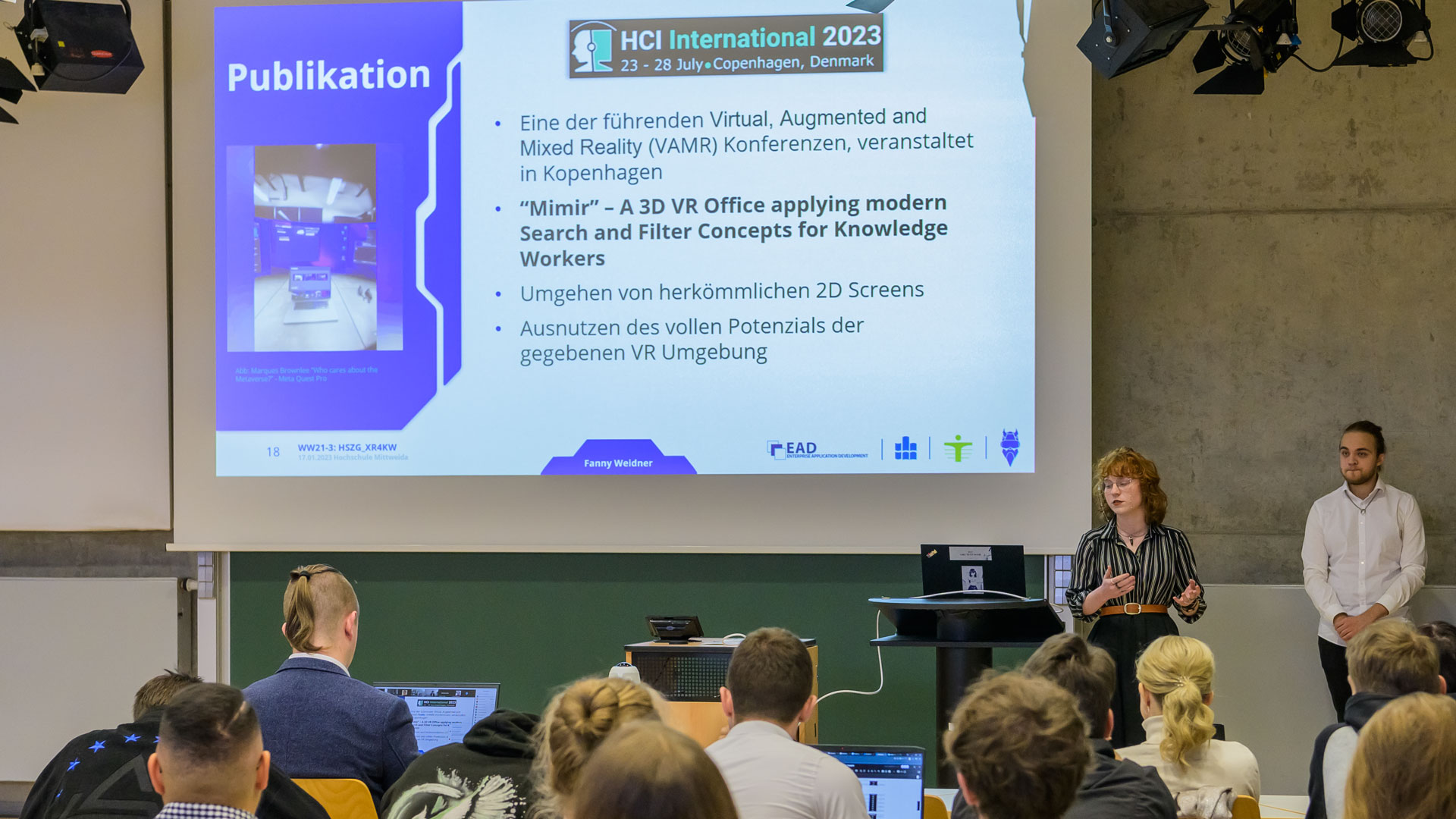
The “XR-Knowledge Worker” group, led by Professor Jörg Lässig from Zittau/Görlitz University of Applied Sciences, ventured into as yet largely unexplored territory: they developed concepts for the use of mixed reality technologies – XR for short – in knowledge work and implemented them as prototypes. The ambitious aim was to use virtual reality to develop a practical concept for AI-supported research into specialist literature and academic work. They were supported by Professor Tobias Czauderna, who has been strengthening the team at Mittweida University of Applied Sciences in the field of virtual and augmented reality technologies and human-technology interaction since 2022.
In contrast, the students in the ‘Traffic AI’ group led by Professor Wolfgang Oertel from HTW Dresden focused on traditional AI methods. Their task was to use a virtual city and the traffic situations depicted within it to build a knowledge base for an expert system intended for use in traffic analysis and monitoring. Among other things, the aim is to enable the early detection of critical situations – such as traffic jams, hazards or accidents – primarily through logic-based methods.
The group led by Professor Marc Ritter from Mittweida developed concepts for the semi-automated assessment of individuals’ health status as part of the ‘Xpose’ eHealth project. To this end, sensors are used to analyse postures, activities and vital signs in real time, with the support of AI.
Studying games: Game development and more in Mittweida
Key areas of focus in the interdisciplinary Bachelor’s degree programme Following the teaching of the fundamentals of computer science and design, the “Media Informatics and Interactive Entertainment” programme focuses on agile project management combined with the development – in terms of content, design and programming – of interactive media offerings and complex software systems for knowledge and information management.
In the Master’s programme of the same name, students can subsequently deepen their knowledge and skills in the following areas: game production, VFX production, web development, mixed reality and deep learning, as well as IT governance.