This page was translated automatically using artificial intelligence (DeepL). The German version is binding. More information about automatic translation
This year’s ‘Controversial Dialogue (Dialog Kontrovers)’ series at Mittweida University of Applied Sciences (HSMW) drew to a close with two events on 2 and 9 June.
The longing for immortality
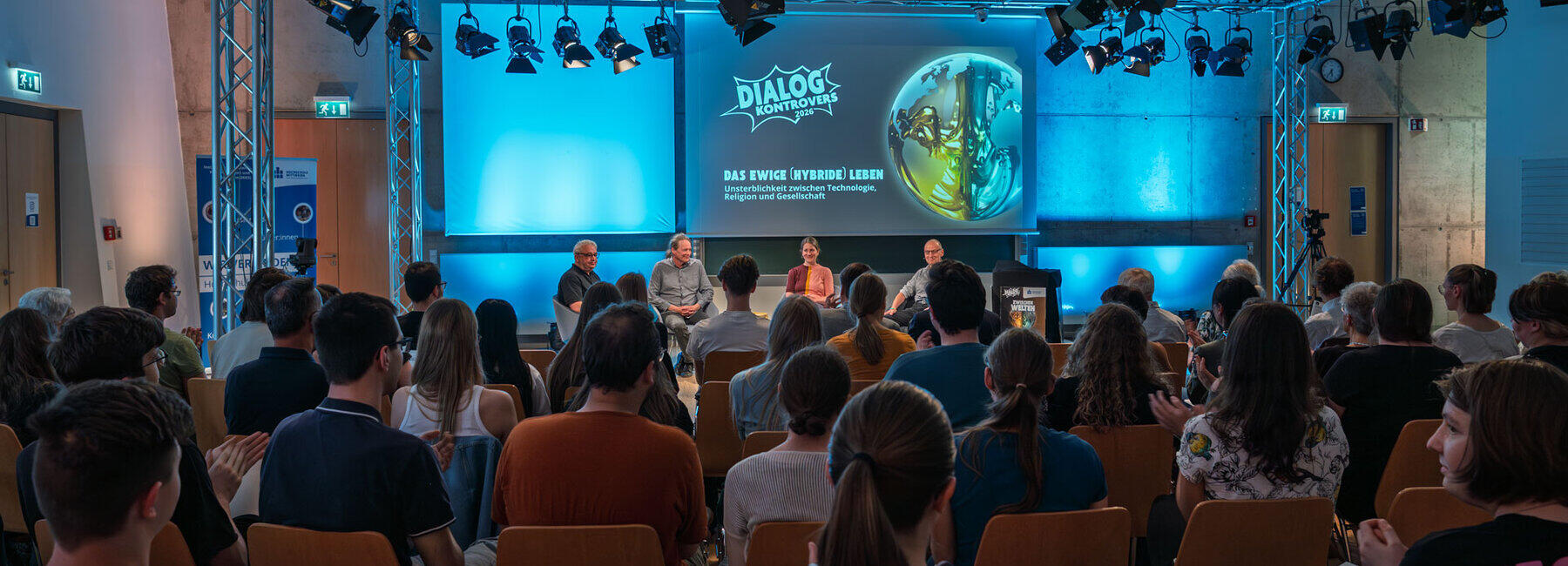
By exploring the question of eternal, hybrid life at the intersection of technology, religion and society, the sixth evening of the “Controversial Dialogue (Dialog Kontrovers)” series on 2 June addressed one of humanity’s great questions. The starting point was the age-old yearning to overcome human limitations and perhaps one day use technology to overcome death. At the same time, it became clear that the current debate on longevity, cryonics and transhumanism is no longer merely a vision of the future, but is being driven forward with renewed vigour by tech elites, Biotechnology and discussions on artificial intelligence. Professor Gunter Süß moderated the panel, which featured participants from a range of specialist backgrounds: theologian and pastor Nina Maria Mixtacki, political scientist Christopher Coenen, and Röbbe Wünschiers, Professor of Biochemistry and Molecular Biology at the HSMW.


Coenen described transhumanism as a long-standing tradition of ideas that seeks to transcend the ‘primate body’ and extend human existence through technology. Mixtacki countered this with a theological perspective, according to which human beings are limited but not deficient; mortality is part of life and is what opens up the space for meaning, relationships and dignity in the first place. Wünschiers made it clear that whilst Biotechnology does offer real possibilities for prolonging life – for example, through anti-ageing, gene therapy or medical interventions – an infinite life appears highly unlikely from a biological perspective.
Particular criticism was levelled at the current debates surrounding so-called ‘tech bros’ and their visions of a technologically perfected human being. Warnings were issued here against a blurring of the lines between a belief in progress, elitist overconfidence and questionable views of human nature. Environmental and social consequences also played a role: a significantly longer lifespan for many people raises questions about resource consumption, social justice and the resilience of existing systems.


In the end, there was no consensus, but there was a shared conclusion: the longing for immortality says a great deal about our contemporary self-image. Whilst some defend death as the ultimate limit and the very condition of human existence, others see the passing on of knowledge, children, deeds and memory as a different, more realistic form of immortality.
AI and creativity
The latest edition of “Controversial Dialogue (Dialog Kontrovers) 2026”, held on 9 June, focused on the question: “Creative and intelligent – or just well-trained?” The panel and audience were enriched by the International Week at the HSMW. AI-powered live German subtitling made it easier for all attendees to follow the English-language discussion.
On the panel, Dr Stefanie Kremmel from the HSMW welcomed visual artist Nadja Verena Marcin, composer and journalist Matthias Hornschuh, and social scientist Sarah Bowman. The question of what creativity actually entails sparked a discussion about the societal implications of generative AI: the devaluation of knowledge work, losses in value creation, and the danger of a ‘race to the middle’ – that is, becoming accustomed to average and standardised content.


Furthermore, attention turned to the global interconnections underlying these seemingly intangible applications. The working conditions of clickworkers, resource consumption and the abuse of power by market-dominant companies were just some of the otherwise invisible aspects that were discussed. The guests agreed that a responsible and ethically sound future for generative AI is only possible through political regulation and societal effort.
Nadja Verena Marcin demonstrated how art and political engagement can be combined to foster a critical approach to generative AI, using her feminist audio bot ‘SophyGray’ as an example. Furthermore, other subversive strategies such as conscious abstention, appropriation and boycott were discussed as forms of artistic and social resistance.


Despite all the criticism, the evening was marked by a sense of optimism. The discussion highlighted just how important it is to actively encourage creativity and to give people time to learn, experiment and try things out – because that is the only way new ideas and innovations can emerge.
A look back at the ‘Controversial Dialogue (Dialog Kontrovers)’ debate
“This year’s Controversial Dialogue brought together students, university staff and members of the public to discuss a fascinating and important set of issues,” summed up Professor Gunter Süß, Director of Studies at the Institute for Competence, Communication and Languages (IKKS) at HSMW, which organised the series, “Renowned experts offered insights from different perspectives into the worlds between physical and digital reality – and our place within them. They shed light, in a clear and vivid manner, on the spectrum ranging from the future of conflict, through solutions to climate change, urban life and the use of AI for a healthier or even immortal life, right through to its influence on creativity and culture.”


Anyone who missed the talks or would like to watch them again can find them on Mittweida University of Applied Sciences’ YouTube channel. The first videos are already online. The links and additional material can be found on the information pages for the respective events.
In the summer term of 2027, the “Public Lecture Series” will return to explore a topical issue that is of concern to society.
Text: Professor Gunter Süß/Helmut Hammer
Photos: Helmut Hammer