This page was translated automatically using artificial intelligence (DeepL). The German version is binding. More information about automatic translation
Episodes 5 and 6 of the seven-part series ‘Controversial Dialogue (Dialog Kontrovers)’, held at Mittweida University of Applied Sciences (HSMW) under the theme ‘Between Worlds’, have focused – or are focusing – on people as the centre of the hybrid reality between the physical and digital worlds. Episode 4, scheduled for 28 April, had to be cancelled due to illness.
A look ahead to 2 June: from a healthy life to eternal life
The Controversial Dialogue on 2 June at 5.30 pm in Studio B at the HSMW will explore the age-old longing for immortality, which has been reignited by AI and other technologies: under the heading ‘Eternal (hybrid) life. Immortality between Technology, Religion and Society”, theologian Nina-Maria Mixtacki, political scientist Christopher Coenen and molecular biologist Professor Röbbe Wünschiers will discuss the topic – with one another and with the audience. The Controversial Dialogue (Dialog Kontrovers) is aimed at both university members and interested members of the public. The full programme and additional material for each evening can be found on the event page.
A look back at 12 May: AI and medicine
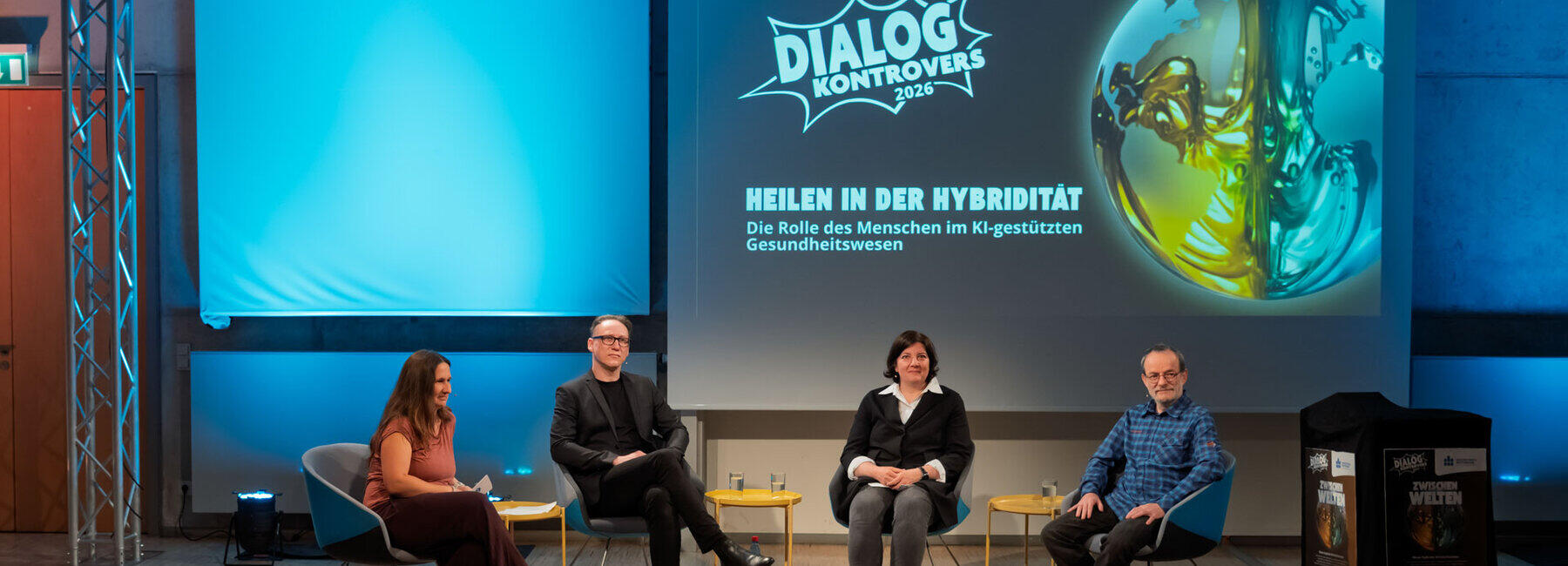
The fifth evening, on 12 May, entitled ‘Healing through hybridity. The role of humans in AI-supported healthcare’ provided answers to the question of how artificial intelligence (AI) is transforming healthcare and where the limits of technological support lie in the sensitive relationship between doctors and patients. The panel was interdisciplinary, comprising researchers from the fields of mathematics, medicine and psychology.


Dr Marika Kaden, a mathematician, research assistant at the HSMW and researcher on the ‘AI Med’ project, chaired the evening’s proceedings. She bridged the gap between technical precision and ethical responsibility. Kaden urged clarity of terminology: rather than referring to AI that supposedly ‘thinks’, it would be better to speak of ‘machine learning’ in order to avoid false expectations. She was particularly critical of the residual error rate in language models: with an accuracy of 97 per cent, she argued, the remaining 3 per cent represents a high risk in a medical context.
Kadens’ colleague, Professor Thomas Villmann from the HSMW, called for AI systems to be used only for their intended purpose and for their limitations to be clearly communicated. He emphasised that machine learning is already superior to humans in areas such as cancer detection. However, he also pointed out that the human voice is a biometric fingerprint, which makes it technically difficult to achieve complete anonymisation of voice recordings. Villmann is Professor of Technomathematics and Computational Intelligence and Director of the Saxon Institute for Computational Intelligence and Machine Learning (SICIM) at the HSMW.
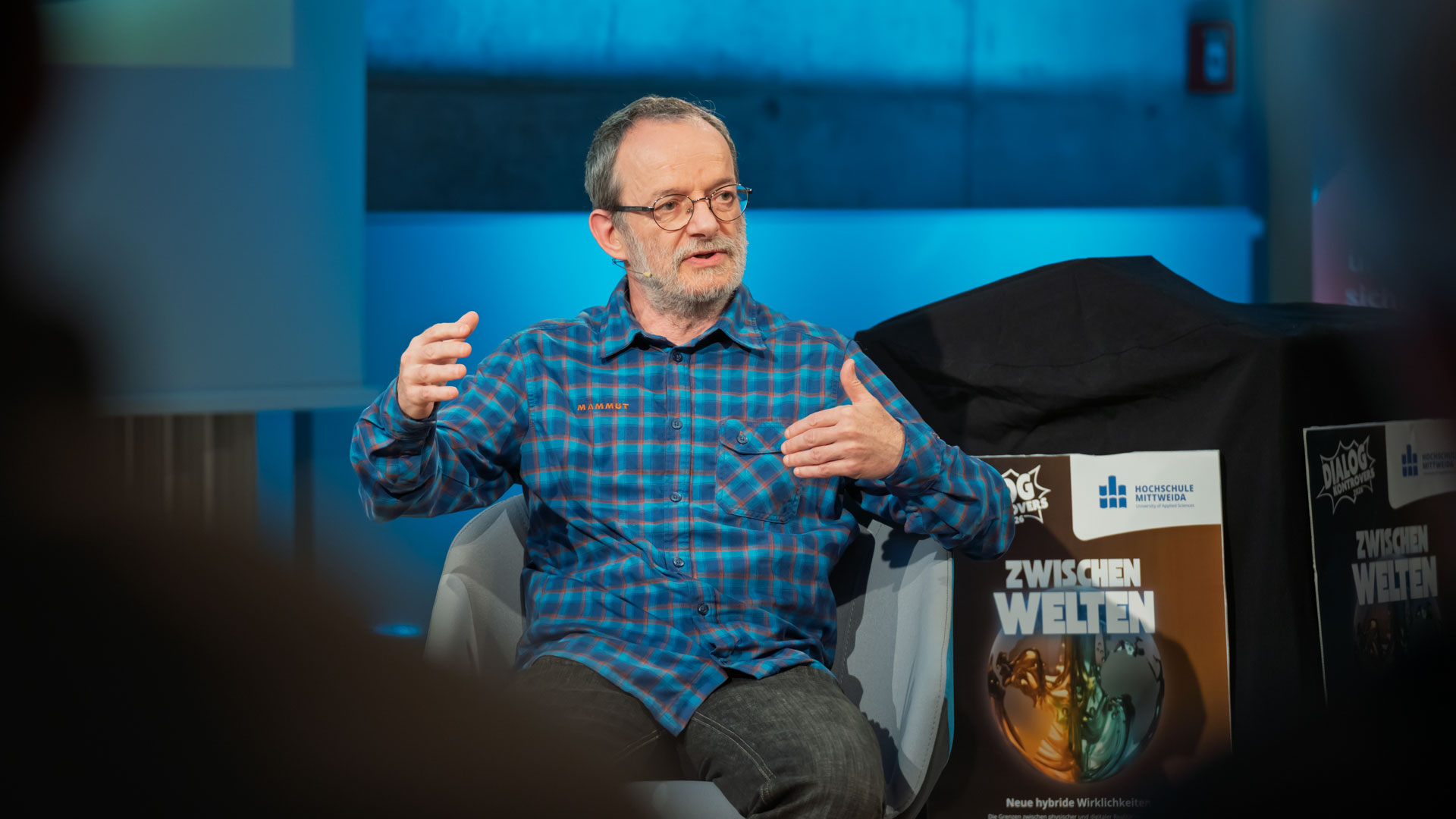

Professor Christine Rummel-Kluge, a medical specialist, is a senior consultant at the Department of Psychiatry and Psychotherapy at Leipzig University Hospital and head of the hospital’s psychiatric outpatient clinic. She drew on her clinical experience and described AI as “both a curse and a blessing”. Whilst she sees automated documentation (speech-to-text) as a necessary way of easing the workload on staff, she warned against the ‘transparent patient’ and the loss of therapeutic space. She also addressed the changing expectations of patients who arrive at consultations with preliminary diagnoses generated by ChatGPT.


Dr Maximilian Bretschneider, a social scientist and psychologist at Chemnitz University of Technology, is conducting research there into the ‘convergence’ of humans and technology. He warned against viewing the use of AI in psychotherapy as a ‘technocratic solution’ that reduces human relationships to a ‘solvable data problem’. Bretschneider emphasised the risk of excessive trust, whereby users no longer realistically assess the limitations of the systems. He referred to the phenomenon of ‘cyberchondria’, whereby an excessive preoccupation with symptoms – particularly given the current tendency of AI tools to provide confirmation – can lead to insecurity or a false sense of confidence. Furthermore, he made it clear that this tendency towards reassurance lacks the nuance and confrontation that are often necessary in a therapeutic context.
Man or machine
A key point of contention during the evening was the question of measurability. Dr Kaden illustrated this using the example of ‘empathic confrontation’: whilst an AI is statistically likely to respond, it lacks an understanding of the real-world context. Rummel-Kluge added that whilst parameters such as an elevated heart rate are measurable for an AI, it cannot distinguish between an emotional crisis and physical exertion, such as a sprint to catch the bus. The experts agreed that, in moments of crisis, humans must continue to take the lead. According to Villmann, this is because, in specific applications such as suicide prevention, developing reliable systems is extremely time-consuming and costly.


During the discussion with the audience, further societal aspects of AI were raised – for example, the focus on generative language models and the observation that AI’s other potential applications are often overshadowed in public discourse. Villmann made it clear that this current fixation obscures the view of the existing and more reliable applications in healthcare, such as image analysis in MRI and CT procedures – which has been practised successfully for many years – as well as the potential of AI-supported drug research and data analytics.
Media literacy amongst young people and the psychological strain social media places on them were further issues that preoccupied the audience. Rummel-Kluge advocated for strengthening analogue spaces and subjects such as ‘resilience and personal development’ in schools. Villmann added that pupils needed to be encouraged to critically question AI-generated answers by finding counter-examples.

The evening made it clear that AI in healthcare offers an opportunity to ease the burden, provided it is understood as a tool that must be critically curated. Pioneering projects such as the Leipzig-based AI chatbot ‘Emotionslotse’ or the research into interpretable models at SICIM are paving the way for a form of medicine that remains technologically innovative whilst keeping people at its heart.
Text: Babette Nimschowski, Helmut Hammer
Photos: Helmut Hammer