This page was translated automatically using artificial intelligence (DeepL). The German version is binding. More information about automatic translation
This year’s public lecture series at Mittweida University of Applied Sciences (HSMW) came to a close on 24 June with the closing event, which also served as the seventh lecture. The series was entitled ‘What is normal?’. Professor Christoph Meyer, a historian and Vice-Rector for Education at HSMW, looked back over the previous six lectures in a multifaceted reflection on the concept of normality, whilst adding his own insights.
Right from the start, Meyer made it clear: normality is not a fixed concept, but a social construct. He asked the audience to list what they perceive as “not normal”: from “anti-social” and “mentally ill” to “violence” and “injustice”. The list made it clear that normality is always defined in relation to deviation and societal judgements.
Meyer traced a path from historical conceptions of normality – for example, under National Socialism or in the post-war period – right through to current political debates. He took a particularly critical look at how political parties use the term ‘normal’ as a rallying cry without clearly defining it, thereby building on a theme from the opening lecture in March. He also addressed the changing nature of standard employment relationships and the invisibility of informal work – the subject of the fifth session. Building on the second lecture, Meyer questioned whether social resilience is always positive or whether it can also lead to the acceptance of problematic conditions. And, referring to the second event this summer, he demonstrated how conceptions of normality are changing with regard to mental health and how new clinical pictures are emerging.
In conclusion, Meyer emphasised that normality must not be an exclusive or exclusionary endeavour. Diversity and ‘otherness’ are part of it. The lecture series as a whole highlighted how important it is to continually question social norms critically.
Act normal! Normal in the Netherlands
Earlier, on 3 June, in the penultimate session of this year’s lecture series, Professor Jos Beelen from The Hague University of Applied Sciences took the audience on a humorous and tongue-in-cheek journey through Dutch cultural history. The lecture, delivered in English, was part of HSMW’s International Week and attracted around one hundred attendees from many different countries.
Under the heading ‘Act normal! Behave normally!’, the expert on global learning explained, amongst other things, what ‘Chin.-Ind. Spec. Rest.’ stands for. The abbreviation stands for “Chinees-Indische Specialiteiten Restaurant”. Historically, these restaurants emerged from the fusion of the culinary traditions of Chinese immigrants and Dutch colonials returning from the East Indies, and could be found on the ground floor of even the smallest terraced houses. Using these and other examples – ranging from mayonnaise and tulip bulbs to Rudi Carrell – Beelen also demonstrated that normality is a cultural construct. Conversely, engaging with the foreign and the other sharpens our perspective on our own culture and on what we consider to be normal.
Looking back and looking ahead
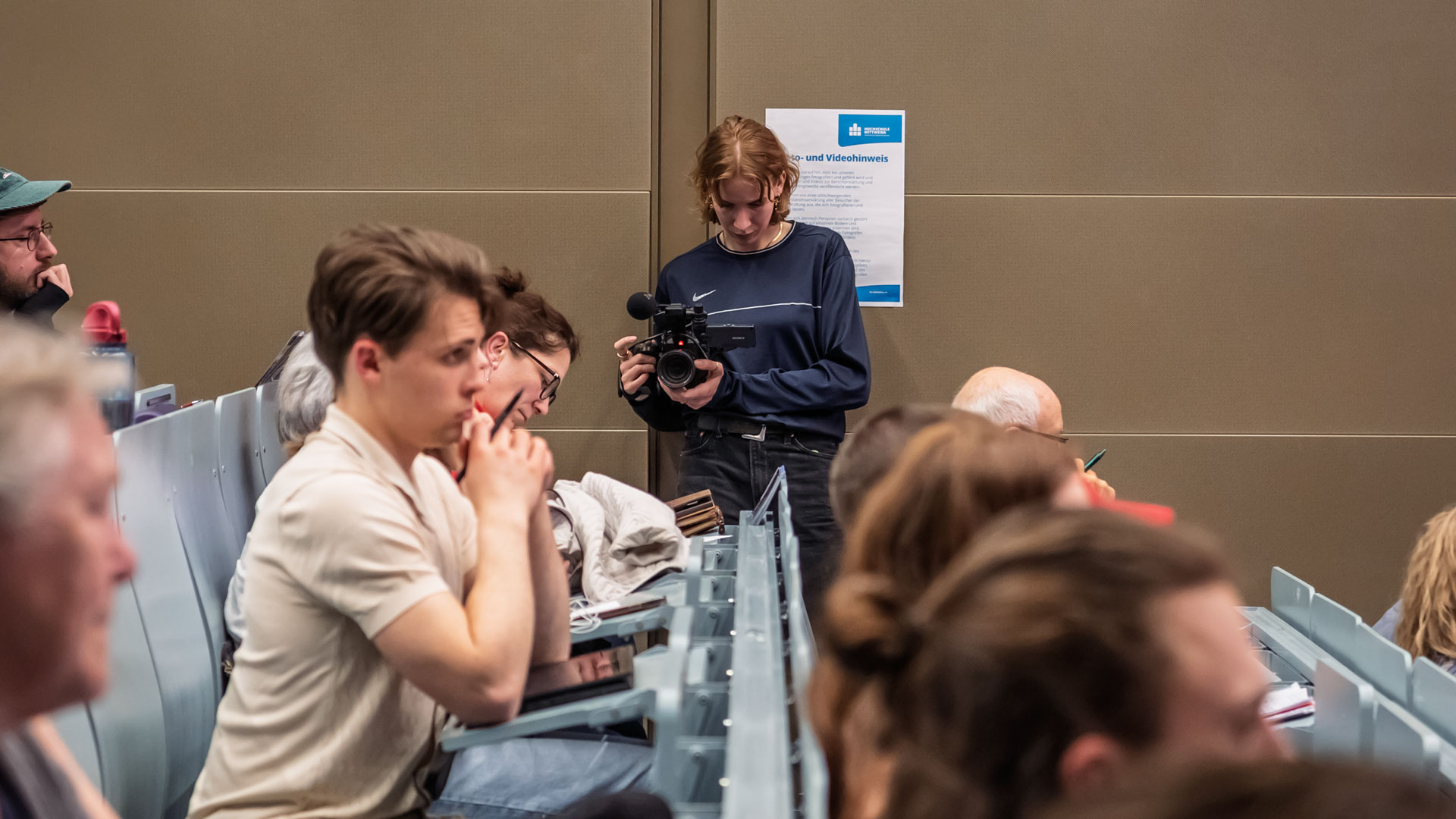
Videos and reports on almost all the talks can be found on the event website of the HSMW’s Institute for Competence, Communication and Languages (IKKS). It is already working on the public lecture series for the summer term of 2026. There will then be six instalments of ‘Controversial Dialogue (Dialog Kontrovers)’ on a topical issue, featuring experts from various disciplines.
Text: Robin Biebl/Helmut Hammer
Photos: Helmut Hammer