This page was translated automatically using artificial intelligence (DeepL). The German version is binding. More information about automatic translation
At the start of a PhD project, one naturally gives very little thought to how it will end. However, if, like Katrin Pförtner, you are undertaking a PhD at a Dutch university – in this case, the University of Groningen – you should start thinking about your thesis defence well in advance and give it a little more thought. To this day, the Netherlands has a formalised doctoral graduation ceremony in which the examination and the ceremony merge, and where historical rituals must be strictly observed.
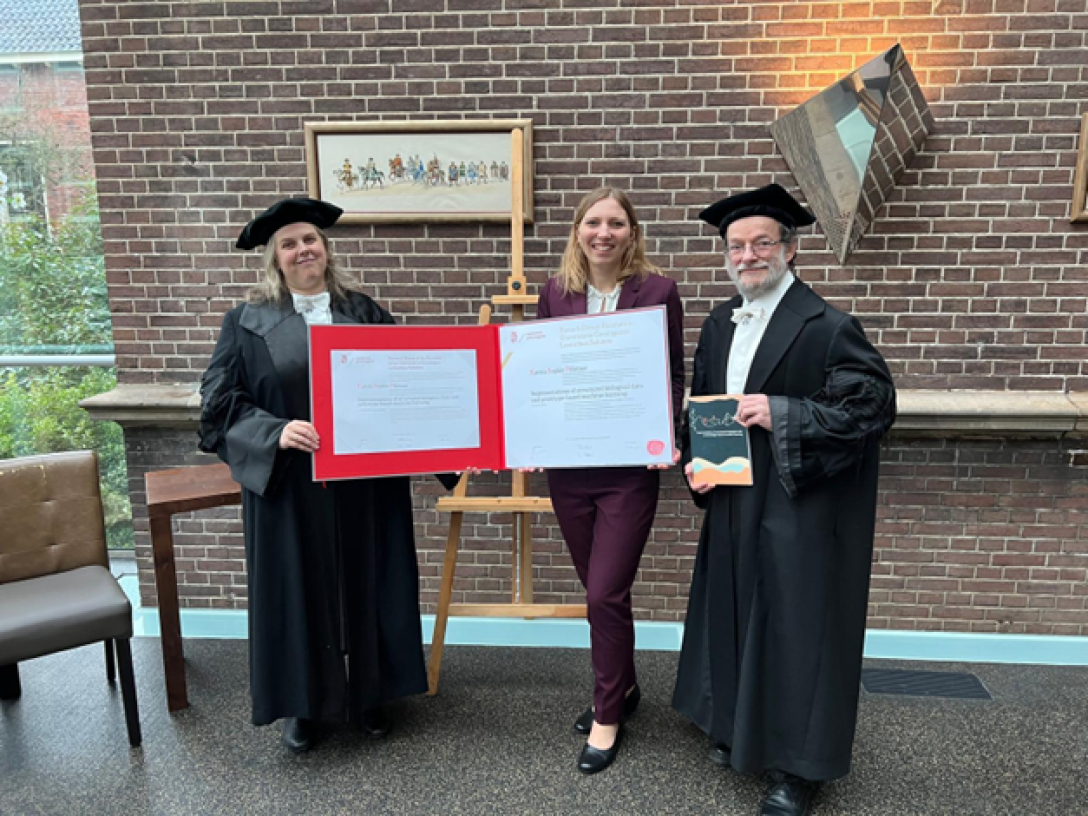
But first things first: Katrin Pförtner – then known as Katrin Bohnsack – began her research work in 2020 as part of the ‘MaLeKita’ early-career research group at SICIM (Saxon Institute for Computational Intelligence and Machine Learning) and in the CI research group led by Professor Thomas Villmann, Professor of Computational Intelligence (CI) and Technomathematics at Mittweida University of Applied Sciences.
She wrote her doctoral thesis on the topic: “Representations of structured biological data and prototype-based machine learning”. The abstract of the thesis states: “Biological data such as protein structures and DNA sequences are inherently complex and vary greatly in form and size. This complexity poses a challenge for standard machine learning (ML) tools, which typically require simple, fixed-size inputs. In sensitive fields such as biomedicine, it is crucial that our models are not only accurate but also interpretable; we need to understand why a classification decision was made. This research focuses on two key strategies to bridge this gap: intelligent data representation and interpretable classification learning in the context of bioinformatics.”
The research carried out as part of this PhD was recognised in 2024 with the Mittweida University of Applied Sciences Research Award. Furthermore, Dr Pförtner’s research work has received accolades at various conferences.
The collaborative PhD was supervised by Professors Kerstin Bunte and Michael Biehl from the University of Groningen and Professor Thomas Villmann from HSMW, who acted as the ‘daily supervisor’.
Thomas Villmann attests that his former protégée has a highly committed and determined approach to her work.
During her PhD, Katrin navigated her way through complex mathematical terrain and managed to link this to biological structures in an impressive manner. This is what makes various bioinformatics data usable for applied AI research in the first place. This work also serves as a resource and inspiration for future researchers, encouraging them to reflect more deeply on the mathematical formulation of biostructural data,
said Villmann.
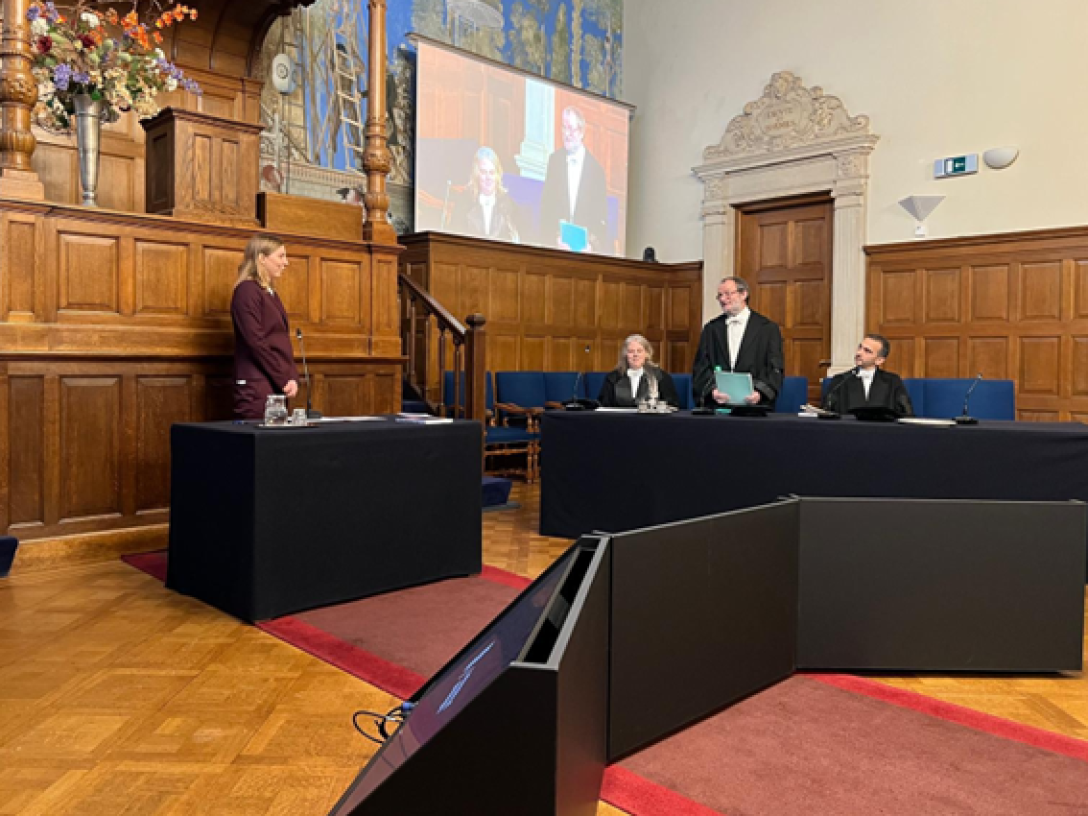
In early December 2025, the big day finally arrived. In the time-honoured doctoral defence hall in the University of Groningen’s Academy Building, the examination committee – comprising the doctoral supervisors – and the candidate met to consider the award of the doctoral degree.
Katrin Pförtner was accompanied by two paranymphen, the traditional companions of a doctoral candidate during a Dutch doctoral defence. Originally, paranymphen were active supporters whose role was to provide academic assistance to the doctoral candidate if they were unable to answer a question due to illness, an accident or being overwhelmed. In early academic tradition, they even served as a kind of bodyguard: during heated academic debates, their role was to prevent discussions from escalating into physical altercations. Nowadays, their duties primarily involve formally accompanying the doctoral candidate during the ceremony and assisting with organisational tasks. Paranymphen are also important sources of emotional support: they help with the proceedings, reassure the doctoral candidate beforehand, accompany them to the ‘waiting room’ (Zweetkamertje) and, overall, ensure a dignified setting. It therefore stands to reason that it is primarily friends, family members or colleagues who take on the role of paranymphen.
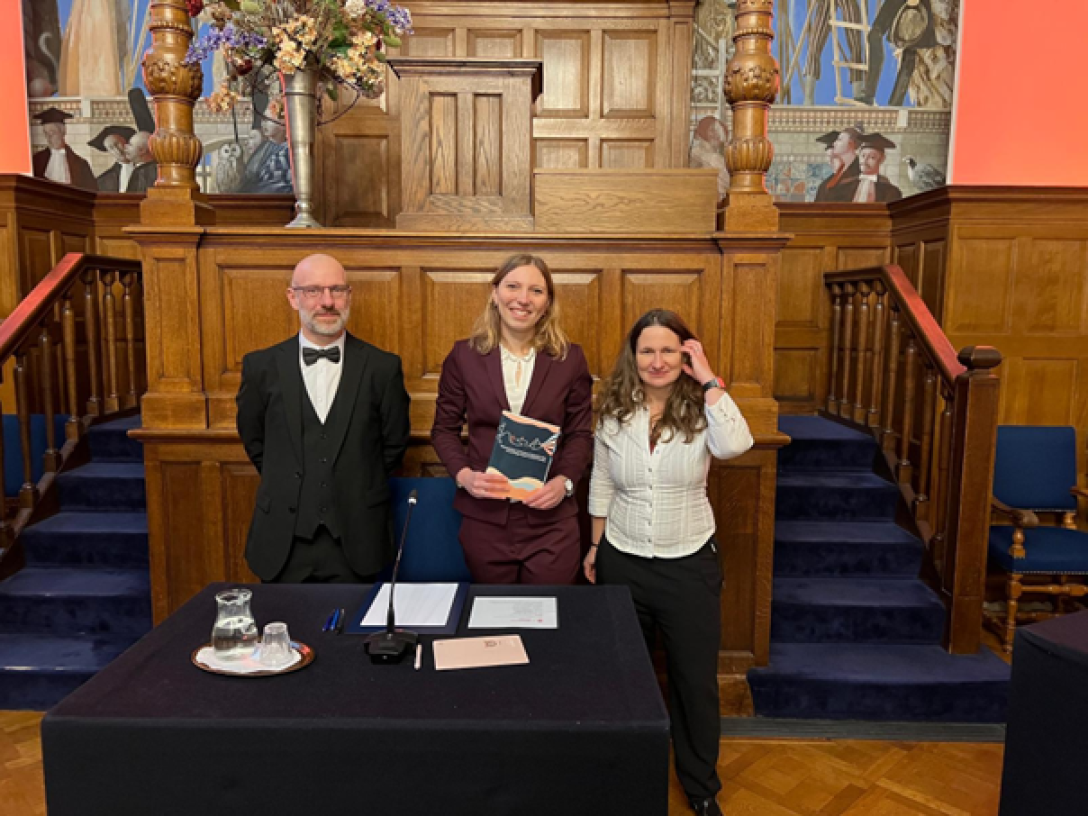
Fortunately, the two Mittweida ‘paranymphen’, Dr Marika Kaden and Dr David Nebel, did not have to defend Katrin Pförtner in the literal sense during the defence of her doctoral thesis. She had to answer the questions on her own.
The defence was presided over by the usher, a sort of master of ceremonies or university attendant who symbolises academic order and tradition. After 45 minutes of questioning, he called out the liberating words “Hora Finita” (“The hour is over”) and the examination board withdrew briefly to deliberate.
When awarding the doctoral degree, the committee expressly praised the textbook-quality of the thesis – a great compliment to Katrin Pförtner!
Anyone interested in the intersection between bioinformatics and machine learning can read Katrin Pförtner’s doctoral thesis here.

During her doctoral studies at Mittweida University of Applied Sciences, Dr Pförtner received funding from, amongst others, the European Social Fund (ESF) (grant reference: 100381749) as part of the early-career research group ‘Machine Learning and AI in Theory and Applications (MaLeKITA)’ from 2020 to 2023.