This page was translated automatically using artificial intelligence (DeepL). The German version is binding. More information about automatic translation

In addition to teaching and research, universities have another important role – often referred to as their ‘third mission’ – which is to bring science to society, not in a patronising manner, but in a way that is understandable and accessible to all. Mittweida University of Applied Sciences pursues its third mission through initiatives such as the Public Lecture Series, the Controversial Dialogue (Dialog Kontrovers) and the Children’s University, which attract people to the university. However, there are also obstacles and barriers to people visiting the university campus.
If people cannot come to the university, then the university will go to the people. At the end of October, Mittweida University of Applied Sciences, together with its Institute for Competence, Communication and Languages (IKKS), set off for Augustusburg and Roßwein to reach out to the people in the region: “Landuni – The university that comes to the people”. On the agenda: topics that are currently of concern to residents in Augustusburg and Roßwein and on which they wish to have their say.
The Landuni project at Mittweida University of Applied Sciences aims not only to bring together people with different perspectives, but also to facilitate discussions on an equal footing and to create a space for learning, exchanging ideas and further reflection. The events are linked to regional cabaret, which brings the motto ‘We connect. University and region.’ even more to life.
Augustusburg and Roßwein were the two towns in Central Saxony selected for the pilot phase of Landuni. The 2nd Social Report for the district of Central Saxony, also produced in cooperation with Mittweida University of Applied Sciences, classifies them into different social regions. This will enable more nuanced insights to be gained and implemented as the project continues next year. The next Landuni events are planned for spring 2024. The Saxon Ministry for Regional Development (SMR) supports Mittweida University of Applied Sciences’ Landuni project as part of the simul+ participatory fund.

A look back: First stop – Augustusburg
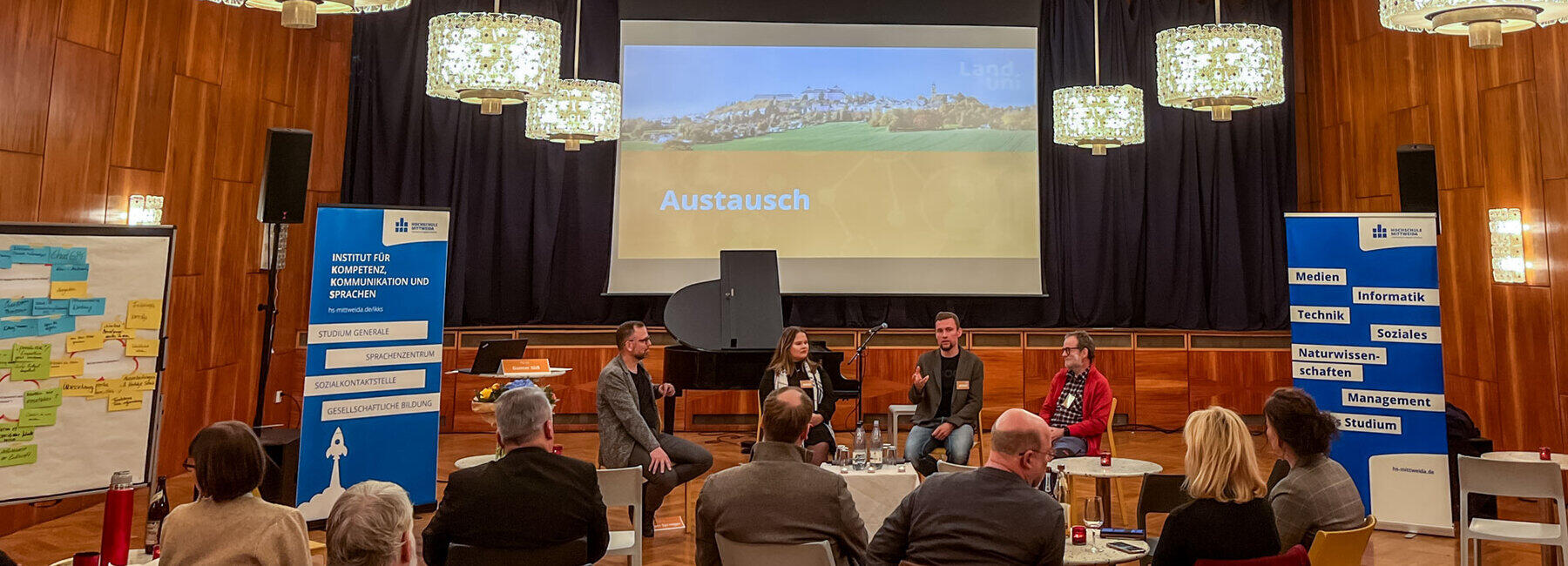
The first Landuni event at the Augustusburg feudal court on 20 October was held under the theme ‘The Appeal of AI – To Think or to Let It Think?’. The local association ‘Auf weiter Flur e.V.’ and the IKKS in Mittweida organised the evening jointly. In his keynote speech, Dr Gunter Süß, Executive Director of the IKKS, vividly highlighted how effectively artificial intelligence records our analogue and digital activities, whilst also pointing out which personal details, for example, are nevertheless misrepresented. In the panel discussion moderated by Professor Michael Spranger, school pupil Joline Munzer (Year 11, Regenbogen-Gymnasium Augustusburg), Professor Thomas Villmann (HSMW) and Stefan Müller (West Saxon University of Applied Sciences, Zwickau) discussed the topic from different perspectives. The exchange with members of the public raised some fascinating everyday questions: “What do career prospects look like as the use of AI increases?”, “Can AI predict the date of my death?” or “How can ChatGPT be used constructively in teaching?”
Villmann, an AI expert from Mittweida who, amongst other things, advises the Free State of Saxony on its AI strategy, highlighted the significance AI already has in our everyday lives and the areas where it has become indispensable. “Thanks to AI, we’ve reached a high standard in medical technology and have been using it for years,” said Villmann. “And yes, we have to admit that AI can write really good texts. But how we deal with all of this and what we make of it is crucial,” added Stefan Müller. What is important, he said, is the interplay: having confidence in progress, viewing AI as a support, but also maintaining a critical eye and always questioning AI.

Second stop: Roßwein
A different town, a different theme on 24 October: The theme ‘Shaping the future. It’s all about the choice’ had been developed by the IKKS in collaboration with Roßwein Town Council, the Protestant parish, the Bürgerhaus initiative and Treibhaus e.V. In his keynote speech, Professor Christoph Meyer, Director of the IKKS, explained the significance of elections in both a personal and societal context. He incorporated questions and views from the audience directly into the subsequent panel discussion with Michaela Neubert (Head of the Municipal Administration in Roßwein), Anja Weber (justice of the peace) and Elise Thiele (aged 16, Year 11, Geschwister-Scholl-Gymnasium).

The panellists provided insights into the topic from a wide variety of perspectives: For Michaela Neubert, as head of the municipal administration, the top priority is “… to ensure compliance with regulations and to provide transparency to the public”. Anja Weber, on the other hand, emphasised that voters must be kept informed and presented with clear, comprehensible proposals for solutions. For Elise Thiele, voting means taking responsibility: “It allows me to express my opinion on where and how my city and my country should develop. I can articulate which values are important to me and how I envisage the future.”