This page was translated automatically using artificial intelligence (DeepL). The German version is binding. More information about automatic translation
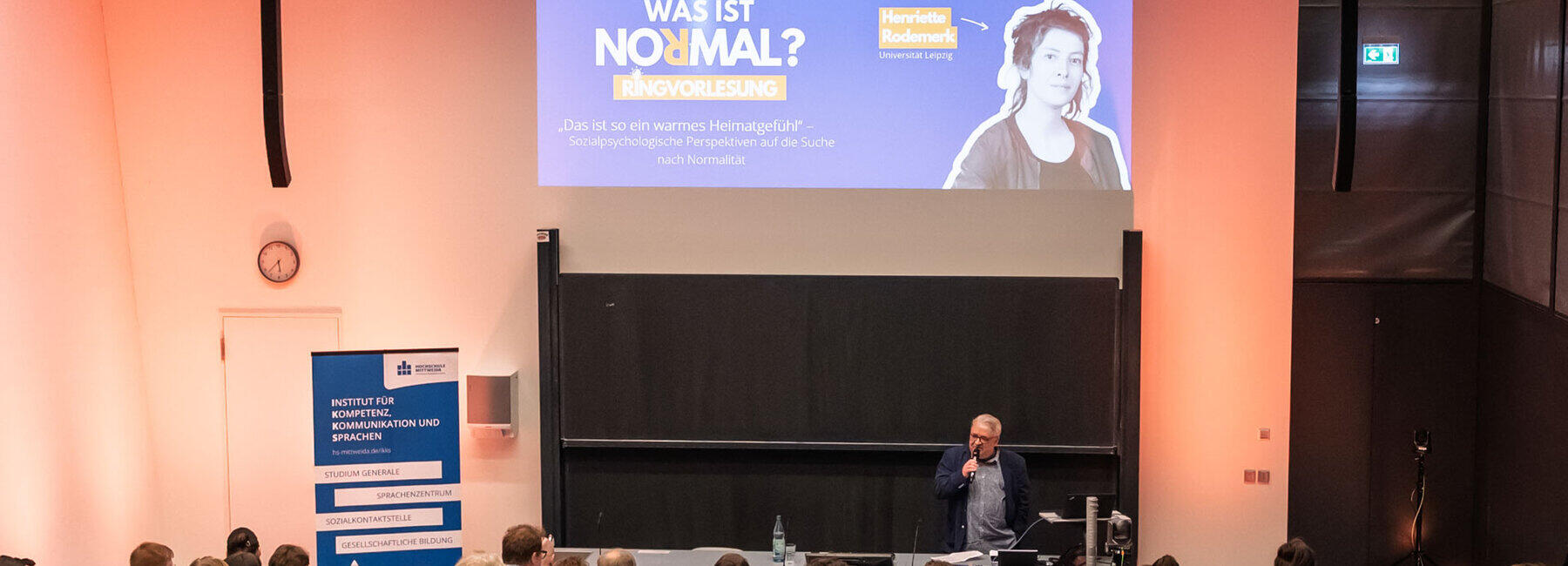
At the launch of the public lecture series ‘What is normal?’ at Mittweida University of Applied Sciences (HSMW) on 18 March, Professor Gunter Süß began by giving a brief introduction to the series’ theme: the concept of normality as a social consensus on values and behaviours that are taken for granted. ‘Normality’ can have both an inclusive and an exclusive effect and varies depending on social and cultural factors. Süß referred to the literary scholar Jürgen Link, who distinguishes between a strict form of ‘protonormalism’, which sets and enforces fixed boundaries, and a form of ‘flexibility normalism’, which adapts norms through observation and data.
Professor Gunter Süß is Director of Studies at the Institute for Competence, Communication and Languages (IKKS) at HSMW, which is organising the lecture series for university members and members of the public. Until 24 June, a total of seven events will be held in the Ludwig Hilmer Building, at which experts from various academic disciplines will explore the concept of ‘normality’ and examine it from different perspectives.
"It gives you such a warm, homely feeling"
Under this heading, Henriette Rodemerk from the Else Frenkel-Brunswik Institute at the University of Leipzig opened the proceedings. In her talk, she explained how society’s understanding of ‘normality’ is linked to one’s own identity. She demonstrated that groups have their own ideas about what counts as ‘normal’, and that these ideas influence how open or dismissive they are towards certain differences. Drawing on theoretical principles and her own empirical research, Rodemerk illustrated which pieces of information, expectations and prejudices prevail in our society – and what they reveal about the way we live together.
In summary, Rodemerk made it clear that normality cannot by any means be regarded as a fixed concept, but rather represents a dynamic, socially constructed concept. It arises within groups through shared values and beliefs and serves as a guide for individual and collective action. At the same time, however, it can also have an exclusionary effect by labelling certain deviations as ‘abnormal’.
The researcher emphasised that notions of normality have a decisive influence on how societies deal with diversity and change. Her studies showed that these notions not only shape our self-image, but can also reinforce or challenge social expectations and prejudices. Ultimately, therefore, normality is not a universal principle, but a flexible and malleable construct that is subject to processes of social negotiation.
“Can resilience help us weather crises?”
At the second event on 1 April, Professor Karina Becker spoke about the growing importance of the concept of resilience in the modern world of work. Becker is a professor of social policy and Social Work at the Gera-Eisenach Cooperative State University. Resilience describes the human ability to adapt to changing circumstances. According to Becker’s analysis, the concept of resilience is far more than just an ideal for individual behaviour – it reflects social and economic structures that increasingly make crisis management an individual responsibility.
Resilience is often touted as a solution to a wide range of challenges, whether in coping with life on an individual level or at a societal level. Yet the concept is closely linked to the notion of crisis: it suggests that crisis situations can be overcome without changes to society as a whole. However, this perspective carries the risk that structural problems are individualised and systemic causes are overlooked.
A key argument put forward by Karina Becker concerned the shift in occupational health and safety: whilst the protection of physical health is largely regulated through welfare state measures, dealing with psychological stress proves more difficult. The increasing pressure in terms of time and performance is hardly objectively measurable, and there are as yet no generally accepted methods or statutory frameworks for minimising psychological stress.
In this context, Becker highlighted the growing tendency for companies to adopt a ‘resilience-based’ approach to workplace health management, which prioritises behavioural prevention measures – such as health days and relaxation courses – over environmental prevention measures aimed at improving working conditions themselves. As a result, responsibility for coping with stress is increasingly being shifted onto the employees themselves. She illustrated this point vividly using the example of the healthcare sector in Germany. As a result of the marketisation of hospitals, employees are under considerable pressure. Relying on individual resilience training in this context could send the message: “Anyone who fails to adapt to a constantly changing environment with increasing demands is not resilient, because they have failed to ensure that they become and remain so.”
On 15 April, the theme is ‘Between normality and taboo: invisible violence against women’. Professor Heinz-Jürgen Voß from Merseburg University of Applied Sciences will present findings from the ‘Saxony Victimisation Study’ on the extent and impact of domestic and sexual violence, as well as stalking.
Full details of the lectures and speakers in the public lecture series