This page was translated automatically using artificial intelligence (DeepL). The German version is binding. More information about automatic translation

Driving dynamics, aerodynamics, packaging: These were the key topics of a week-long intensive course held from 10 to 14 March 2025 at the Nürburgring Academy, in which five students from Mittweida University of Applied Sciences (HSMW) took part alongside fellow students from other universities. They had successfully applied to take part.
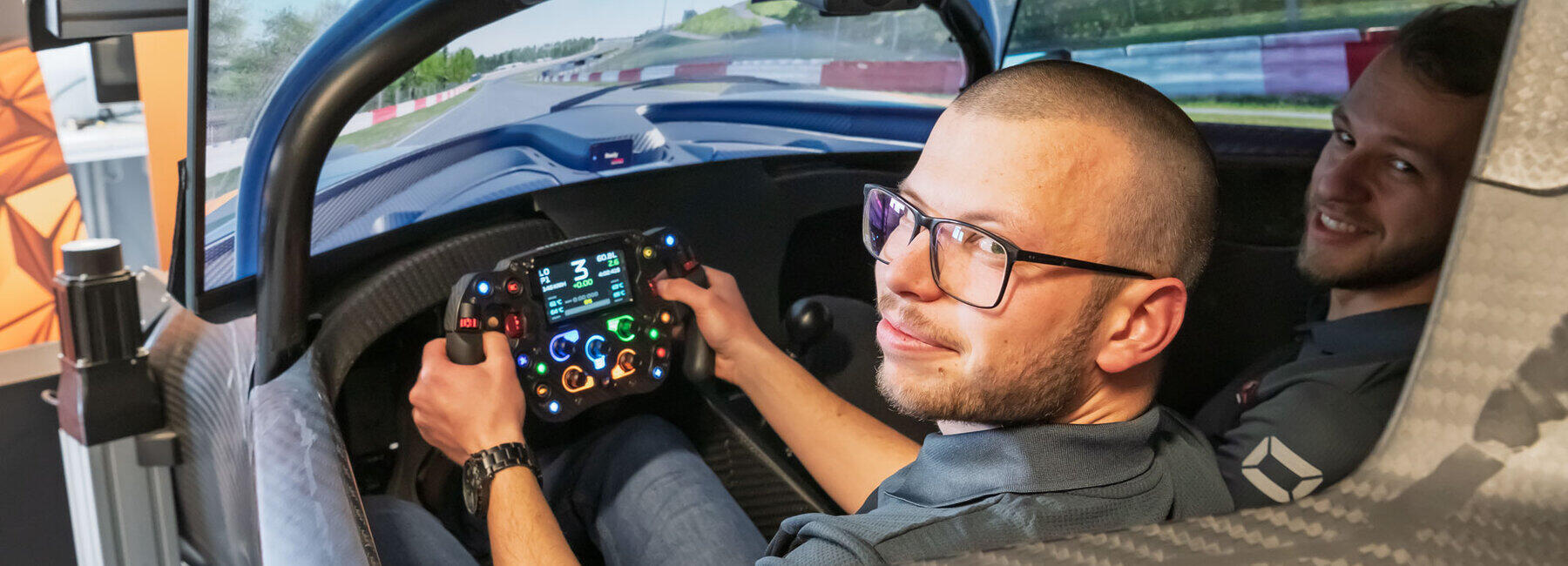
The students from Mittweida and Matthias Vodel, their professor, contributed their experience with modern, AI-supported simulators and simulation environments to the block week’s specialist programme. These offer many advantages for both motorsport and car manufacturers, making vehicle tuning more efficient and safer. Vodel: “At Mittweida, we combine computer science and engineering disciplines centred on the topic of vehicle dynamics.” At the HSMW’s ‘Motion Simulation & Software Development’ Living Lab, these systems are researched and continuously refined through repeated comparison with real-world conditions on the road and on the racetrack.
One of the state-of-the-art systems in the Mittweida laboratory is the ‘KTM xBow GT4 Large-Scale Simulation Platform’. The HSMW uses the real vehicle – the road-legal xBow R variant – to record telemetry data for simulations that are as close to reality as possible.
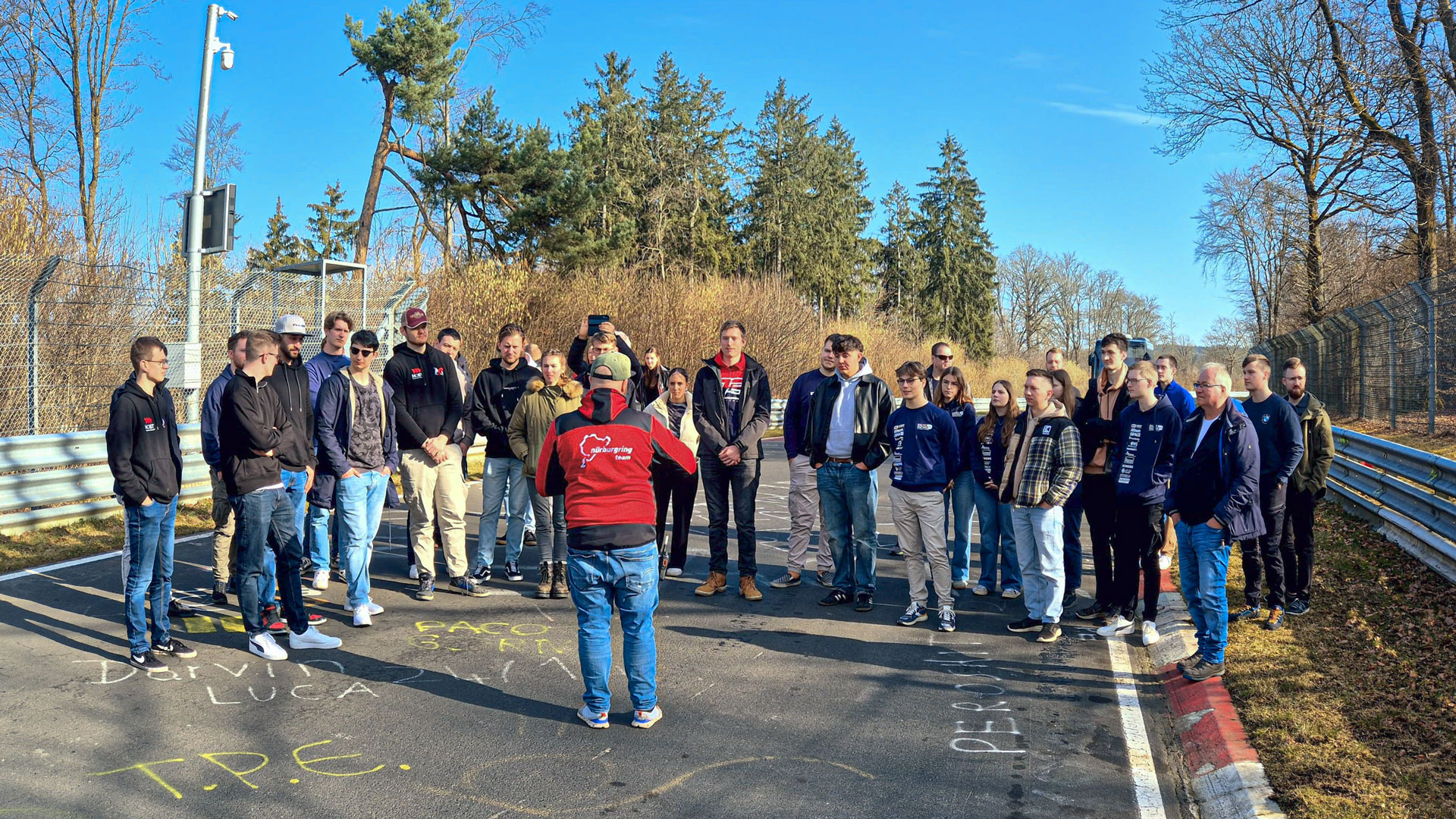
The students didn’t experience the Nürburgring itself in a racing car, but more or less on foot: during a track walk on the Nordschleife right at the start of the week, which was packed with information and anecdotes about this legendary section of track in the Eifel.
Max Walter is studying for a Master’s in Mechanical Engineering at HSMW and is thrilled: “The track walk on the Nordschleife was a great start, which really whetted my appetite for the days ahead. They were packed with impressive experiences, offering deep insights into a wide variety of areas within motorsport.” This included a behind-the-scenes look at renowned motorsport teams and suppliers based around the Ring, including Manthey-Racing, Haupt-Racing, Bilstein and Capricorn.

Study, Research, Do
Alongside their studies, Max and his fellow student Philipp Goldammer are involved in the university’s own team, Technikum Mittweida Motorsport (TMM). There, they are responsible for the driving dynamics of the new Formula Student electric racing car, the ‘Red Viper’. Ahead of the first race, they have been able to take back to Mittweida a few useful tips from the specialist talks and discussions with experienced racing professionals at the Nürburgring: “We were able to seek expert opinions on very specific challenges we’re currently facing, with a view to making our racing car even better,” says Philipp.
Just as TMM’s approach to developing its racing car is interdisciplinary, so too is the Living Lab versatile in its applications. Students on HSMW’s computer science degree programmes – such as Media Informatics and Interactive Entertainment, and Applied Computer Science specialising in Software Development – are just as much at home there as their fellow students from the engineering disciplines, studying Mechanical Engineering and Electrical Engineering – Automation.