This page was translated automatically using artificial intelligence (DeepL). The German version is binding. More information about automatic translation
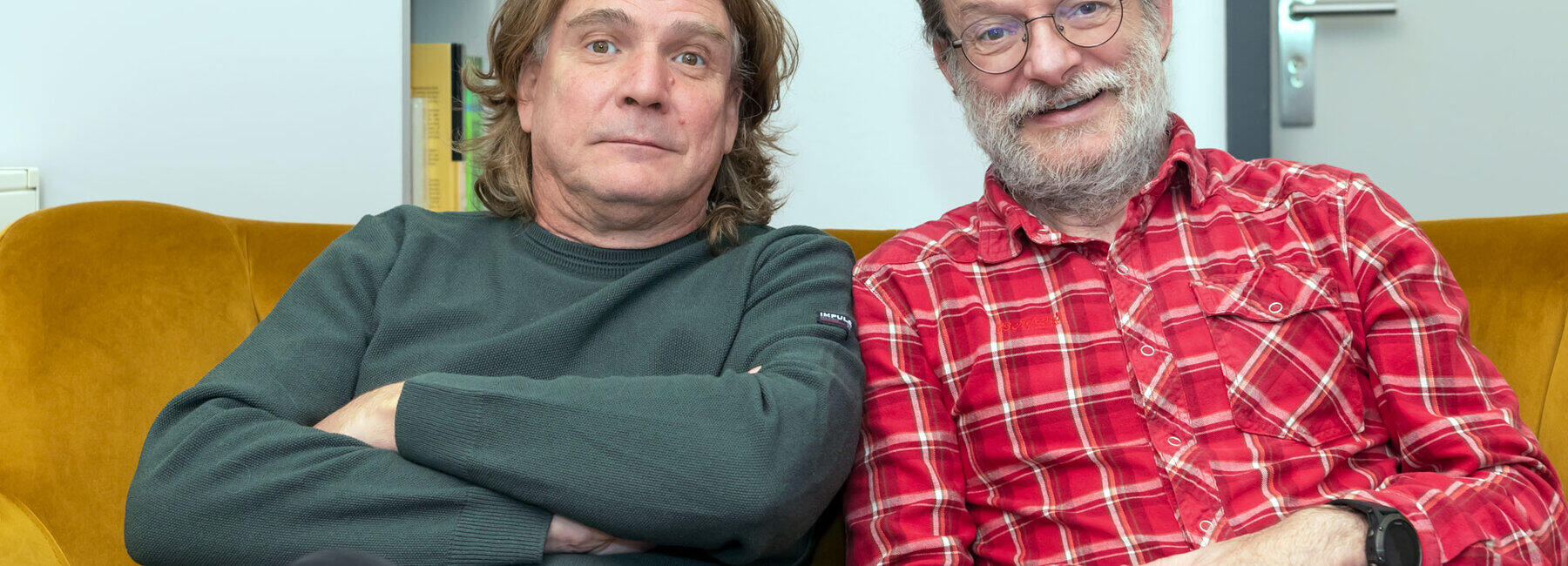
Prof. Dr. rer. nat. Dirk Labudde, Professor of Forensics/Bioinformatics, and Prof. Dr. rer. nat. habil. Thomas Villmann, Professor of Computational Intelligence and Technomathematics, are the first professors at a University of Applied Sciences (UoAS) in Saxony who, in accordance with the provisions of the new Saxon Higher Education Act, are able to independently initiate and supervise doctoral research projects as co-opted professors at a university. The two professors from Mittweida University of Applied Sciences are members of the Faculty Applied Computer Sciences and Biosciences there. In terms of their academic research achievements, they are on a par with their colleagues in the Faculty of Mathematics and Computer Science at TU Bergakademie Freiberg.
Professor Dr. rer. oec. Volker Tolkmitt, Rector of Mittweida University of Applied Sciences: “I am delighted with the decision by the faculty and university management in Freiberg to co-opt two of our finest academics. This opens up excellent prospects for groundbreaking PhD projects and outstanding opportunities for the academic careers of early-career researchers at Mittweida University of Applied Sciences.”
The criteria for co-optation are stringent. Applicants must demonstrate outstanding subject-specific expertise and a high number of publications; the amount of external funding secured and the number of doctoral theses successfully supervised are also key criteria.
Labudde and Villmann possess all these qualities and meet these criteria. The former has also established the research and teaching areas of digital forensics and cybercrime at Mittweida, gaining national and international recognition. He represents the university and his specialist fields externally, collaborates with numerous investigative authorities and is a sought-after expert reviewer and witness. Villmann holds a habilitation and, even before his appointment to Mittweida University of Applied Sciences, had supervised PhD students as a private lecturer at the University of Leipzig. Villmann is Director of the Saxon Institute for Computational Intelligence and Machine Learning (SICIM); his research includes work on interpretable AI, and he has contributed as an expert to the development of Saxony’s AI strategy, amongst other projects.
Villmann on the benefits: “Future PhD students will benefit from simplified procedures for submitting and supervising their doctoral theses. And, of course, we can now also act as supervisors for colleagues at Mittweida University of Applied Sciences or other UoAS partners who have not – yet – been co-opted into the university’s doctoral programme.” Labudde adds: “A simplified procedure does not mean that we are making things easier for our doctoral candidates. The requirements will not change. We have always set very high standards, and we will continue to do so.”
This will also be appreciated by academic talent at the TU Bergakademie Freiberg, who now have two more potential doctoral supervisors at their university in Labudde and Villmann, who will enrich the academic landscape there.
Pursuing a PhD at Mittweida University of Applied Sciences
As a research-intensive UoAS, Mittweida University of Applied Sciences supports doctoral studies even before the option of co-supervision becomes available, and will continue to do so in future, following a practice that has been successfully applied on numerous occasions. At present, 85 researchers at Mittweida University of Applied Sciences are working on their doctoral theses, usually as part of a collaborative programme with a university, in which both a professor from Mittweida University of Applied Sciences and a colleague from the partner university supervise and review the doctoral work. In addition, Mittweida University of Applied Sciences supports doctoral candidates through its own doctoral programme.
At the Mittweida campus, it has been possible to obtain a ‘Doctor of Engineering’ degree at what was then the University of Engineering since 1980. After 1992 and a brief transitional period, Mittweida University of Applied Sciences (FH) lost its independent right to award doctorates, as this right did not exist at universities of applied sciences (later UoAS). The co-optation scheme now introduced in Saxony under Section 92(3) of the Saxon Higher Education Act (SächsHSG) is a way of making it easier for UoAS graduates and researchers to pursue a doctorate.
Update June 2026: Röbbe Wünschiers co-opted at TU Dresden
Professor Dr rer. nat. habil. Röbbe Wünschiers, holder of the Chair of Biochemistry/Molecular Biology, was co-opted by the Department of Biology at TU Dresden in June 2026 and is now authorised, in accordance with the provisions of the Saxon Higher Education Act, to initiate and supervise PhD research projects independently.