This page was translated automatically using artificial intelligence (DeepL). The German version is binding. More information about automatic translation
How can complex-shaped components be coated reliably and to ensure a long service life? This is the question being addressed by the new research project COALA – Coatings for Advanced Layered Architectures, which has been launched at the Laser Institute of Mittweida University of Applied Sciences.
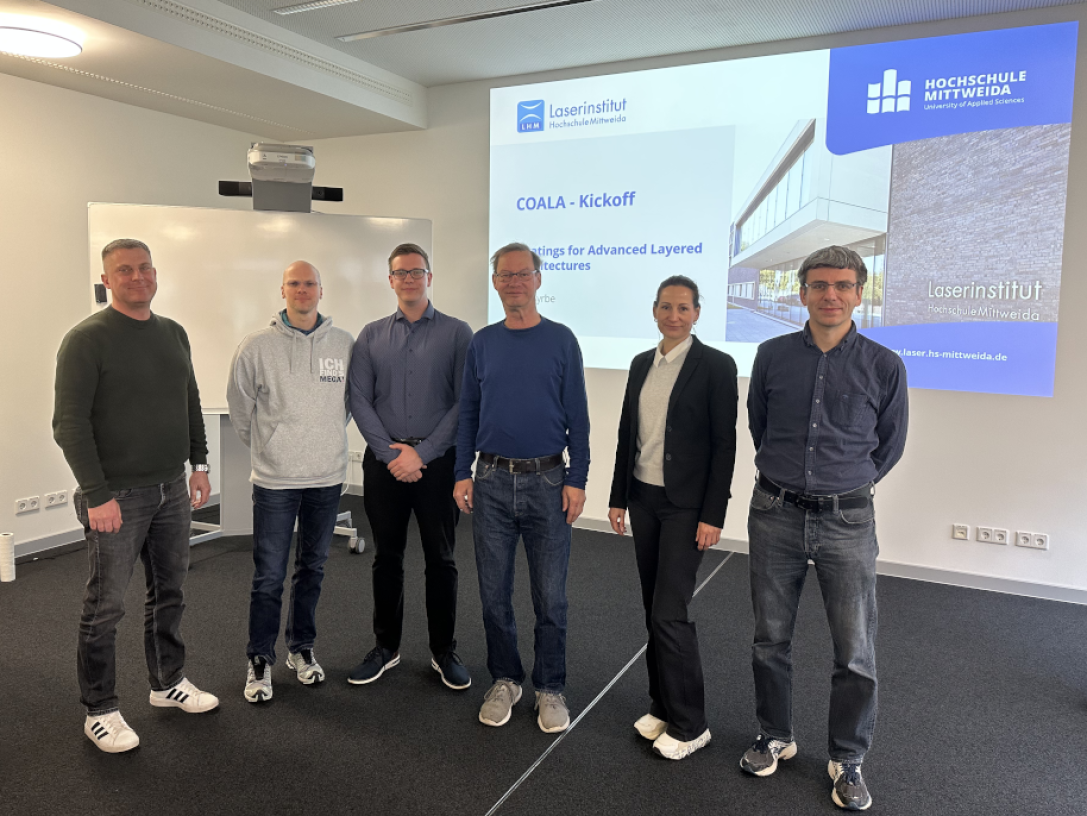
To mark the official start of the project, the project partners met on 26 March 2026 for a joint kick-off meeting at the Laser Institute. The aim of the meeting was to organise the collaboration and define the next steps in the project’s development.
The project is funded by the Sächsische Aufbaubank (SAB) as part of the ESF Plus InnoTeam programme and will run for two years. In addition to the Laser Institute at Mittweida University of Applied Sciences (LHM), IfU GmbH and ANTACON GmbH are also involved.
The project centres on the further development of pulsed laser deposition (PLD), a process for producing particularly hard and wear-resistant coatings. To date, this technology has primarily been effective on flat surfaces – yet many industrial components feature complex, three-dimensional geometries. This is precisely where COALA comes in: the aim is to further develop the coating technology so that even curved and irregular components can be coated uniformly and reliably. To this end, motion sequences, process parameters and plant technology are specifically combined and adapted to one another.
The division of responsibilities within the project is clearly defined: IfU GmbH is responsible for project coordination and contributes its expertise in the development of sensor and measurement systems. The LHM is responsible for the scientific and technical implementation as well as the integration of the coating technology. ANTACON GmbH, a spin-off from the Laser Institute, provides support with its expertise in laser-based coating and industrial applications.
The technologies developed are to be put directly into practice. For sensor and measurement systems in particular, this opens up new possibilities for better protecting components against mechanical stresses and environmental influences and significantly extending their service life.
The project builds on many years of research at the Laser Institute and consistently advances this work towards industrial application. Particularly exciting is the combination of established coating processes with new technological approaches for complex component geometries,
says Prof. Dr Steffen Weißmantel, head of the research group on laser pulse deposition of thin films and laser microstructuring at the LHM.
COALA represents an important step towards making modern coating technologies usable for complex applications, whilst further strengthening Saxony’s position as a centre of technological excellence.