This page was translated automatically using artificial intelligence (DeepL). The German version is binding. More information about automatic translation

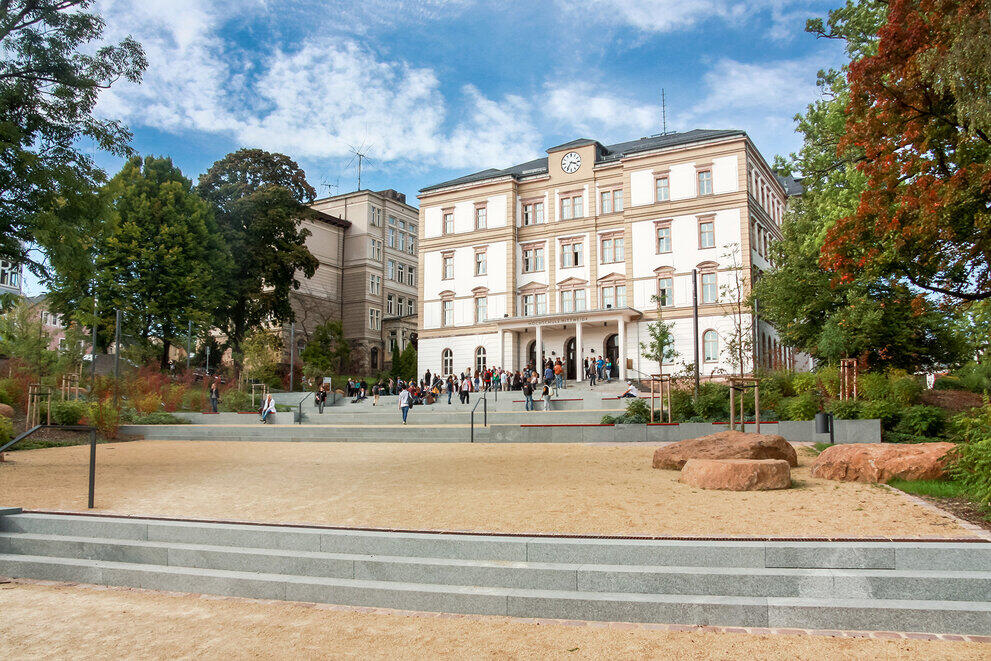
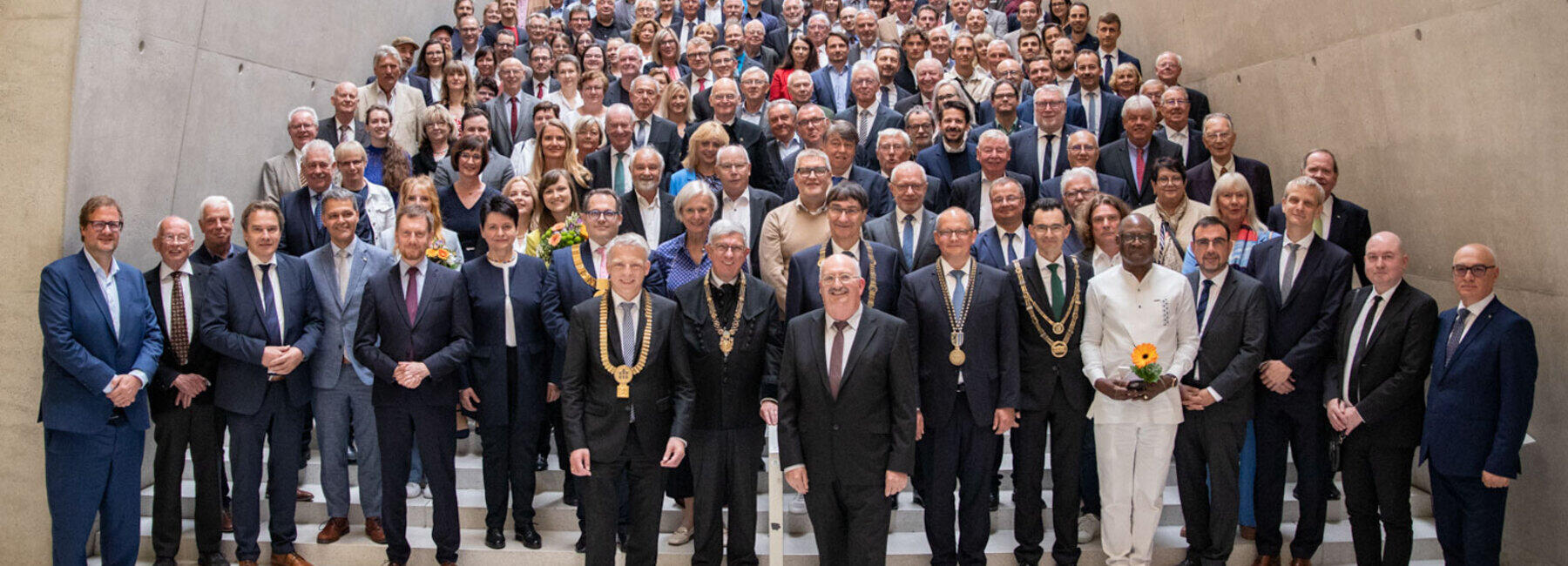
There will never be another scene quite like this: Saxon university rectors in their gleaming chains of office, the Saxon Minister-President, the Lord Mayor of the university town, the Chair of the University Council, the Chancellor of Mittweida University of Applied Sciences (HSMW) and nearly two hundred other distinguished figures from academia, business, society, politics and Mittweida University of Applied Sciences itself stand on the proverbial steps of success at the university’s Centre for Media and Social Work (ZMS). In the front row are Rector Volker Tolkmitt and his predecessor from 2012 to 2023, Ludwig Hilmer. The honorary colloquium for Professor Hilmer on the morning of 3 June brought everyone together. Since then, the ZMS has borne the suffix ‘Ludwig-Hilmer-Bau’, and Ludwig Hilmer has been awarded the golden pins of both the university and the university town.

These highly symbolic awards were preceded by a ceremony in the television studio – the sort of event that could only take place in Mittweida. Amélie Scharschmidt, presenter of the Mittweida Campus Festival 2024, which took place on 5 and 6 June, warmed up by guiding the audience through the speeches during the first hour of the honorary colloquium: Tolkmitt opened the proceedings, paying tribute to his predecessor for his significant contributions to Mittweida University of Applied Sciences, including the development of Mittweida’s media degree programmes since the mid-1990s. As rector over two terms of office since 2012, Hilmer had prevented job cuts and, by restructuring the university, had paved the way for the establishment of new, forward-looking fields of study and research.

This is well known even beyond Mittweida, and in his laudatory speech, Minister-President Michael Kretschmer highlighted not only topics such as lasers, media and forensics, but also Hilmer’s role in two key developments at the HSMW in recent years: collaboration with the regional business community and further internationalisation. A surprise guest, Professor Gabin Ananou, was able to provide a personal account of this. Born in Togo, the former ambassador of his home country to Germany has been an honorary professor at the HSMW since 2022. “If Hilmer lived in Africa,” said Ananou, “he would be described as a ‘baobab’.” In Africa, this huge tree is a symbol of a man of stature who plays a special role at the heart of society. People gather in its shade to exchange ideas and to administer justice. As a large tree, it protects smaller trees, and when it bears fruit, people rejoice.

The fourth speaker of the morning also represents one of these achievements: As expected, Professor Dirk Labudde gave a light-hearted account of how, with Hilmer’s help, the forensic science degree programmes were established at the HSMW, but also used the example of the ‘French Project’ to illustrate how forensic and historical sciences collaborate through the work of Professors Labudde and Hilmer. The HSMW had digitised the skeletons of 28 Napoleonic soldiers that had been discovered in a burial ground near Frankfurt. Once the digitisation was complete, the remains could be reburied in their native soil.
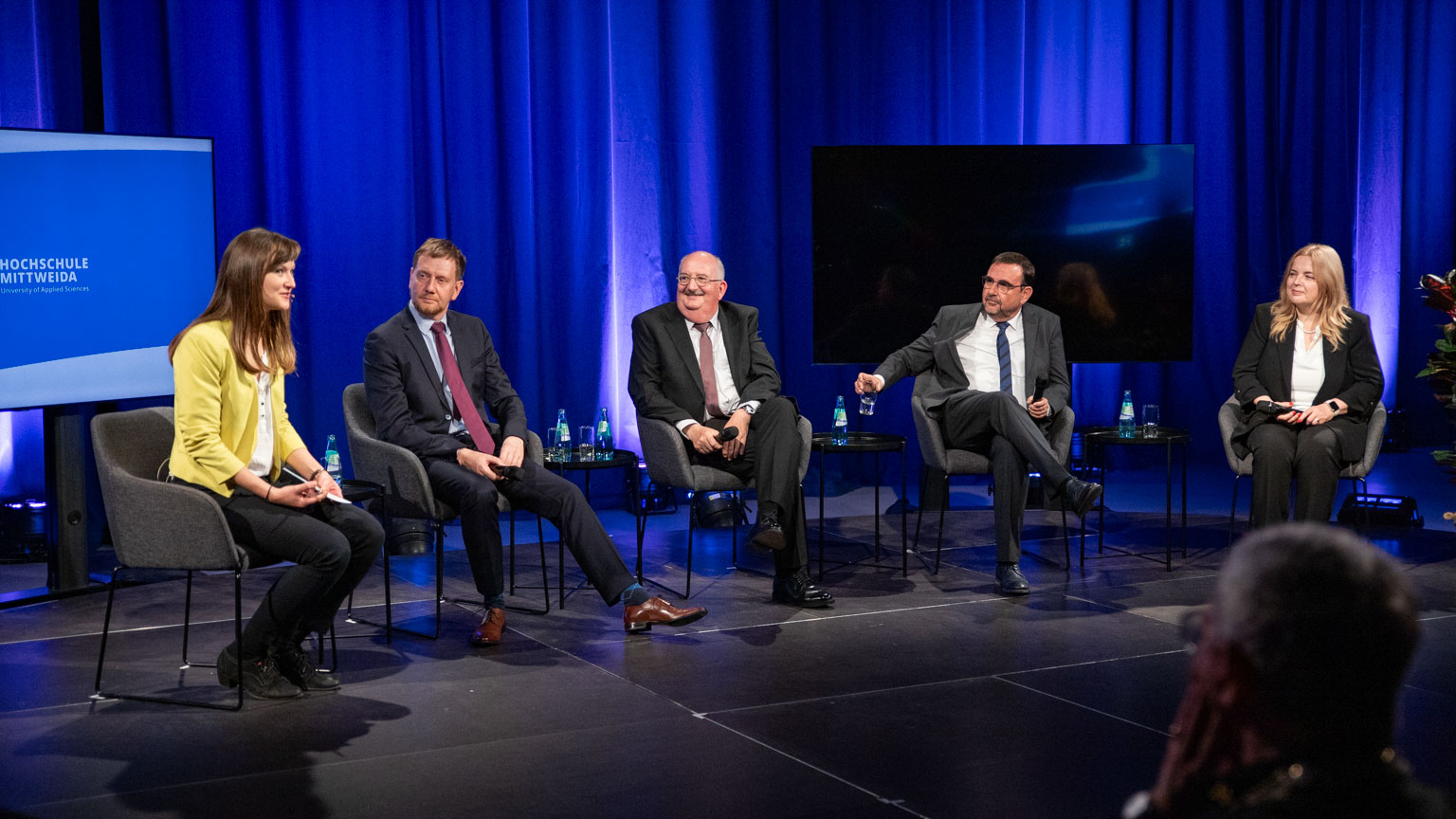
Instead of the customary reply at honorary colloquia – that is, a response from the honouree to the laudatory address – Hilmer and Kretschmer met again in the second half for a round-table discussion moderated by Lisa Fritsch, a Media Management graduate, which was joined by two further colleagues: Professor Delia Balaban from our Romanian partner university, Babeș-Bolyai University in Cluj-Napoca (Klausenburg), and Professor Klaus Holetschek, Honorary Professor of Communication and Civic Dialogue at the Faculty Media Sciences at HSMW. The event provided an opportunity for a professional exchange among the communications experts gathered on the podium, as well as for the sharing of the odd anecdote from personal encounters with Ludwig Hilmer, and for him to express his gratitude to the many people who had worked alongside him during his tenure of over ten years.

The academic part of the event was followed by a reception, during which Professor Hilmer signed the university town’s guest book. Many gifts and messages of goodwill were received from both within and outside the university, all alluding to Hilmer’s virtues and preferences.
Text: Helmut Hammer
Photos: Antonia Scherf