This page was translated automatically using artificial intelligence (DeepL). The German version is binding. More information about automatic translation
The laser is gaining ground worldwide as a versatile tool. Young researchers at Mittweida University of Applied Sciences are investigating how to use it in an energy-efficient way: An interdisciplinary group of early-career researchers is bringing together the fields of laser material processing, 3D Printing and Biophotonics under the guiding principles of the UN Sustainable Development Goals and the Free State of Saxony’s innovation and digitalisation strategy. Six early-career researchers have found a home for their research in ‘LaNa-Sax’ (standing for laser technologies, sustainability and Saxony) at the Laser Institute of Mittweida University of Applied Sciences (LHM) and are working on the energy-efficient use of laser sources for various applications, such as medical diagnostics and battery manufacturing.
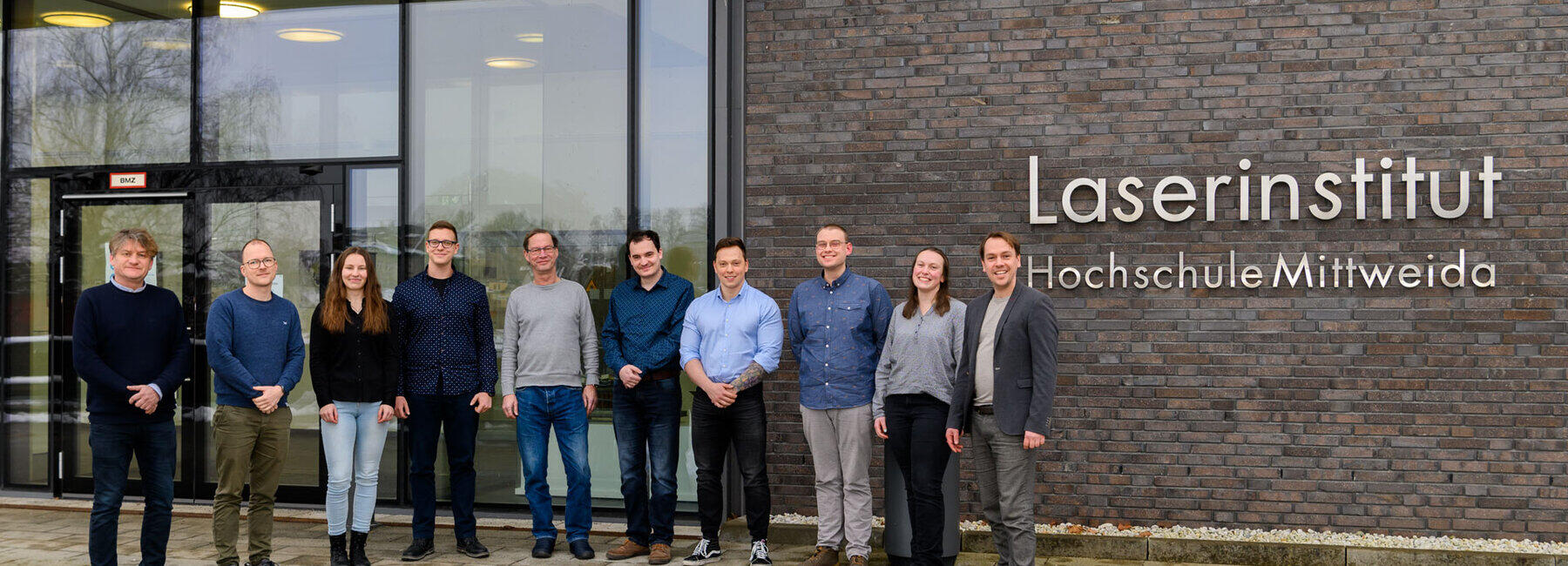
On 26 January, Laura Römer, Vanessa Schumann, Felix Erichson, Florian Heinrich, Philipp Rebentrost and Eric Syrbe began their work. All of them had previously studied Biotechnology or Laser Technology at Mittweida University of Applied Sciences. LaNa-Sax is therefore also an example of how the university specifically supports young scientists.
Professor Richard Börner is the head of LaNa-Sax: “Our aim is to provide the best possible support to academic talent in their work. The LHM offers the ideal conditions for this. Two of our young LaNa-Sax colleagues are already enrolled in a collaborative PhD programme. I’m looking forward to two exciting years with the early-career researchers’ group. Well done!”
Alongside Börner, the six projects in the field of photonics are supervised by Professors André Streek, specialising in 3D Printing, and Steffen Weißmantel, specialising in laser material processing. The individual projects address current sustainability-oriented fields of research in battery development (3D Printing), wear-resistant tool coating (laser material processing) and the optical characterisation of ribonucleic acids (Biophotonics) for the pharmaceutical industry and medical diagnostics. The findings are set to be transferred into practical applications very soon. This is intended to promote Mittweida – and, by extension, the Free State of Bavaria – as centres for application-oriented research and forward-looking businesses.
Background
In recent years, the wide range of laser technologies has seen strong growth in industrial applications worldwide. One reason for this is the rapid technical and technological advancement of laser sources and their scalability. The latter, in particular, contributes significantly to their energy efficiency and, consequently, to the efficiency of the processes themselves in which lasers are used. With the challenges posed by climate change, this aspect is becoming increasingly important.
Further information on LaNa-Sax can be found at the following link.