This page was translated automatically using artificial intelligence (DeepL). The German version is binding. More information about automatic translation
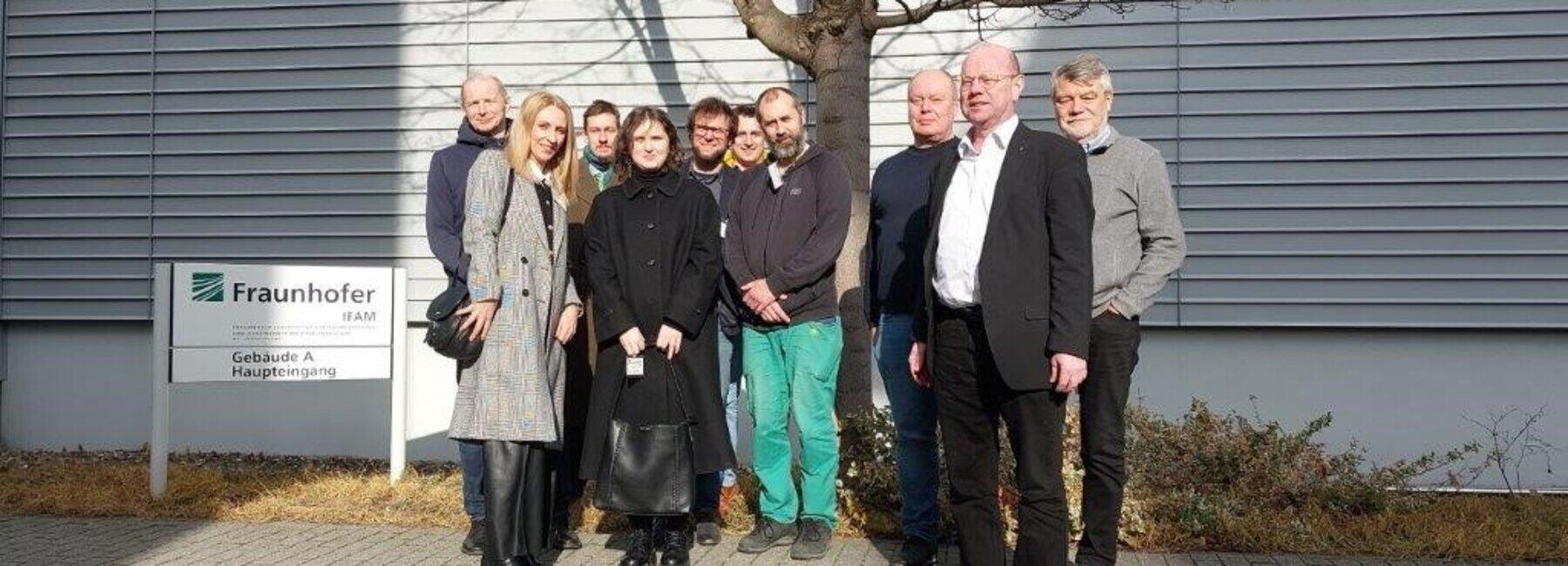
Storing energy in the form of hydrogen remains one of the key issues when it comes to the expansion and storage of renewable energy. In the M-ERA.NET project DC-PEM (Development of a Cost-effective Anode for Polymer Electrolyte Membrane Water Electrolysis), launched in 2023, four research institutes and an innovative company have joined forces to develop holistic solutions for the cost-effective production of PEM electrolysers. At the project meeting on 10 and 11 February on the campus of Fraunhofer IFAM (Institute for Manufacturing Technology and Applied Materials Research), all partners came together to present the results achieved so far and to agree on the next steps. The team members from the participating institutes have set themselves the goal of analysing the entire value chain involved in the manufacture of acid membrane electrolysers and proposing innovative solutions where appropriate.
A closer look at electrode production
One approach involves the paper-based manufacture of the electrode substrate. In this process, the green body is first produced in a manner similar to paper production, but with significantly higher filler content of titanium compounds, and is subsequently sintered. The expertise for this lies with Fraunhofer IFAM. This approach can significantly reduce costs on an industrial scale compared with the current production of sintered bodies or fibre-based titanium non-wovens. Another important cost factor is the corrosion protection of the anodically loaded electrodes. The “University of Chemistry and Technology Prague (UCTP)” is working on the production of titanium hydrides and on gaining a fundamental understanding of the corrosion mechanisms that occur during operation, with a view to extending the service life of electrolysers. The Process and Surface Technology Research Group led by Professor Frank Köster at Mittweida University of Applied Sciences is tasked with achieving the most efficient possible catalyst deposition on the porous transport layer. The aim is to use electroplating techniques to achieve a uniform coating of the surface with minute particles of iridium and ruthenium. The “University Politehnica Timisoara (UPT)” is responsible for characterising the catalyst activities and developing a recycling concept for the reprocessing of used electrolyser electrodes. The overarching aim of the project is to produce a demonstrator that combines all these approaches and can be tested at LeanCat. At the meeting in Dresden, it was already possible to mark important milestones on the way to this goal as having been achieved.
Further information on the project can be found at the following link: Project website
Text: Dr Johannes Näther
Photo: Prof. Frank Köster