This page was translated automatically using artificial intelligence (DeepL). The German version is binding. More information about automatic translation
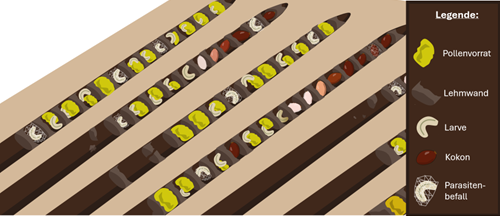
The decline in insect populations poses a growing threat to ecosystems and agriculture. Studies show an alarming loss of biomass among flying insects in Germany of up to 77 % over the last three decades [1]. Around 45 % of the wild bee species found in Germany are considered to be at risk of extinction – with far-reaching consequences for fruit-growing regions such as Saxony and the Rhineland [2]. Agri-environmental measures are intended to counteract the increasing insect mortality caused, amongst other things, by the intensification of agriculture [1]. The extent to which certain pollinator groups, such as solitary wild bees – for example, mason bees (Osmia spp.) – benefit from these measures remains to be analysed. Of great importance to bee health is their bacterial community (microbiome). Whilst this has already been extensively researched in honeybees, it has not yet been sufficiently investigated in native wild bees [3]. Wild bees differ fundamentally from honey bees in their social behaviour, as they do not tend to their brood and the development of the bee larva depends entirely on the surrounding nesting material [4]. For example, the female red mason bee lays her eggs, together with pollen stores, in brood cells separated by clay walls (Figure 1).
Für die Identifizierung des Wildbienen-Mikrobioms wird zu Beginn jedoch eine zuverlässige, standardisierbare Methodik für die Isolation der bakteriellen DNA aus den Materialien der Brutzellen benötigt. Besondere Herausforderungen entstehen dabei durch die Adsorption der DNA an Partikeln, wie Huminsäuren, aber auch durch den rapiden Abbau der DNA in den Umweltproben durch entsprechende Enzyme [5]. Zu diesem Zweck werden momentan verschiedene Methoden und Ansätze zur DNA- Isolation getestet, modifiziert und miteinander verglichen. Anschließend soll die extrahierte DNA für die taxonomische Identifikation der Mikroorganismen genutzt werden. Zu diesem Zweck wird die Methode des Metabarcodings verfolgt. Dafür werden spezifische DNA-Abschnitte, welche im wissenschaftlichen Sprachgebrauch als „Barcodes“ bezeichnet werden zu Beginn mittels PCR vervielfältigt und anschließend sequenziert (Abbildung 2).
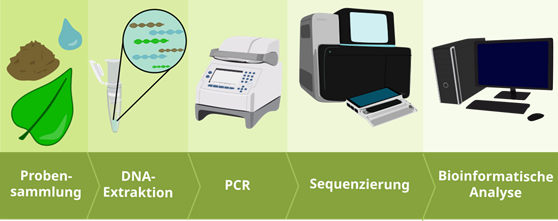
Für die spezifische Identifikation von Bakterien wird dabei das sog. 16s rRNA-Gen verwendet, welches häufig für die Identifizierung von Bakterien genutzt wird [6]. Dieses wird anschließend mit dem MinION von Oxford Nanopore Technologies sequenziert und mit bekannten Sequenzen verschiedener Bakterien-Stämme abgeglichen (siehe Abbildung 2). Dabei bietet die Methode des Metabarcodings den bedeutenden Vorteil, dass aus verhältnismäßig wenig Probematerial ein umfassendes mikrobielles Spektrum erfasst werden kann [7]. Mit den Ergebnissen können Rückschlüsse auf den Gesundheitszustand der Bienen gezogen werden. Diese Daten sollen in Bezug auf verschiedene Landschaftsszenarien das Zusammenspeil von landwirtschaftlichen Praktiken und Agrarumweltmaßnahmen bewerten und ggf. anpassen.
Zur Person
Vanessa Bergler studiert seit 2020 Biotechnologie an der Hochschule Mittweida. Dabei spezialisierte sie sich im Master auf die Genomische Biotechnologie und unterstützt in ihrer Masterarbeit das Projekt von Lisa Prudnikow und Professor Wünschiers, wobei sie sich dem genetischen Nachweis von Bakterien in Umweltproben widmet.
Literatur
[1] Hallmann, CA., Sorg, M., Jongejans, E., Siepel, H., Hofland, N., Schwan, H. (2017) More than 75 percent decline over 27 years in total flying insect biomass in protected areas. PLoS ONE 12 (10): e0185809. doi.org/10.1371/journal. pone.0185809
[2] Nationale Akademie der Wissenschaften Leopoldina (Hrsg.) 2020: Globale Biodiversität in der Krise – Was können Deutschland und die EU dagegen tun? Dokumentationsband zu Diskussion Nr. 24, Halle (Saale).
[3] Voulgari-Kokota, A., Steffan-Dewenter, I., Keller, A. (2020): Susceptibility of Red Mason Bee Larvae to Bacterial Threats Due to Microbiome Exchange with Imported Pollen Provisions, Insects 2020, 11, 373; doi:10.3390/insects11060373
[4] Voulgari-Kokota, A., McFrederick, Q., Steffan-Dewenter, I., Keller, A. (2019): Drivers, Diversity, and Functions of the Solitary-Bee Microbiota. Trends in Microbiology, December 2019, Vol. 27, No. 12 doi.org/10.1016/j.tim.2019.07.011
[5] Kelly, R., Shelton, O., Gallego,R., (2019): Understanding PCR Processes to Draw Meaningful Conclusions from Environmental DNA Studies, Scientific REPORTS (2019) 9:12133 doi.org/10.1038/s41598-019-48546-x
[6] Janda, M., Abbott, S. (2007): 16S rRNA Gene Sequencing for Bacterial Identification in the Diagnostic Laboratory: Pluses, Perils, and Pitfalls, JOURNAL OF CLINICAL MICROBIOLOGY, Sept. 2007, doi:10.1128/JCM.01228-07
[7] Ruppert, K., Kline, R., Rahman, S. (2019): Past, present, and future perspectives of environmental DNA (eDNA) metabarcoding: A systematic review in methods, monitoring, and applications of global eDNA, Global Ecology and Conservation 17 (2019) e00547, doi.org/10.1016/j.gecco.2019.e00547