This page was translated automatically using artificial intelligence (DeepL). The German version is binding. More information about automatic translation
DATI stands for the German Agency for Transfer and Innovation. DATI aims to help translate research findings into economic and/or societal applications through the effective transfer of ideas, knowledge and technology, and to unlock innovation potential. To establish the agency, calls for proposals were issued for so-called DATIPilot innovation sprints. From more than 3,000 proposals submitted, 300 very diverse projects were selected for funding; they all have one thing in common: they provide solutions to the challenges of our time and create social added value.
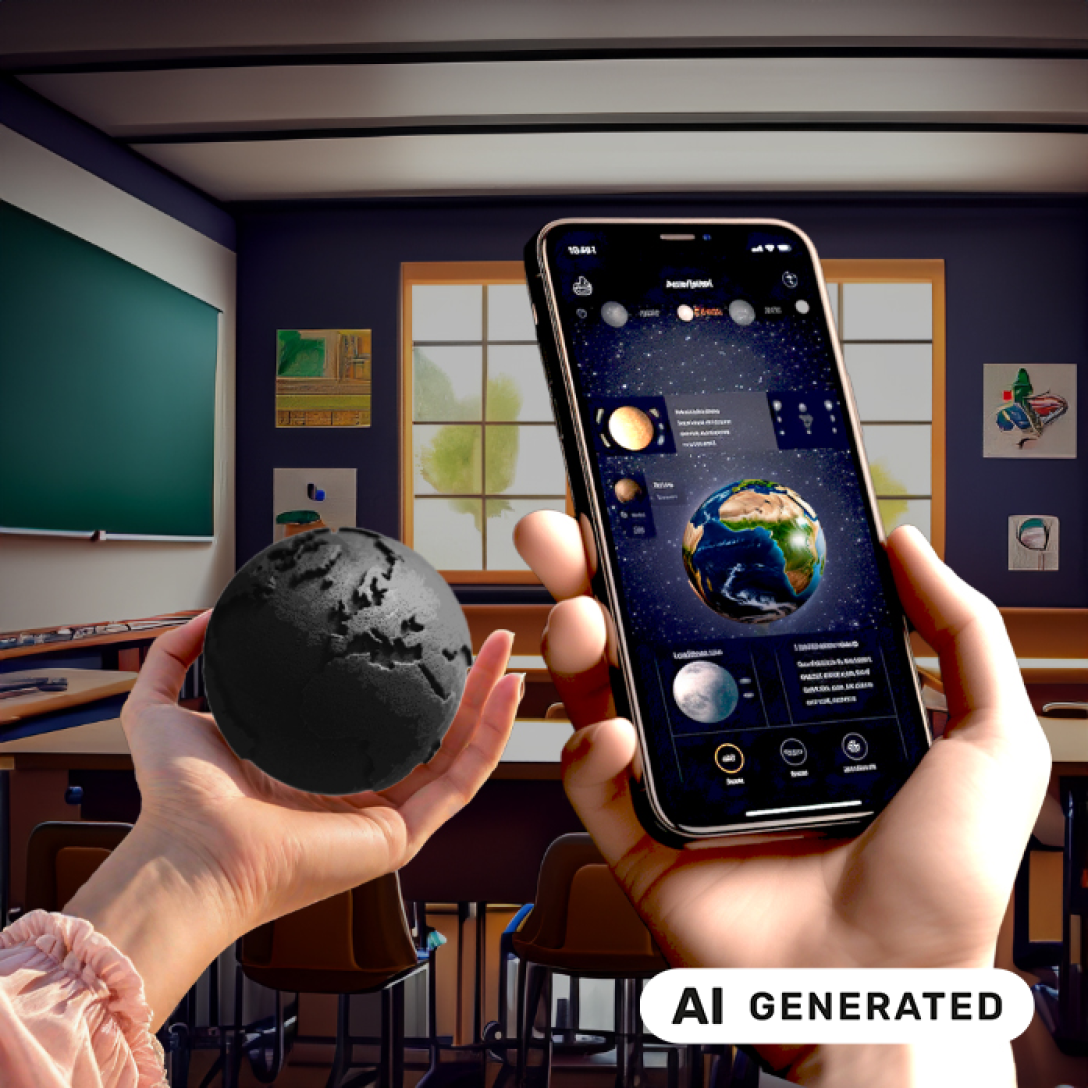
At Mittweida University of Applied Sciences, Professor Philipp Klimant from the CB Faculty, together with the project partner and initiator Faszinaturen UG from Berlin, was delighted to receive confirmation of funding. His project, ‘AR-Faszinaturen: Integration of real-world mass models into AR for better teaching of STEM fundamentals’, aims to provide a clear and accessible introduction to topics such as size, mass, gravity, stability, distances and much more. To this end, Faszinaturen UG has already developed haptic models that represent the actual proportional mass of their ‘originals’ (Eiffel Tower 12 cm = 1 g; Earth 13 cm = 6 kg). This initiative is now to be expanded through integration with Augmented Reality (AR), thereby enabling an even more motivating learning experience that combines the haptic and digital worlds.
The ‘AR System’ sub-project is being carried out at Mittweida University of Applied Sciences. The aim of the sub-project is to develop an AR application that can recognise the haptic models reliably, without delay and thus consistently, and display content on the haptic model via a tablet and/or a smartphone.
Users can then interact with the content via the AR application in the usual way, exploring the subject matter in a playful manner and thus learning independently. This includes not only overlays directly on the models, but also virtual objects and content alongside the mass models in free space. This poses a particular challenge when there are greater distances between the physical model and the virtual content, as it must be assumed that the physical model will not remain permanently within the camera’s field of view of the output device.
The focus of this sub-project is therefore, in addition to creating the basic AR application, the development of real-time tracking that robustly enables all six degrees of freedom in space by tracking the mass model, in combination with spatial tracking.
The project began on 1 July 2024 and will run for 18 months.