This page was translated automatically using artificial intelligence (DeepL). The German version is binding. More information about automatic translation
When research meets teaching and innovation emerges from their collaboration, it demonstrates what modern higher education can look like. At Mittweida University of Applied Sciences, this ethos is put into practice every day through the ‘Digital Skills and Products (DSP)’ teaching concept. This concept, which was awarded the Saxon Teaching Prize 2020, aims to equip students with practical digital skills and product development capabilities throughout their entire course of study. In doing so, teaching, research, knowledge transfer and university management are closely interlinked – from teaching fundamental computer science skills right through to the implementation of complex, interdisciplinary projects with strong partners from industry.
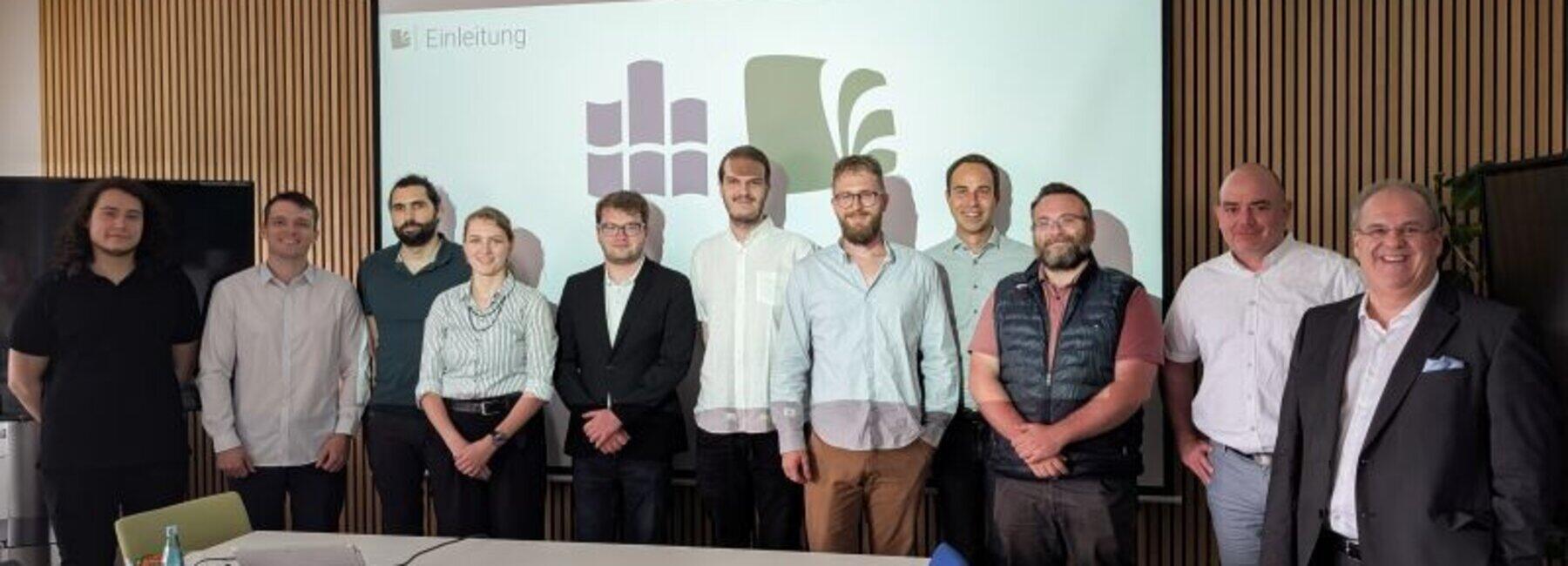
As part of this, students on the Bachelor’s and Master’s degree programmes in Media Informatics and Interactive Entertainment carried out a challenging practical project in collaboration with domeba GmbH over the course of two semesters. The project was supervised by Professors Christian Roschke and Matthias Baumgart, with support from research assistants Dominik Breck and Max Schlosser from the Institute for Computer Science and Media in Research and Transfer, as well as from domeba GmbH, in particular Dr Ruben Wittrin, Matthias Domes and Andreas Rosenbaum. The aim was to develop a prototype for a pipeline for the capture, versioning and structured storage of texts – a crucial building block for the future integration of machine learning methods in the field of text retrieval.
The proof of concept developed addressed a key scientific question: How can heterogeneous text sources – ranging from structured HTML formats to unstructured PDF documents – be processed in such a way that they can serve as a consistent and high-quality basis for AI-supported processes? To overcome this challenge, natural language processing (NLP) and computer vision technologies were specifically combined – an approach that is also highly relevant in current research into multimodal processing and information retrieval systems. The focus was on ensuring data quality, as only clean, consistent data enables valid results in subsequent machine learning applications. The aim was to establish a scalable pipeline that automatically captures data from various sources, converts it into a uniform, structured format and versions any changes. In doing so, the project not only delivers practical benefits but also provides a robust foundation for further research, such as the development of ML-based text search and semantic analysis systems.
The project illustrates how practice-oriented learning can be linked to real-world business requirements, and how this link creates genuine added value for all those involved. The students were able to specifically deepen their technical skills in computer science, media informatics, project management and soft skills, apply them in a practical context and, in doing so, go through the entire development cycle of a complex software project – from requirements analysis through technical implementation to quality assurance. Through close collaboration with experts from domeba, they gained valuable insights into agile development processes, sector-specific requirements and the use of state-of-the-art technologies in an industrial setting. At the same time, their prototype made a substantial contribution to the further development of domeba’s integrated compliance management software.
Professor Christian Roschke sums it up: “Our collaboration with domeba GmbH was characterised by a continuous and constructive exchange of technical expertise, ideas and feedback. We would like to take this opportunity to express our sincere thanks for this spirit of trust and cooperation. The prototype developed not only serves as a basis for future AI-supported search and analysis systems, but also represents an important milestone in the joint development of innovative technologies. This example illustrates how Mittweida University of Applied Sciences systematically transfers innovative ideas and scientific expertise from teaching into industry, thereby driving forward digitalisation in research, practice and society in the long term. Such collaborations give rise to a fruitful innovation ecosystem in which teaching, applied research and industry work together in partnership.”
Text: Prof. Christian Roschke
Image: courtesy of domeba GmbH, 2025 (c)