This page was translated automatically using artificial intelligence (DeepL). The German version is binding. More information about automatic translation
Following the competitive selection process between universities and universities of applied sciences in Saxony, a total of 78 project proposals were submitted under the ESF+ Higher Education and Research funding programme, specifically the ‘Doctoral Projects’ funding module. Of these, 22 projects were classified as collaborative doctoral projects, i.e. projects supervised at Saxon universities of Applied Sciences. It is particularly pleasing that 12 of the 22 funded projects are now based at Mittweida University of Applied Sciences.
The ESF funding aims to strengthen the economic region, increase employment opportunities, promote collaboration with businesses, strengthen cooperation between universities and foster innovation potential. It is also worth noting that, of these 12 projects, one is one of only three industry-based PhD programmes funded across the whole of Saxony.
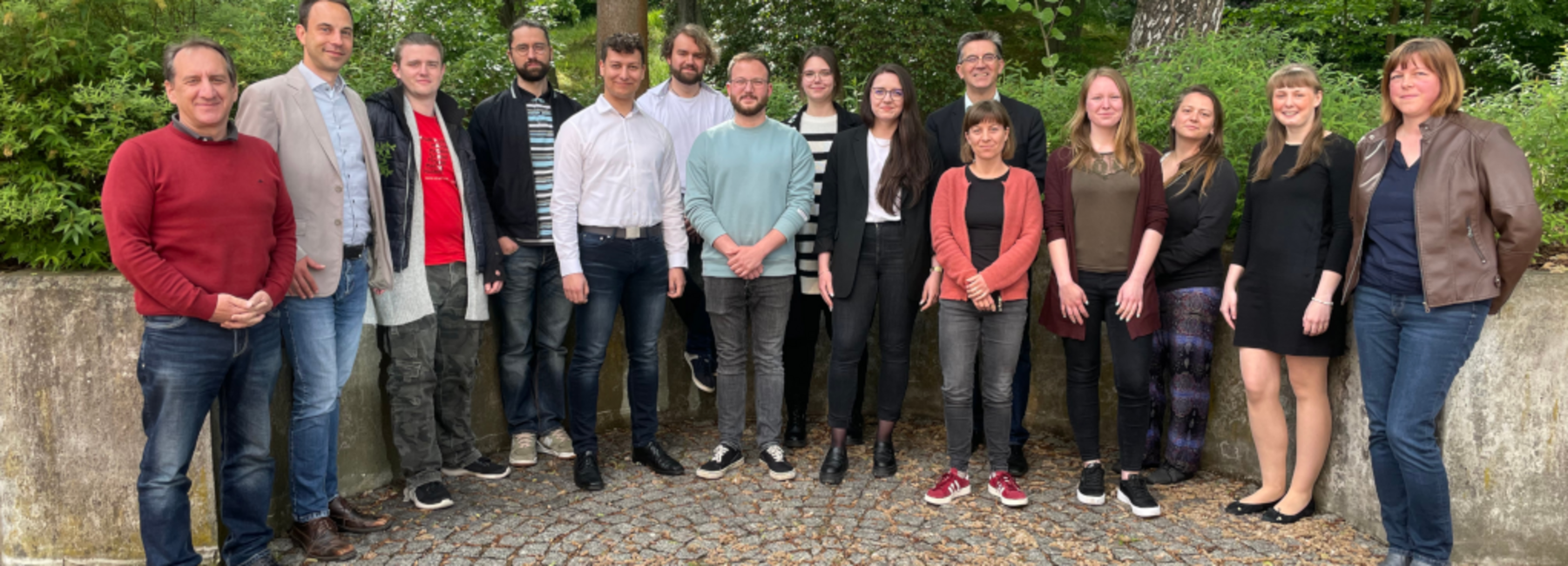
On 24 May 2023, the kick-off meeting for the projects starting between 1 June 2023 and 1 September 2023 took place at Mittweida University of Applied Sciences. During the meeting, academic talents received information about the funding and were able to network across faculties. Matthias Baumgart, the ESF coordinator, is pleased that a fruitful exchange took place, particularly due to the high number of AI-related PhD topics and their distribution across all five faculties. At the kick-off meeting, the supervisors, Professor Michael Kuhl and Professor Thoralf Gebel, were able to share their experiences, whilst Ms Sina Krause from the Budget Department provided information on financial reporting.
The research topics, which are spread across all five faculties of the university, are briefly outlined below.
At the Laser Institute of Mittweida University of Applied Sciences, Andreas Kotsch will undertake a PhD project entitled ‘Production of free-form hardenable structures through in situ carburisation in the selective laser melting process’ as an industry-sponsored PhD. Under the supervision of Professor André Streek, he will investigate new methods for producing free-form structures through the use of in situ carburisation in the selective laser melting manufacturing process. The partner university for this project is the TU Bergakademie Freiberg, and the project is being carried out in collaboration with KOBRA Formen GmbH. A distinctive feature of this funded industrial PhD programme is that KOBRA Formen GmbH is contributing 50 per cent of the funding.
At the Faculty of Applied Computer Sciences and Biosciences, Lynn Reuss will be undertaking her PhD research on the topic “Analysis and prediction of the evolutionary molecular biological development of pandemic pathogens using AI methods” under the supervision of Professor Thomas Villmann at the Saxon Institute for Computational Intelligence and Machine Learning (SICIM). The partner university for this project is Bielefeld University, which is renowned for its excellent research in the fields of AI and bioinformatics.
Florian Meyer, a PhD student at the same faculty, will be researching the topic ‘The spread of hate on social media and the determination of dynamic toxicity’. Under the supervision of Professor Dirk Labudde, he will investigate how hate spreads on social media and how dynamic toxicity can be determined. The partner university for this project is the University of Cologne.
At the Faculty of Engineering Sciences at Mittweida University of Applied Sciences, Kevin Blümel will be undertaking his PhD research project entitled ‘A contribution to the sensor data fusion of radar and camera data for the detection of object trajectories in industrial environments’. Professor Michael Kuhl will be supervising him on this project. The partner university for this project is Chemnitz University of Technology.
Friederike Haubold will be researching the topic ‘Digital skills in Social Work practice and their teaching within degree programmes’ at the Faculty of Social Sciences at Mittweida University of Applied Sciences. Under the supervision of Professor Isolde Heintze, she will investigate the importance of digital skills in Social Work and explore ways of teaching these skills as part of the degree programme. The partner university for this project is also Chemnitz University of Technology.
Alexander Kühn, a PhD candidate at the Faculty of Applied Computer Sciences and Biosciences, will be carrying out his PhD project entitled “Development of an interactive AI sandbox modelled on the Mittweida University of Applied Sciences campus for use in research-based teaching”. Under the supervision of Professor Marc Ritter, he will develop an interactive AI sandbox that can be used in teaching. The partner university for this project is once again Chemnitz University of Technology.
Thomas Davies will also be conducting research at the Faculty Applied Computer Sciences and Biosciences on the topic of “Processing heterogeneous data structures and sequence data in complex AI systems, incorporating robust, interpretable AI models”. Under the supervision of Professor Thomas Villmann, he will investigate at SICIM how heterogeneous data structures and sequence data can be processed effectively in AI systems. The partner university for this project is Bielefeld University.
Oliver Seidel, a PhD student at the same faculty, will be researching the topic ‘Computer Vision Anti-Cheat – A New Approach to Preventing Cheating in Video Games’. Under the supervision of Professor Marc Ritter, he will develop innovative methods for detecting cheating in video games. The partner university for this project is Chemnitz University of Technology.
Sabine Richter, also a PhD candidate at the Faculty Applied Computer Sciences and Biosciences at Mittweida University of Applied Sciences, will be working on the PhD project ‘Automated creation of a person-specific rig for the identification of individuals in video footage’. Under the supervision of Professor Dirk Labudde, she will work on the development of an automated system capable of identifying individuals in video footage. The partner university for this project is the Doctoral Centre for Applied Computer Science (PZAI).
Julia Walter will be conducting research at the Faculty Media Sciences at Mittweida University of Applied Sciences on the topic ‘Social Journalism First? An investigation into the potential, processes and products of integrating social media into German media organisations’. Under the supervision of Professor Janis Brinkmann, she will examine how social media can be integrated into German media organisations. The partner university for this project is the University of Weimar, which is renowned for its expertise in the field of media research.
Anna Marie Gorski will undertake her PhD research project, entitled ‘Human-Machine Interaction – On the Development and Empirical Investigation of an Intelligent Assistance System for Process Innovation within German Newsrooms’, at the same faculty. Under the supervision of Professor Janis Brinkmann, she will investigate the development of an intelligent assistance system designed to support process innovation in German newsrooms. The partner university for this project is once again the University of Weimar.
Susann Siegel will be conducting research at the Faculty of Industrial Engineering at Mittweida University of Applied Sciences on the topic ‘Strategic approach to implementing sustainability in Saxony’s SME sector – current situation, offerings and needs’. Under the supervision of Professor Thoralf Gebel, she will investigate how sustainability concepts can be implemented in Saxony’s small and medium-sized enterprises. The partner university for this project is, once again, Chemnitz University of Technology.
These twelve promising PhD projects cover a wide range of research topics and offer a unique opportunity to advance research across all four of the university’s key research areas. All participating academic talents are supported by professors at Mittweida University of Applied Sciences and work closely with renowned partner universities and companies. The results of these projects are expected to lead to new insights and innovations in their respective fields and make a valuable contribution to the scientific community.
We wish all academic talents every success in carrying out their PhD projects!
Projects due to start between 1 June 2024 and 1 September 2024 can already be prepared for the 2024 funding round of the ESF+ doctoral funding programme at Mittweida University of Applied Sciences. If you have any questions, please contact Mr Matthias Baumgart.
Text and photo: Matthias Baumgart