This page was translated automatically using artificial intelligence (DeepL). The German version is binding. More information about automatic translation
‘Ceramics’, ‘Additive Manufacturing’ and ‘Selective Laser Sintering’: these terms make up the project acronym for the completed CerAM SLS project. The project therefore focused on the additive manufacturing of ceramics using the SLS process. However, this is only part of the story, as the project’s full title indicates: ‘Qualification of thermoset-based powders for selective laser sintering of ceramic components’. Strictly speaking, the project focused on the qualification of thermoset-based powders for the selective laser sintering of ceramic components.
The SLS process has now become an established method for 3D Printing of plastic components such as nylon, TPU, PP and PA. A wide variety of manufacturers now offer machines for this purpose, and as a result, prices have in some cases fallen significantly. A major advantage of the SLS process is that the components do not require support structures, which significantly reduces the amount of post-processing required. However, there is still a clear need for further development, particularly in terms of structural resolution, surface finish and the range of materials that can be processed. It was this last point that the CerAM SLS project addressed, with the aim of expanding the range of materials to include ceramic components and, in particular, photocatalytically active ceramics.
The project tasks were divided into eight work packages. The total funding amounted to around 810,000 euros.
The aim of the project was to develop thermoset-based powders for the SLS process, which can be used to manufacture photocatalytically active ceramic components. When exposed to UV light, these photocatalytically active ceramics form free radicals which lead to the decomposition of organic substances; this is expected to play an important role, particularly in (waste) water treatment, where they are expected to play an important role in removing harmful organic substances – predominantly introduced into the environment by humans – such as pesticides, hormones and pharmaceutical residues, the concentrations of which are steadily rising. According to the Federal Environment Agency, 40 different pharmaceutical active ingredients (as well as their transformation and degradation products) had already been detected in drinking water alone by 2023. In groundwater (104), surface water (222) and effluent from sewage treatment plants (327), however, the figures are significantly higher, with corresponding consequences for the environment (e.g. infertility and kidney damage in fish). The latter figure in particular shows that conventional sewage treatment plants are unable to reliably remove these trace substances. Currently available options for modernising sewage treatment plants are costly, require intensive maintenance and/or are unable to filter out all trace substances. This is where the CerAM SLS project came in, aiming to develop innovative, cost-effective and durable filter elements that could also be used on a decentralised basis, e.g. in camper vans, homes and clinics.
Previous photocatalytic technologies have already shown promise in the removal of trace substances. However, due to a lack of support structures, short service life and energy inefficiencies, they have not yet reached market readiness. The methodology used in CerAM SLS makes it possible, in particular, to produce structures from solid material (which ensures a very long service life) and to create structures with large surface areas and optimised geometries, thereby guaranteeing high photocatalytic activity.
In order to manufacture such components using SLS, commercially available photocatalytically active ceramic particles were embedded in a polymer matrix, which were then processed into powders, shaped using the SLS process, and finally sintered at defined temperatures to remove the remaining polymer and produce a pure ceramic that has retained its photocatalytic activity.
If the ceramic particles were irradiated directly with a laser beam, the processing temperature could not be set precisely enough, which would result in a phase transformation within the ceramic, causing it to lose its photocatalytic activity. Mittweida University of Applied Sciences was particularly sought after for its expertise and technology in the field of micro-SLS, with structural resolutions of < 50 µm, in order to produce components with a significantly increased active surface area per unit volume.
Mittweida University of Applied Sciences’ involvement in the project
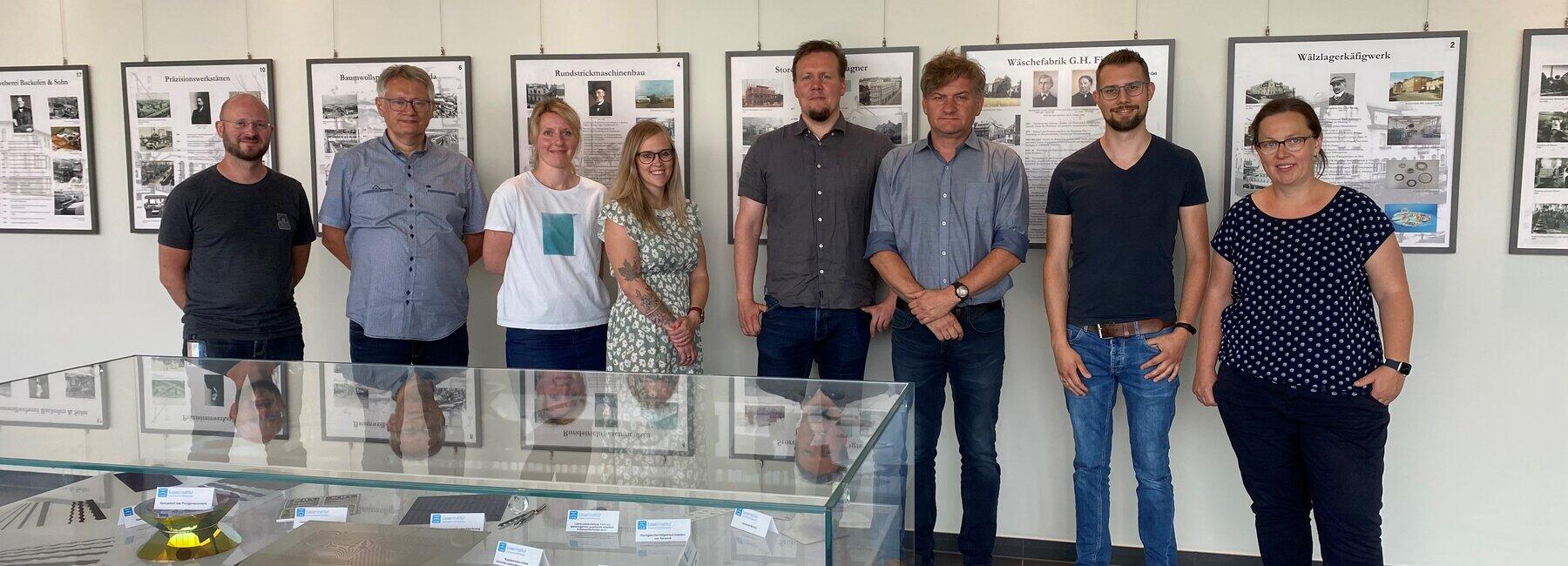
The project leader at Mittweida University of Applied Sciences was Professor André Streek; the university’s Laser Institute was primarily involved on a technical level, largely due to the specialised equipment which enabled the project to produce green bodies with a structural resolution of up to 50 µm. To this end, the university’s in-house µSLS systems were utilised, along with a wind sifter, which enabled the production of the powder fractions required for very fine structures. In-house expertise was also required here, as the starting material used for the ceramic components presented a number of challenges that had not previously been encountered on this scale. On the one hand, the powder was very light due to its polymer content, which allowed interparticle forces to take effect more strongly and led to increased agglomeration and surface adhesion to machine parts. Secondly, the powder was irregular in shape and, due to the polymer-ceramic matrix, consisted of both relatively soft and very hard material; this allowed the powder particles to become wedged together and interlock, which – like the agglomerations mentioned – led to a significantly poorer powder feed rate. Despite this, various powder fractions with, for example, particle sizes up to d90 = 10 µm were produced from the starting material, and green bodies with a structural resolution of 50 µm were fabricated. The Research Department, in collaboration with the SAB (Sächsische Aufbaubank), supported the administrative management of the EU project.
An overview of the key findings
The project partner TIGER was able to produce powders that have been qualified for use on commercially available SLS machines in the wavelength range from 445 nm to 10.6 µm. In doing so, the ceramic content in the powder was increased to up to 60 per cent, whilst still ensuring sufficient mechanical stability.
It is expected that the organic thermosetting binder material developed as part of the project, in combination with ceramic SLS printing and the sintering process, will also be suitable for a wide range of other ceramic materials, thus representing a very valuable knowthat has been filed by TIGER and IKTS in the form of a European patent to ensure its commercial viability by the project partners (patent number EP23182257).
Furthermore, a sintering strategy was developed in which the photocatalytic phase of the ceramic could be largely preserved. This is remarkable in that the required sintering temperature was well above the temperature at which the phase transformation takes place. However, compared with dip-coated structures, the SLS structures still exhibited lower degradation rates.
In addition, extensive know-how was gained regarding the production, composition and fractionation of the starting powders, as well as the influence of these parameters on manufacturability using (µ)SLS technologies, the subsequent sintering and the resulting photocatalytic activity.
In particular, the µSLS samples produced by the LHM yielded very promising results, especially as these had only 1/14th of the volume of the test specimens produced using conventional SLS in the test rig, which suggests a correspondingly better degradation rate when fully utilised.
The project’s latest publication can be accessed via the following link: https://www.sciencedirect.com/science/article/pii/S2666539524000786
Outlooks
The project has achieved its objectives and, with its findings, provides a solid foundation for a follow-up project aimed at achieving commercial viability. Further optimisation of the results obtained to date appears feasible in all areas, and there are other points that would be of great interest for further investigation, including:
1. A more precise validation of the differences in the results between µSLS and SLS structures.
2. Targeted optimisation of the phase ratio in the ceramic by adjusting the processing steps (the literature suggests an optimal phase ratio for maximum photocatalytic activity).
3. Production of a filter prototype with optimised illumination and structure, e.g. as an SLS–µSLS hybrid.
4. Expanding the range of applications by qualifying further (specialised) ceramics.
Acknowledgements
The CerAM SLS project was funded by the European Union’s Horizon 2020 research and innovation programme under grant agreement No. 958174. The project was funded by the Austrian Federal Ministry for Climate Protection, Environment, Energy, Mobility, Innovation and Technology (BMK) and carried out as part of the ‘Production of the Future’ programme (FFG 892468). The author would like to thank the Sächsische Aufbaubank (SAB) for funding the CerAM SLS project – application number: 100630574/100633121, which was funded under the EuProNet guidelines.
Text: Stefan Gronau
Images: CerAM SLS (1), Fraunhofer IKTS (2, 4), Laser Institute, Mittweida University of Applied Sciences (3)