
This page was translated automatically using artificial intelligence (DeepL). The German version is binding. More information about automatic translation
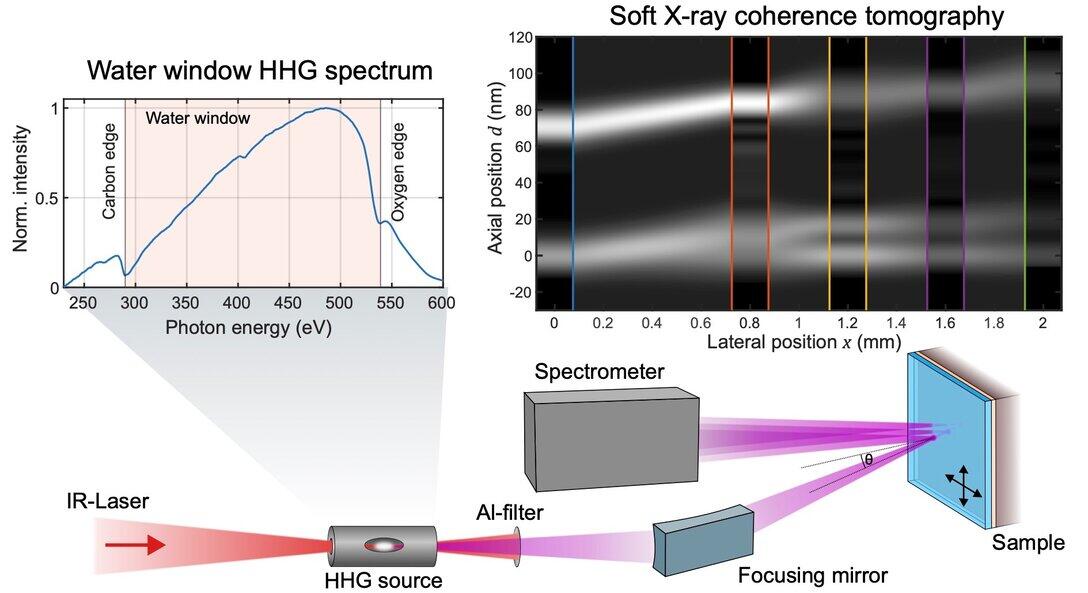
A research team from Jena, Berlin and Mittweida, including Professor Silvio Fuchs from the Laser Institute at Mittweida University of Applied Sciences, has made a significant breakthrough in laboratory-based soft X-ray imaging. The findings were published in the prestigious *Nature* journal *Light: Science & Applications*. For the first time, the team has successfully demonstrated Soft X-ray Coherence Tomography (SXCT) in the so-called water window using high-harmonic generation (HHG) – with an axial depth resolution of 12 nanometres and in a completely non-destructive manner.
The importance of the water window in X-ray imaging
The water window encompasses the spectral range between the absorption edges of carbon (wavelength ≈ 4.4 nm) and oxygen (≈ 2.3 nm). In this wavelength range, soft X-rays offer a unique combination of high spatial resolution, comparatively large penetration depth – up to around 10 µm in aqueous materials – and pronounced element- and material-dependent contrast. These properties make the water window particularly attractive for applications in materials research, nanotechnology and, in the future, also in the life sciences.
SXCT: Soft X-ray coherence tomography
The soft X-ray coherence tomography used in the study is conceptually derived from optical coherence tomography (OCT), but utilises soft X-rays and the full spectral bandwidth of the source. This allows depth information to be reliably reconstructed even in the presence of very weak reflections.
The Fourier-based analysis has proven to be particularly robust against noise interference. As a demonstrator, the research team investigated a nanoscale layered system consisting of aluminium oxide (Al₂O₃) and platinum (Pt). The layer thicknesses and lateral inhomogeneities determined using SXCT were independently validated by ion beam etching as well as scanning and transmission electron microscopy (SEM/TEM) and showed very good agreement.
HHG high-flux source enables laboratory operations within the water window
A key technological element of the work is a broadband HHG source from Berlin, which provides a continuous spectrum in the energy range from 200 to 600 eV. The article reports a photon flux density of approximately 10⁶ photons/eV/s (for example, at 500 eV). This high brilliance is crucial for making HHG-based imaging in the water window—previously considered extremely challenging—feasible for the first time in a laboratory setting.
In combination with the noise-resistant SXCT methodology, this opens up new possibilities beyond large-scale synchrotron infrastructures.
Contribution from Mittweida University of Applied Sciences
Mittweida University of Applied Sciences is directly involved in the team of authors through the Laser Institute. Prof. Dr Silvio Fuchs is the corresponding author of the publication and played a key role in the experimental design, development of methodology and data analysis. The work also highlights the close and successful cross-site collaboration across the entire value chain – from laser and source technology, through tomographic reconstruction methods, to material analysis validation.
Prospects for materials research and microelectronics
The authors regard SXCT in the water window as an important step towards the non-destructive characterisation of materials whose absorption in the extreme ultraviolet (EUV) is too strong. Applications involving buried interfaces, multilayer systems and in micro- and nanoelectronics are particularly relevant. The excellent agreement between the SXCT results and established TEM measurements demonstrates the method’s potential as a complementary analytical tool offering genuine depth resolution.
Publication
Julius Reinhard et al.
Soft X-ray imaging with coherence tomography in the water window spectral range using high harmonic generation.
*Light: Science & Applications* (2026)
DOI: 10.1038/s41377-025-02057-9
Link to the publication: www.nature.com/articles/s41377-025-02057-9