This page was translated automatically using artificial intelligence (DeepL). The German version is binding. More information about automatic translation
On 25 March 2025, the SAXSIM – Saxon Simulation Conference took place at Chemnitz University of Technology. This annual conference provides a platform for researchers, industry representatives and students to exchange views on the latest developments in numerical simulation. Mittweida University of Applied Sciences was represented by two specialist presentations from the Faculty Engineering Sciences and presented innovative research findings in the fields of artificial intelligence for collaborative robots and numerical simulation for additively manufactured heat exchangers.
In Ehsan Matour’s presentation on ‘Dynamic safety zones using LSTM and deep reinforcement learning for collaborative robots – A simulation-based study’, a learning-based system was presented that dynamically adjusts safety zones in human-robot interaction. The system combines laser data, an LSTM model for motion prediction, and several deep reinforcement learning models to adjust the zone in real time. The aim is to enhance human safety whilst avoiding unnecessary interruptions to robot operation. The system’s performance was successfully demonstrated both in simulation and in real-world test scenarios.
Justus Reuter’s second presentation, entitled ‘Numerical Simulation and Optimisation of Mesh Generation Strategies for Additively Manufactured Heat Exchangers with Gyroid Structures’, presents an innovative method for the efficient mesh generation of complex, gyroid-based heat exchangers for numerical flow simulations. Gyroid structures are characterised by novel minimal surfaces with a high surface-to-volume ratio, which enables particularly effective heat transfer. The wrapping techniques presented automatically generate optimised mesh structures, which ensure both significant reductions in simulation time and a high degree of accuracy in the numerical results. The Newton-Raphson method is used to precisely calculate the growth rate and number of layers, ensuring an accurate representation of the boundary layers in the flow simulation. The method has been experimentally validated and leads to a significant reduction in the computational resources required, as well as improved agreement with measured data. This opens up new application prospects for industry and the aerospace sector in the field of TPMS heat exchangers.
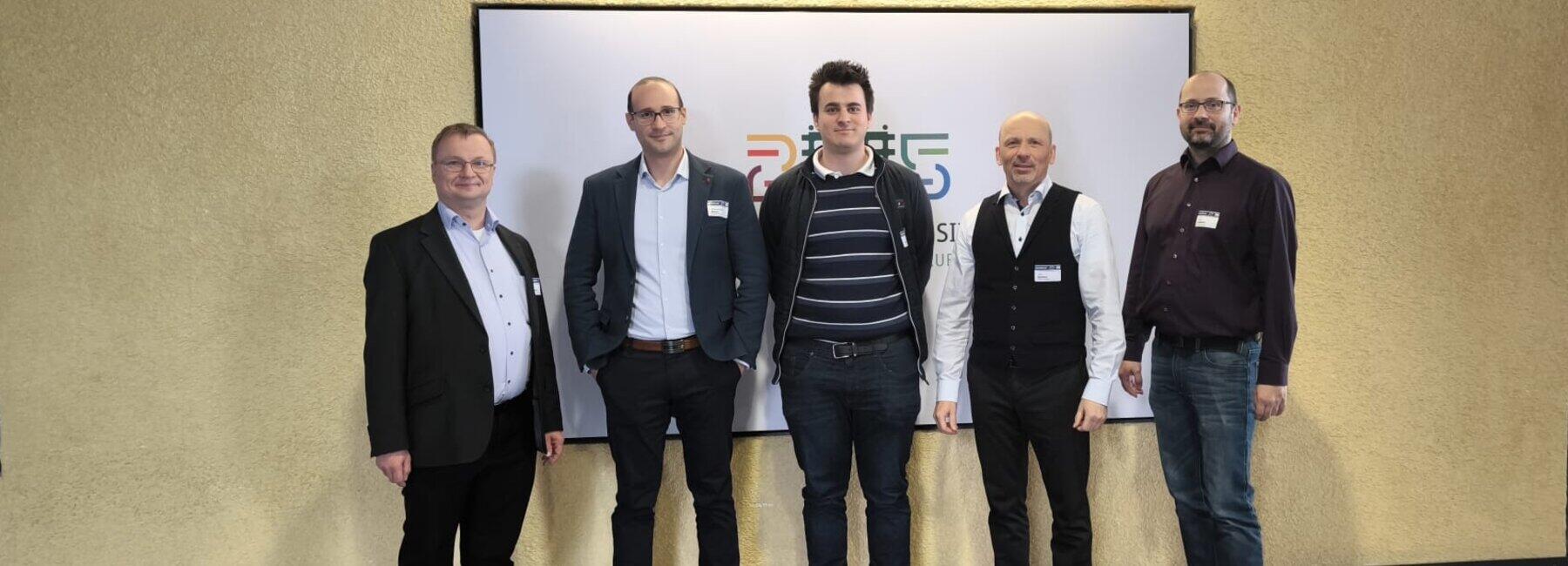
One session was chaired by Professor Jörg Matthes from the Faculty of Engineering Sciences.
Professor Uwe Mahn, Vice-Rector for Research and also a conference participant, summed up enthusiastically: “This is now the 14th time that simulation experts have come together at SAXSIM to discuss the latest developments. Participants come from all over Germany, and some from Switzerland and other countries. I am delighted that we, as Mittweide University of Applied Sciences, were represented this time by two excellent academic talents, both of whom delivered very engaging presentations and, during the always lively discussions at SAXSIM on their topics, demonstrated a deep understanding of the subject matter.”
Text and photos: Prof. Uwe Mahn