This page was translated automatically using artificial intelligence (DeepL). The German version is binding. More information about automatic translation
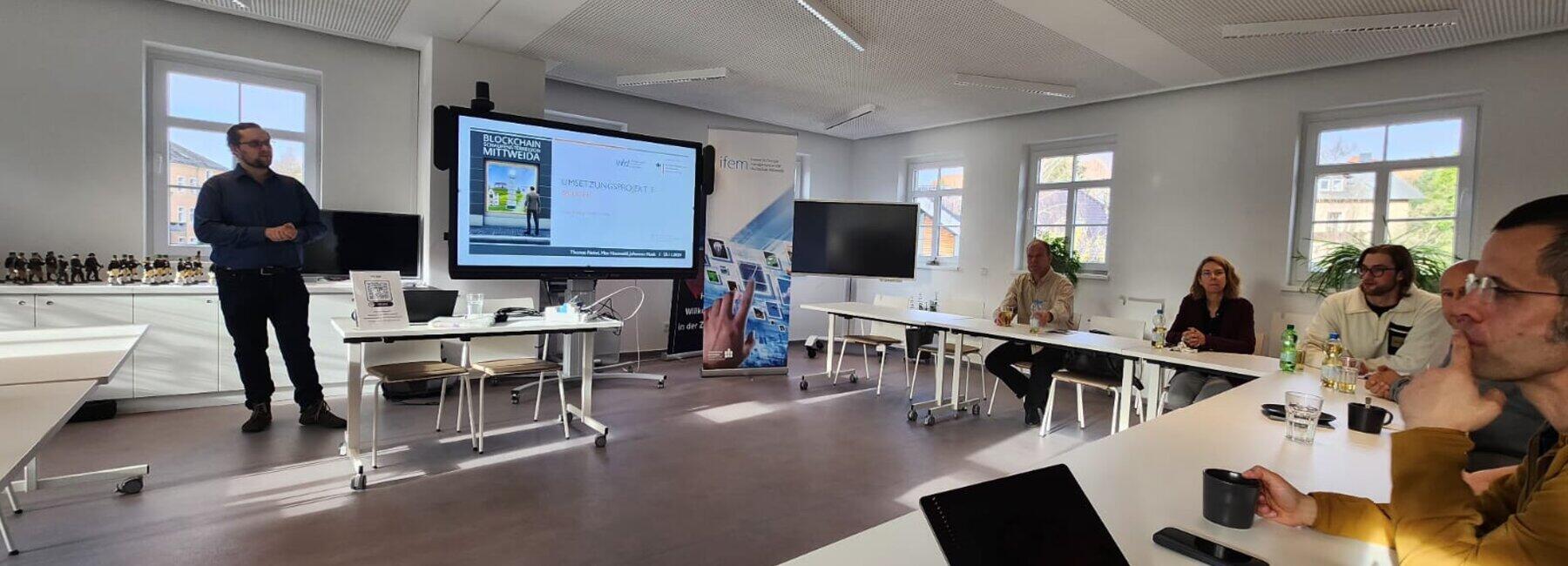
The ‘BRIDGER’ research project presented its findings at Werkbank32 at the end of last year. Alongside representatives from the project partners, exceeding solutions and Mittweida University of Applied Sciences, several associated partners also attended the closing event.
The statutory ‘tenant electricity’ scheme has structural weaknesses that hinder the expansion of renewable energy in rented properties. Under this model, the landlord becomes a full-service supplier, which means they must purchase energy on the electricity market to ensure a continuous supply to tenants. This entails both a high administrative burden and financial risks. Furthermore, it is not possible for the landlord to use the electricity generated for their own purposes, and feeding the entire output into the grid proves unprofitable. As a result, the use of photovoltaic technology often remains untapped for tenants.
The project offers an innovative approach to overcoming the structural weaknesses of the tenant electricity scheme. By dividing a meter into two programmable registers, a tenant can purchase electricity from two different suppliers. An algorithm records the energy generated by the photovoltaic system with precise timing and allocates it to the two registers. At the end of the billing period, the landlord receives an invoice for the energy supplied.
Since ‘BRIDGER’ submitted its application, the legal framework has evolved rapidly. With the Solar Package 1, adopted in May 2023, the concept of communal building supply was introduced and Section 42b of the Energy Economy Act (EnWG) was amended. Approval by the Bundestag in May 2024 enshrined the concept in law. Nevertheless, questions remain, particularly regarding measurement and calibration legislation. In this regard, ‘BRIDGER’ is in dialogue with the relevant authorities to develop solutions for the billing of meter readings.
The team made significant progress, including the development of a universally applicable distribution algorithm by Mittweida University of Applied Sciences, as well as the exemplary implementation and procurement of demonstrator components by exceeding solutions. Other milestones include the installation of the first gateway with paired meters, establishing contact with calibration authorities to clarify legal issues, and the development of user-friendly web interfaces for tenants and landlords, complemented by the modelling of the underlying database. The integration of the EXS API to support market communication was also successfully advanced. A highlight of the closing event was the presentation of the landlord portal, which enables intuitive management of energy flows and billing.
The market potential of ‘BRIDGER’ is considered to be high. In the network area of partner MITNETZ Strom, there are around 688,000 households that qualify as potential customers. Particularly in cities with a high density of rental properties, the model offers a promising opportunity to drive forward the energy transition.
Further information on the research project can be found at https://blockchain-mittweida.com/bridger/.
Text: Elena Dillmann
Image source: Blockchain Showcase Region Mittweida