
This page was translated automatically using artificial intelligence (DeepL). The German version is binding. More information about automatic translation
Checking lecture notes on OPAL in the morning, reading news updates on the HSMW app in between, researching reading material for a seminar, collaborating with fellow students on a cloud-based file, and using an AI application to study in the evening – for many HSMW students, this has long been part of everyday life. Staff, too, coordinate projects digitally, work in virtual teams and are increasingly using digital tools in teaching, research and administration.
But what does it actually take to navigate this digital world confidently, critically and competently? The answer is: digital literacy. Today, it is one of the most important skills for the future – both in higher education and in professional life. That is why it is a central theme of the Digital Campus.
More than just technology
When people hear the term ‘digital literacy’, they often think first of programmes, apps or artificial intelligence. In fact, the term encompasses much more than that. Digital literacy describes the ability to use digital technologies in a conscious, critical, safe and purposeful manner.
This includes, for example:
- researching and evaluating information
- using digital tools effectively
- acting safely and responsibly online
- communicating and collaborating online
- creating digital content
- Reflecting on and critically examining new technologies
Digital literacy thus combines technical knowledge with media literacy, critical thinking and problem-solving skills.
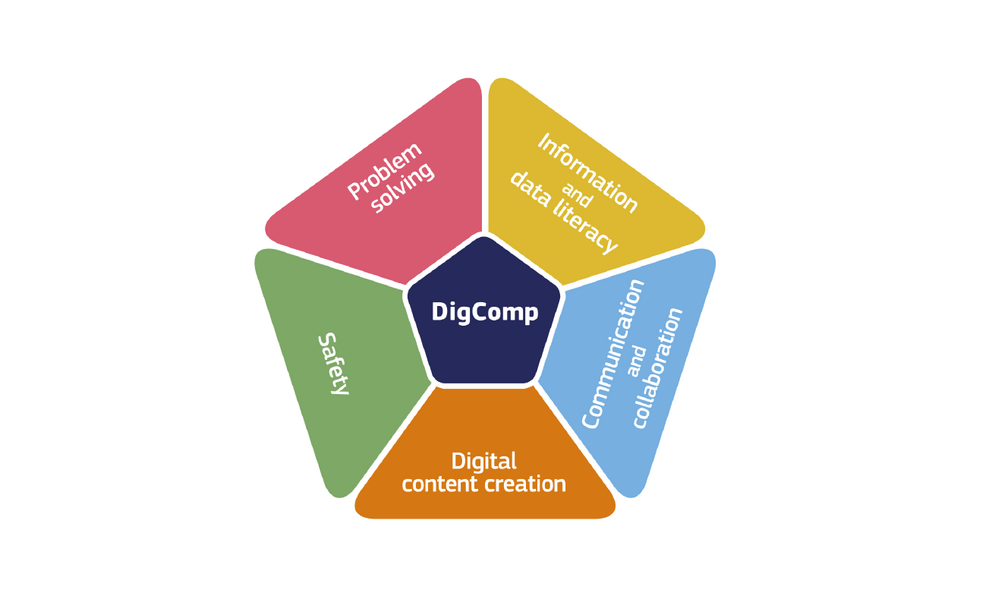
Guidance through DigComp
To make digital competences more tangible, the DigComp (Digital Competence Framework for Citizens) competence model was developed at European level. It describes five key areas of competence:
- Information and data literacy
- Communication and collaboration
- Digital content creation
- Security
- Problem-solving and innovation
We encounter these areas every day – often without even realising it.
Digital literacy in everyday university life
A typical example from university life illustrates just how closely this topic relates to our everyday reality:
A student is preparing a presentation. They search for academic literature via the university library, assess the quality of the sources, organise their notes digitally and work on a presentation together with others. An AI tool may also be used to assist with this; its results are critically examined and care is taken to cite sources correctly.
Staff also face similar challenges: they organise projects digitally, coordinate via various platforms, create digital teaching materials or analyse data for research projects.
In both cases, it is not simply a matter of being able to use digital tools. What is crucial is to use them consciously, thoughtfully and in a targeted manner.
Why is digital literacy so important for HSMW?
Mittweida University of Applied Sciences sees itself as a modern university with close links to professional practice, innovation and social change. Digital technologies now shape almost all academic disciplines and professional fields.
Digital literacy is therefore not an additional qualification, but a fundamental skill for successful learning, working and research.
Learning never stops
Unlike many specialist skills, digital literacy is never fully complete. New technologies, applications and ways of working are constantly emerging. That is why it is less about mastering every single tool. Far more important is the ability to familiarise oneself with new digital tools independently and to assess their potential and limitations.
The rapid development of artificial intelligence, in particular, highlights just how important this ability has become.
The Digital Campus as a guide
The Digital Campus at Mittweida University of Applied Sciences supports students and staff in further developing their digital skills. Here you will find information, ideas, practical examples and inspiration relating to digital tools, methods and developments in everyday university life.
After all, digital competence does not arise from technology alone. It grows through experimentation, reflection and collaborative learning.