This page was translated automatically using artificial intelligence (DeepL). The German version is binding. More information about automatic translation
Around 80 participants celebrated the anniversary of an exceptional collaboration at the symposium ‘10 Years of Mittelsachsen Sozial: Science and Practice – What Was. What Is. What’s Next.’ on 24 November at Mittweida University of Applied Sciences (HSMW). Since 2015, the Faculty of Social Sciences at HSMW and the Mittelsachsen district administration have been working together on a continuous integrated social planning programme. Academic expertise, teaching and local practice come together closely here. Professor Isolde Heintze, the project’s initiator and academic director, takes the lead in ensuring continuity and academic quality, supported by her core team of two research assistants. However, other disciplines have long been involved as well, including the Faculty of Media Sciences and the Faculty Applied Computer Sciences and Biosciences.

Social planning – why it affects us all
In her keynote address at the start of the conference, Lisa Manhart, a social planner from Schwerin, clearly explains to all participants what integrated social planning actually achieves: she describes social circumstances, identifies trends at an early stage and highlights the support people need in different life situations. She answers questions that directly affect everyday life – such as where infrastructure needs to be expanded, how to ensure that ageing and older people continue to be well looked after, or what services families will need in the future.
A special collaboration
Ten years after the partnership began, the symposium impressively demonstrated just how much has been achieved during this time. Three comprehensive social reports have systematically highlighted the social situation across the district for all regions. The website ‘www.mittelsachsen-sozial.de’ now provides a central hub for accessing data, projects and results. A local monitoring scheme, which now comprises over a million data records, also provides an exceptionally comprehensive and robust database that strengthens regional social planning in the long term.
In addition, there have been numerous academic studies, projects and evaluations carried out in collaboration with the university. Around 80 Master’s students from the Faculty of Social Sciences have analysed social spaces, conducted surveys and worked with local organisations as part of applied research projects. The survey of the population aged 55 and over, which has recently been analysed, builds on this and forms the basis for the district’s new strategy on policy for older people.

Cooperation as a beacon for the future
Over the years, the collaboration between the district and Mittweida University of Applied Sciences has developed into a true flagship initiative in eastern Germany – a project that receives reliable funding, is constantly evolving and thrives on mutual trust. Jörg Höllmüller, the district’s second deputy mayor, gave a positive assessment: the combination of academic analysis and local government practice has noticeably advanced the district and created tangible added value for the administration, the funding bodies and the local population.
Inspiration, discussions and exchanges
The symposium provided ample opportunity for substantive input and personal exchange. A panel discussion focused on key figures in integrated social planning. The discussion deliberately spanned a range of topics, from a review of the past through current collaboration to hopes for the future. It became clear just how much all those involved value their joint work and wish to build on it further.

The discussion also highlighted that sustainable social planning must reach different generations – and therefore requires different approaches to communication. In the subsequent breakout sessions, experts from local government, voluntary organisations, politics and academia explored these topics in greater depth. They discussed how participation is implemented in practice, the role data plays in local action, and how cooperation can be further strengthened. It became clear just how closely the district is interconnected as a result of the work carried out over the past ten years, and how much the various stakeholders now benefit from one another.

Results for the region
The presentations throughout the day highlighted the benefits the region has derived from ten years of collaborative work. Political decisions can now be taken strategically on the basis of much more robust data. Social contexts can be described in greater detail, trends identified at an earlier stage, and services developed in a more targeted manner.


At the same time, a collaborative learning process has emerged that brings together the local authority, the sector’s various organisations and the academic world. Students experience the district as a real-world learning environment, forge links with the professional world and contribute innovative perspectives – an advantage that will also help to meet the demand for skilled workers in the long term.
Looking ahead: digitalisation, demographics and AI
In her closing lecture, Professor Heintze looked to the future. The coming years will be shaped by digitalisation, demographic changes and participatory formats.

A key new feature will be the ‘Mittelsachsen Sozial’ dashboard. The content and technical foundations for this have already been laid; from mid-2026, the dashboard will gradually begin to make up-to-date local authority key figures publicly available on an ongoing basis.
This will significantly facilitate access to social data for public authorities, service providers and interested members of the public. In addition, the project will work closely in future with Professor Thomas Villmann from the Faculty Applied Computer Sciences and Biosciences. The joint development of AI-supported methods for social reporting is intended to enable data to be analysed even more precisely, thereby enhancing the capacity for policy management at local authority level.
At the same time, the strategy on policy for older people represents a major focus area within Integrated Social Planning; it builds on the findings of the new 55+ survey and provides important impetus for an ageing society.

Central Saxony: Out and About for Social Causes
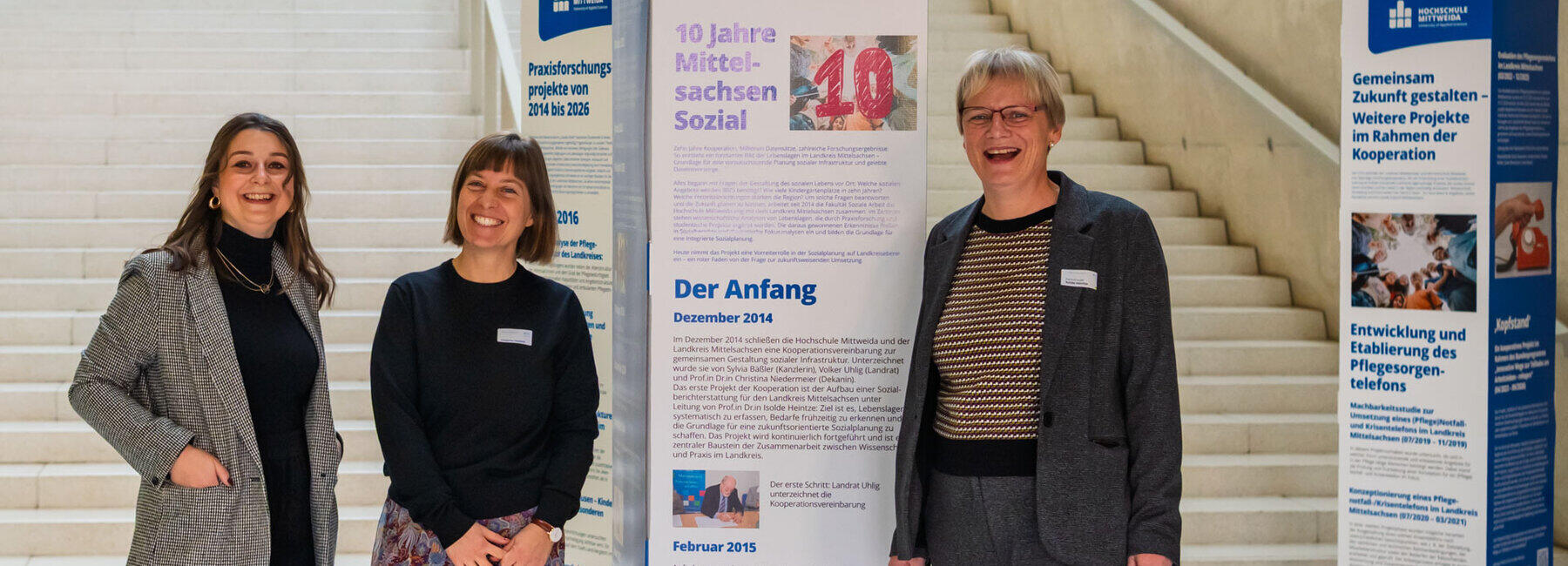
Throughout the symposium, participants were able to visit the travelling exhibition ‘Ten Years of Mittelsachsen Sozial’. It showcases key projects, research findings and experiences of cooperation from the past decade and will be on display at various locations across the district in the coming months. The symposium made it clear that “Mittelsachsen Sozial” stands for active cooperation, reliable partnerships and social planning that shapes the future. The region has achieved a great deal over the past ten years – and it is ready to continue on this path together.