This page was translated automatically using artificial intelligence (DeepL). The German version is binding. More information about automatic translation
The laboratory grows dark and the microscope begins to scan. After a few minutes, an image made up of glowing pixels emerges. The dye sample becomes visible and, as the image zooms out, one can make out the fine structures of a microfluidic chip that did not even exist a week earlier.
What began as a design by 18 students from various disciplines is now a fully-fledged experimental setup. As the first measurement results become apparent, the summer school is slowly drawing to a close.
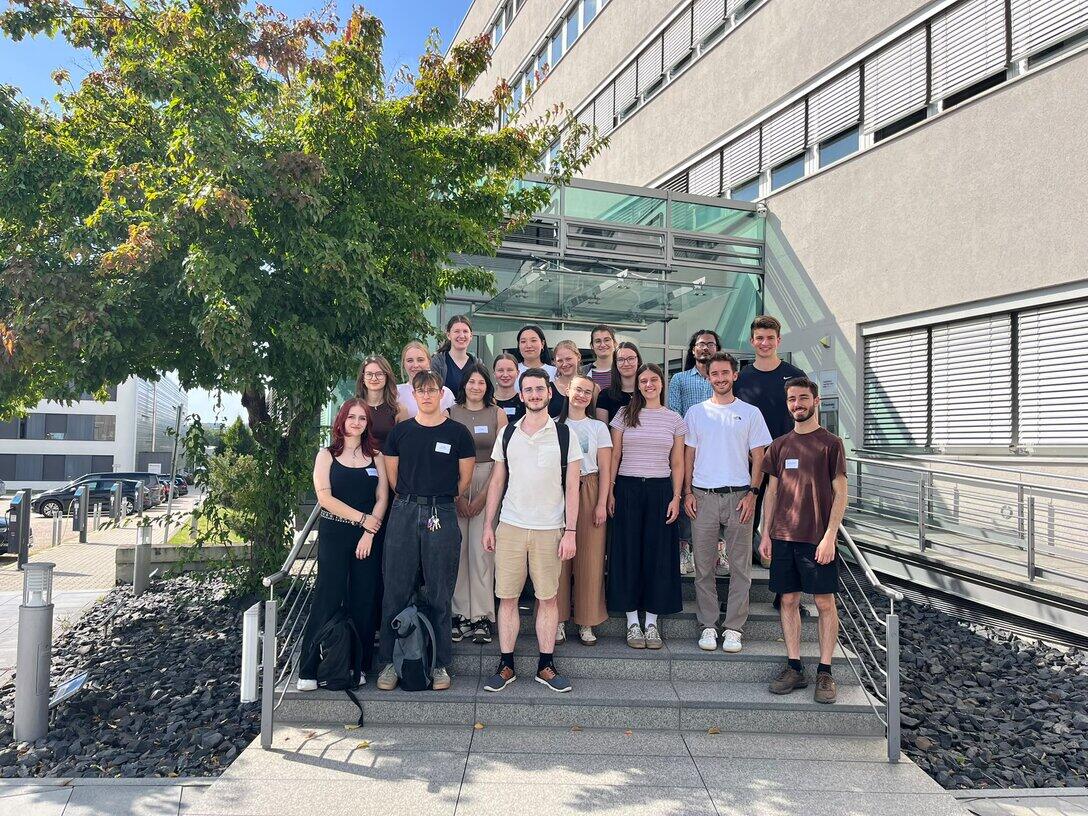
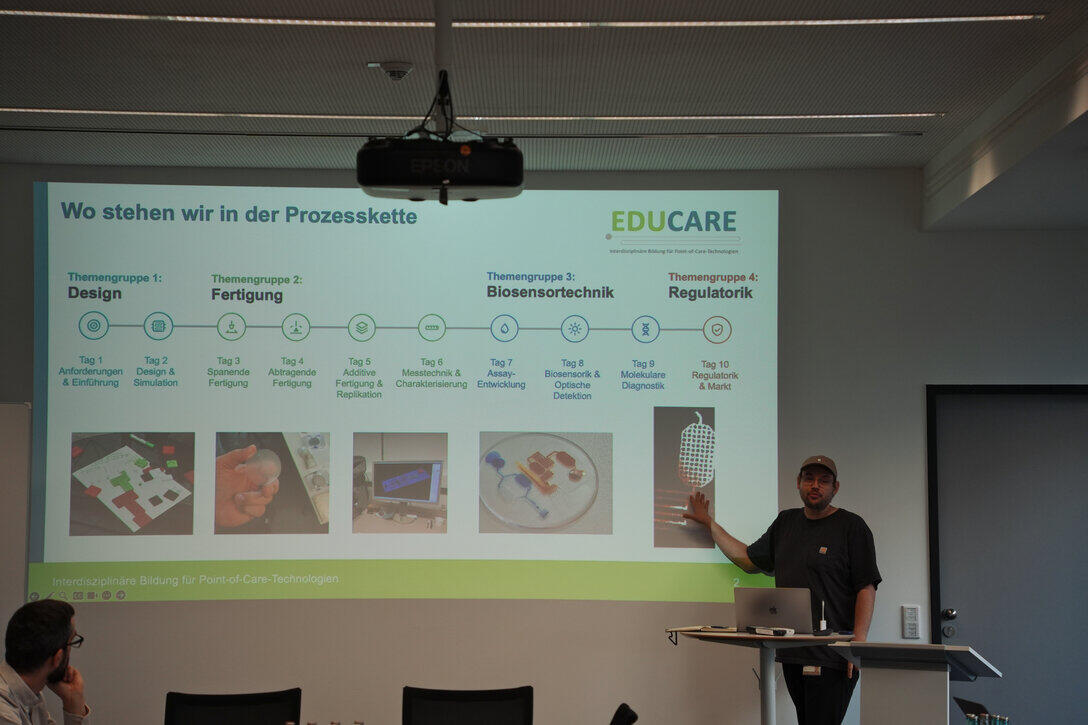
A lot has happened up to this point. For two weeks, 18 students from Mittweida, Chemnitz, Leipzig, Erlangen and Halle had been exploring, as part of the EDUCARE Summer School ‘Future Technologies in Diagnostics’, how an idea can be turned into a functioning point-of-care testing system. In the process, they gained an understanding of the various aspects of the process chain: from the design and manufacture of a microfluidic chip, through biosensor technology and data analysis, to regulatory requirements.
At the heart of the summer school was a micro-project of their own. The students first developed a microfluidic design, which was then turned into a functional chip. Together with partners from Chemnitz University of Technology, the Fraunhofer IWU and the Fraunhofer IZI, they followed the process from design through to manufacture and initial functional tests. Once the chips had been successfully filled with liquid for the first time, the groundwork was laid for the final measurements at the Laser Institute at Mittweida University of Applied Sciences (LHM).
From the finished chip to the diagnostic application
In Mittweida, the focus eventually shifted to the actual diagnostic process. The emphasis was no longer on the manufacture of the chip, but on the question of what happens within the microfluidic structures from a biological and metrological perspective. The participants explored biosensors, optical detection, DNA diagnostics and modern data analysis.
But how does a sample become a measurable signal? The participants first approached this question from a theoretical perspective. Professors Richard Börner and Ulrich Rant provided the fundamentals of optical detection and biosensor technology. Biomolecules such as nucleic acids or proteins can be specifically detected, and their interactions translated into measurable signals. This is an important prerequisite for harnessing biological processes for diagnostic applications. Felix Erichson then broadened the focus to the sample itself: where do samples for diagnostic tests actually come from, what can be detected in them, and what challenges does this pose for point-of-care applications?
In-house chips tested in the laboratory
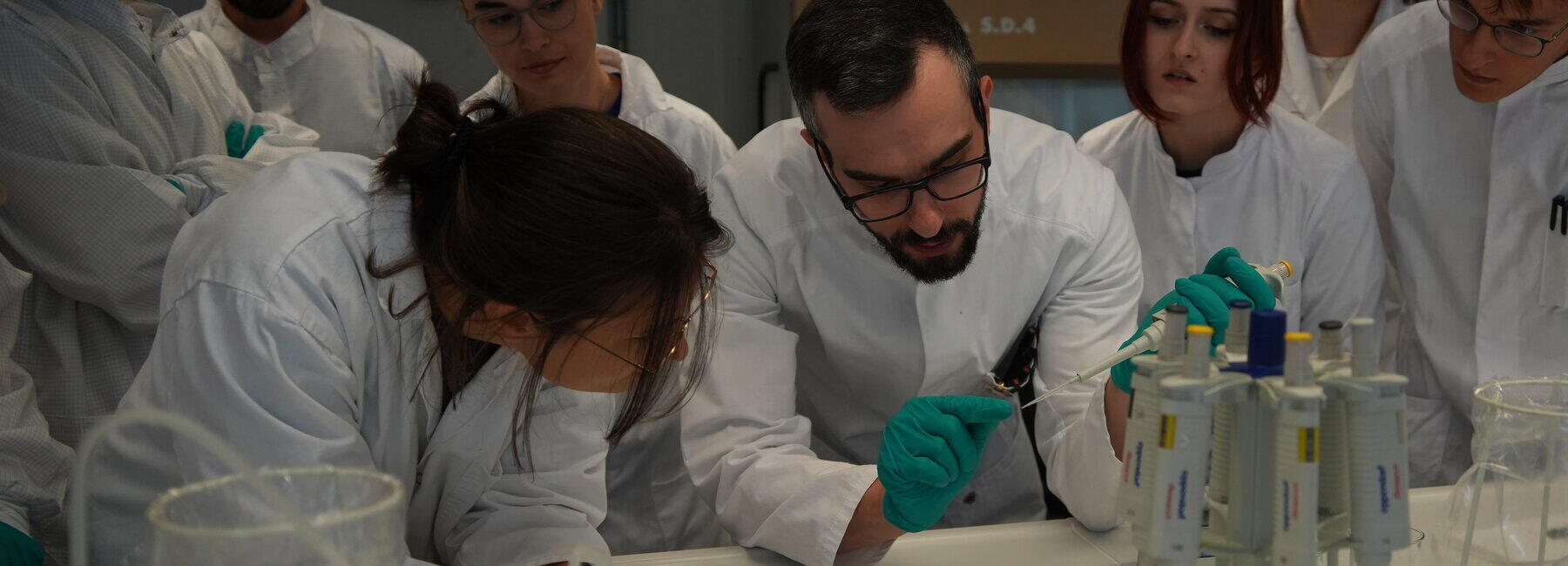
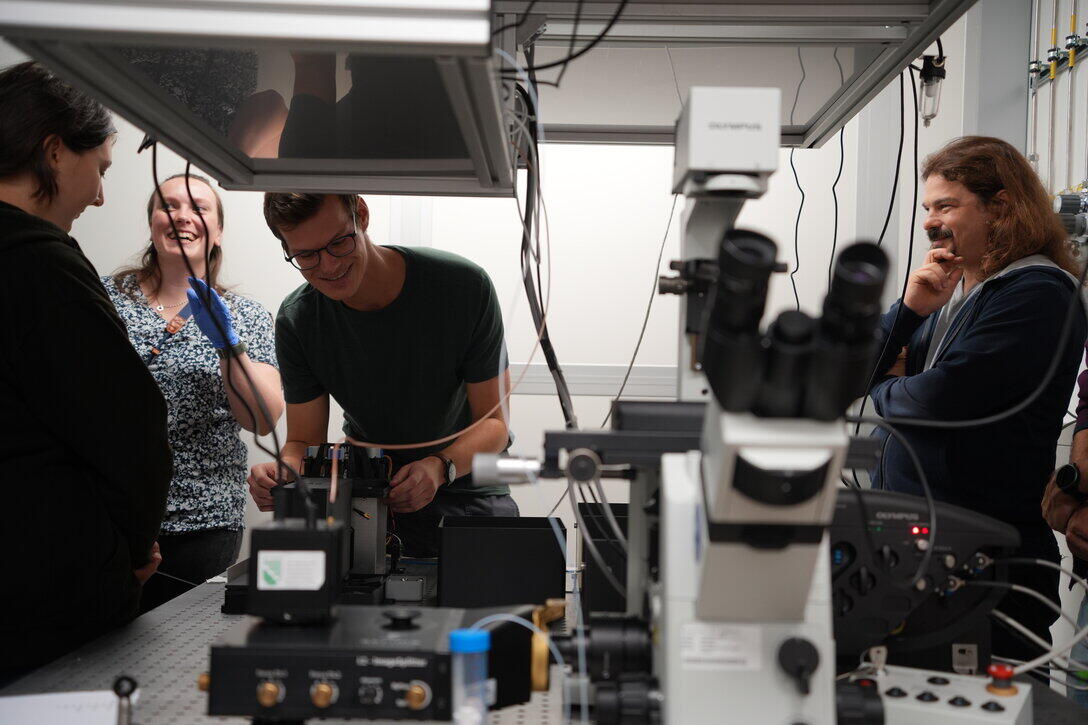
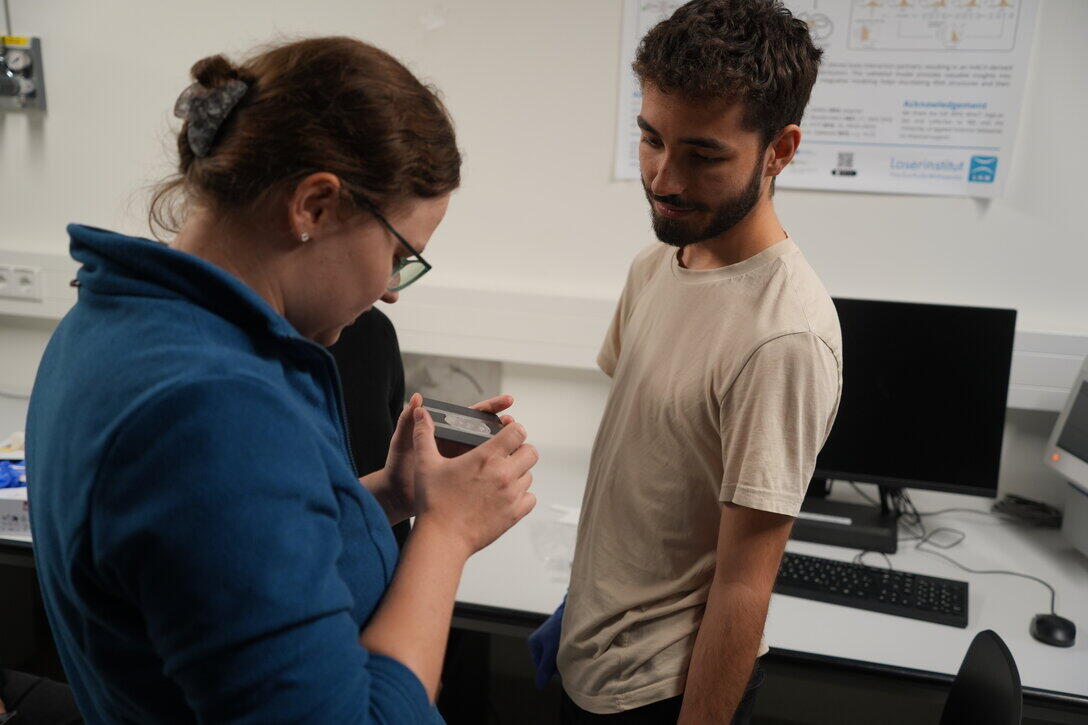
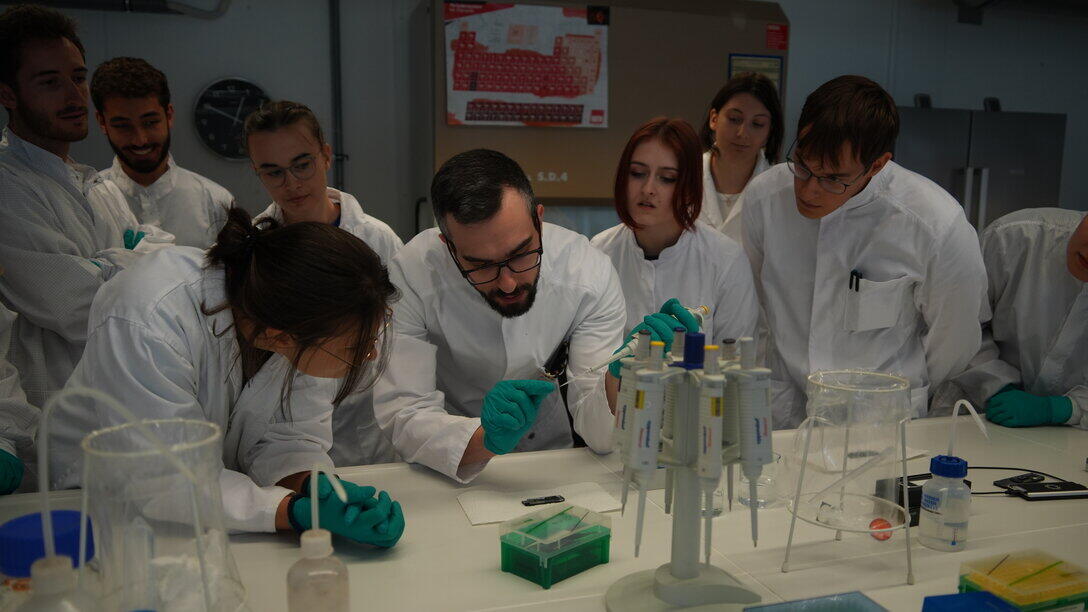
Armed with this basic knowledge, the group headed to the laboratory with Vanessa Reimann and Josephine Meitzner. The participants were then able to see, through two experiments, the different ways in which samples can be processed and analysed in diagnostic systems. The first experiment focused on the microfluidic chip developed in-house. It was prepared for measurement, filled with a dye sample and then analysed using fluorescence lifetime imaging (FLIM). This enabled the participants to visualise where the sample was located within the chip and how it was distributed. Their own design had thus been transformed into a real experimental setup. The second experiment focused on sample preparation. This was carried out automatically via a pressure-controlled microfluidic system, before the prepared sample was analysed using single-molecule measurements. This made it clear that, for point-of-care systems, it is not only the actual detection that is crucial, but also the question of how samples can be prepared as reliably and automatically as possible. However, a measurement carried out in the laboratory does not, in itself, provide an interpretable result. In the subsequent workshop on data analysis, the recorded data was used to create a visual representation of the filled chip. The participants analysed the data themselves and were thus able to trace the process from the sample through the measurement to the result.
Insights into DNA sequencing
The micro-project was completed with the analysis of the measurement data – but the question of how diagnostics might work directly at the point of care in future went beyond that. The participants were introduced to another area of application: DNA sequencing. New techniques such as nanopore sequencing open up the possibility of reading genetic information in an increasingly compact and decentralised manner.
Together with Nils Schön from Professor Röbbe Wünschiers’ research group, the participants prepared a sample for sequencing and then initiated the measurement using a commercial microfluidic sequencing system. It became clear that it is not only the actual analysis, but every preparatory step, that determines how well a method can later be automated and integrated into a point-of-care system. DNA sequencing thus provided a fitting conclusion to the topic of biosensor technology. It demonstrated once again how closely sample handling, microfluidics, sensor technology and data analysis are interlinked – and why different specialist disciplines must collaborate when developing point-of-care systems.
Science meets community
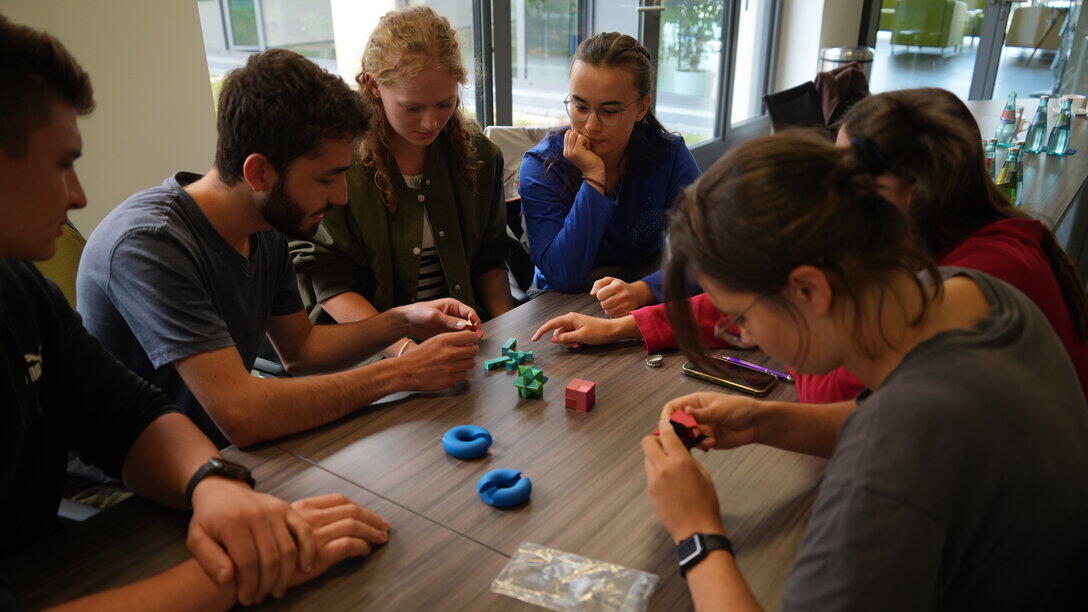
As well as laboratory work and specialist presentations, there was also plenty of opportunity for personal interaction. In the mini pub quiz, three teams of students competed against the lecturers and organisers. With a slight edge in experience, the lecturers’ team secured victory. However, the symbolic prize – a tin of biscuits – was passed straight on to the runners-up.
The days at the Laser Institute drew to a close with a barbecue for everyone, featuring conversations, card games and plenty of opportunities for networking.
Outlook
However, that was not quite the end of the Summer School. On the final day, attention turned to the last stage of the development chain: regulatory matters and the market. After all, even a technically functional point-of-care test must meet regulatory requirements before it can become a market-ready product. This brought the Summer School full circle – from the initial microfluidic concept to the approved product. The next Summer School is already scheduled for 16 to 27 August 2027 – save the date!
About the EDUCARE Summer School
The Summer School is part of the EDUCARE project within the DIANA Alliance. The project is funded by the BMFTR as part of the ‘WIR! – Change through Innovation in the Region’ programme. Participants include the Laser Institute at Mittweida University of Applied Sciences, Chemnitz University of Technology, the Fraunhofer IWU in collaboration with the VEMAS Innovation Network, and the Fraunhofer IZI. A heartfelt thank you to everyone involved – the speakers, organisers and participants – and in particular to Professor Röbbe Wünschiers’ research group for their support during the two days at Mittweida University of Applied Sciences.