This page was translated automatically using artificial intelligence (DeepL). The German version is binding. More information about automatic translation
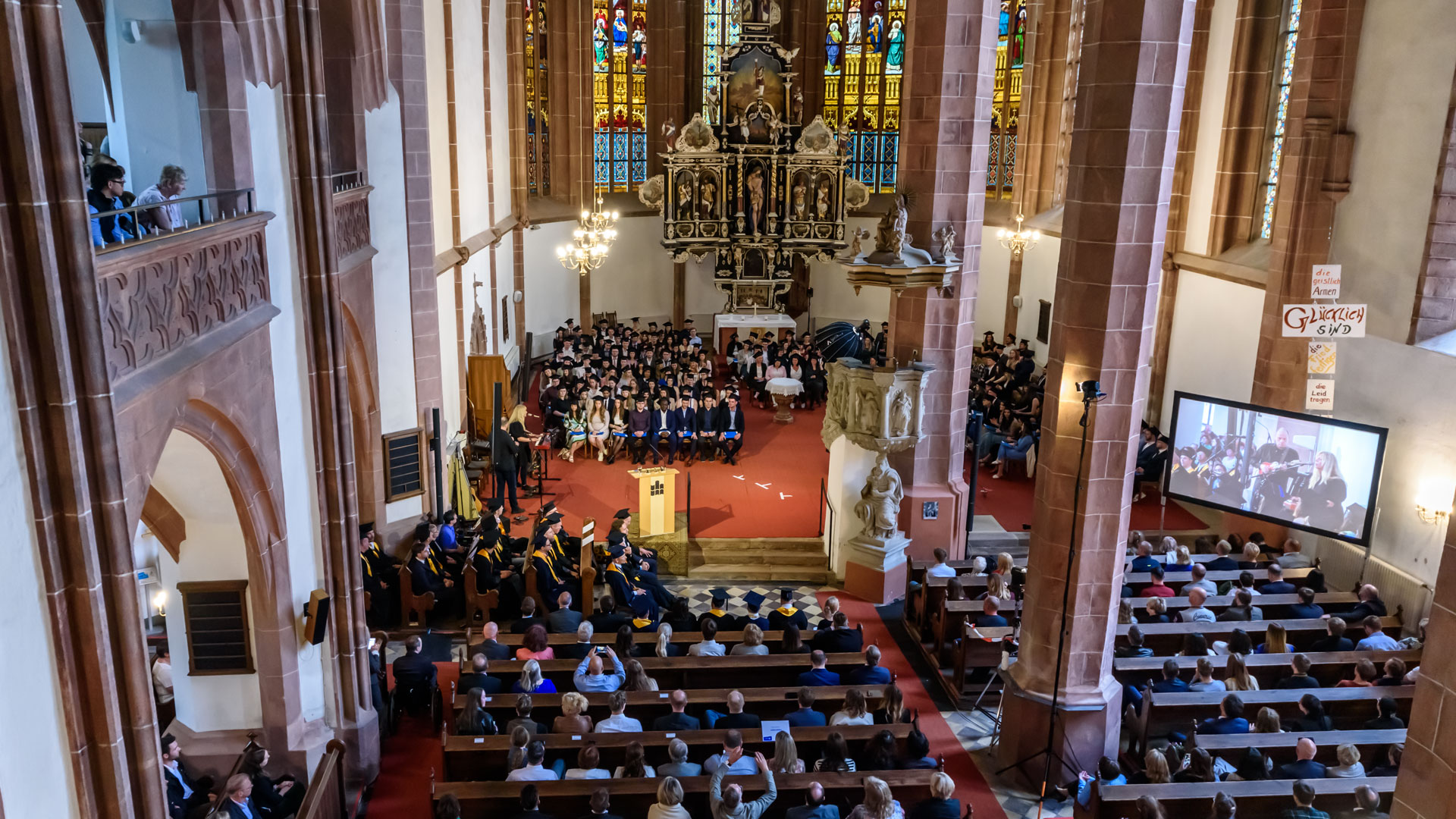
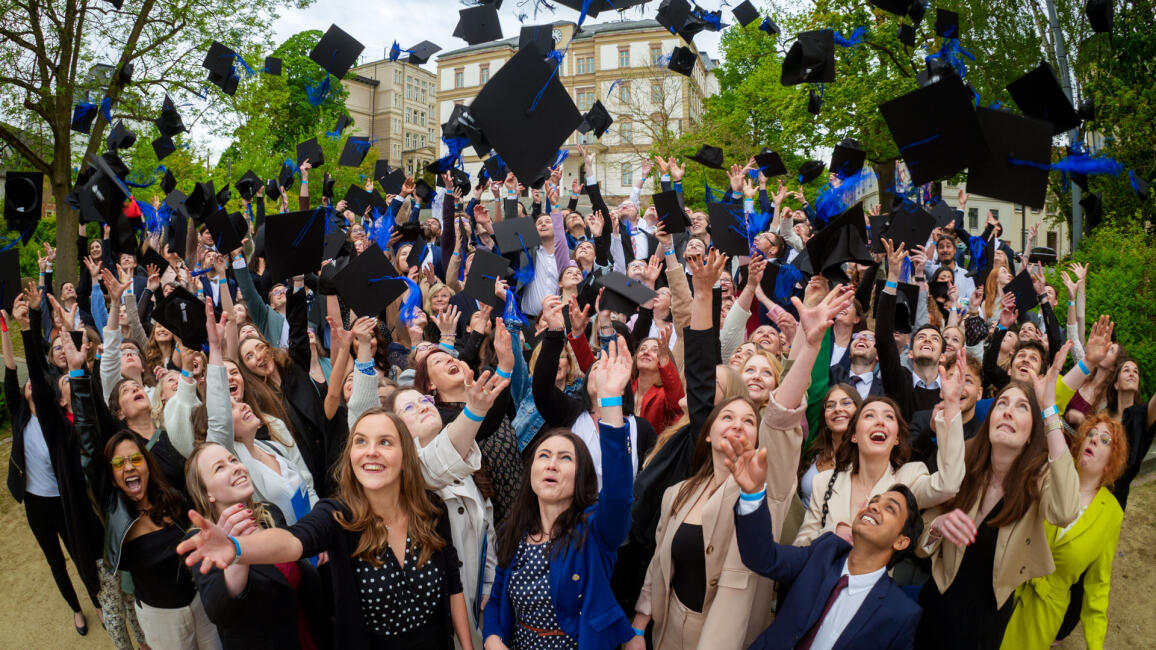
Even though the scenes may seem similar – it’s never quite ‘the same procedure as every year’ when Mittweida University of Applied Sciences celebrates its new graduates. Today, 210 of them, accompanied by around six hundred family members, gathered at the Evangelical Town Church. For each and every one of them, it was a special, and probably once-in-a-lifetime, moment: to be congratulated and ‘looked after’ by their lecturers after successfully completing their studies.
The “ceremony” at Mittweida University of Applied Sciences was, once again, something special. It always celebrates itself, and rightly so – and this time with 624 good reasons to do so. That is how many graduates it sent out into professional or further academic careers between early October 2023 and late March 2024. The Graduation Ceremony (Feierliche Exmatrikulation) therefore also symbolises the fact that lecturers and staff in the faculties and university management have helped the university to successfully fulfil its primary mission: to provide students with an academic education and guide them to graduation. Among them are not only young people – the youngest graduate is 21 years old – but also the two oldest graduates, aged 55, who are setting out towards a new future with their degrees from Mittweida.
Freedom and Responsibility
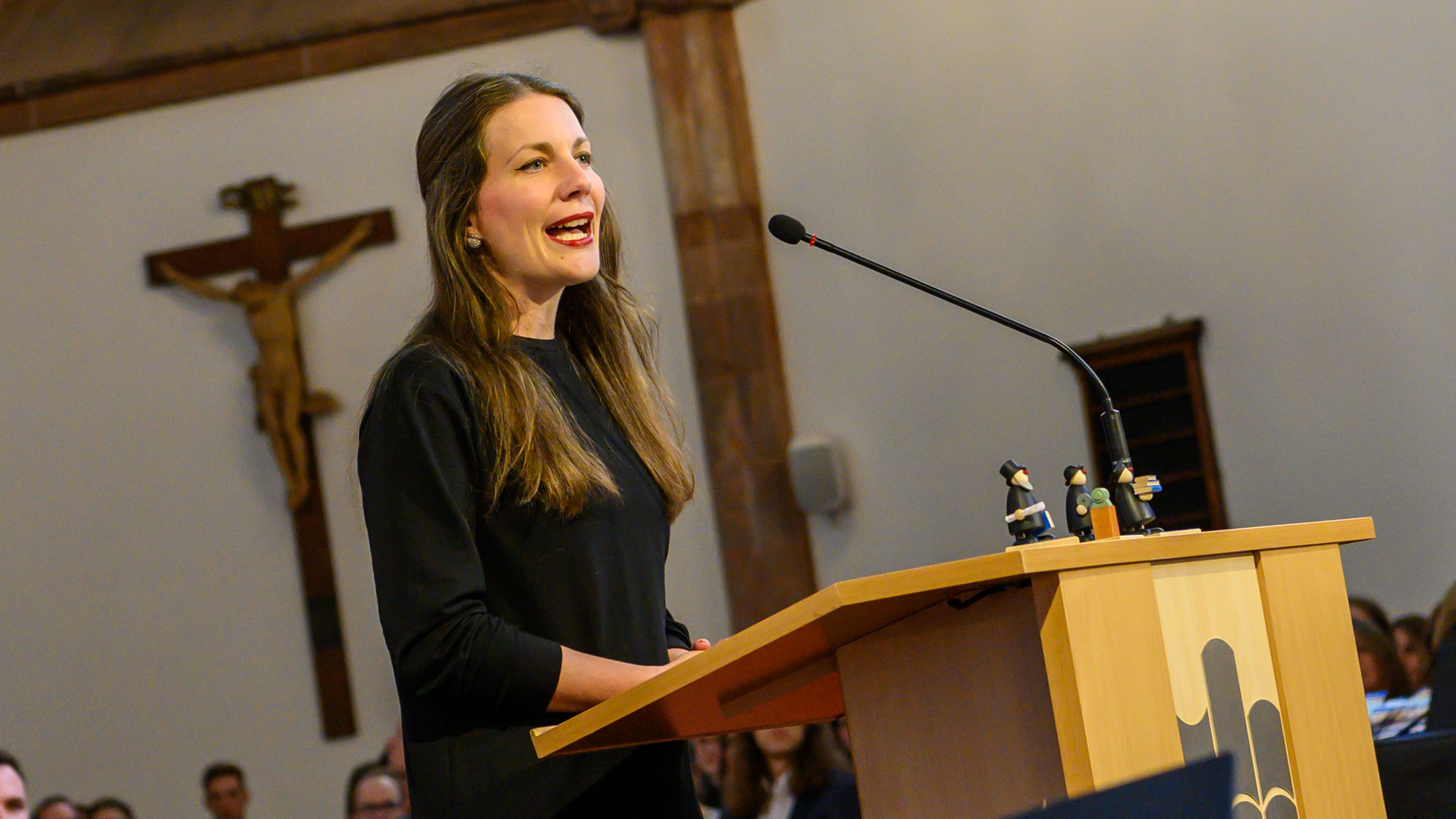
The Protestant student chaplain, Nina-Maria Mixtacki, welcomed the congregation gathered in the packed nave with a passage of wisdom from the Apostle Paul, which he shared with the young Christian community in ancient Corinth some 2,000 years ago: “Everything is permissible for me, but not everything is beneficial. Everything is permissible for me, but I will not be mastered by anything.” (1 Corinthians 6:12) Corinth “was a very diverse society, and there was a great struggle to live together harmoniously. Much like today, in fact”. Mixtacki unambiguously applied Paul’s admonition to the here and now: “Of course, I am free to vote for whoever I want in the upcoming elections. But perhaps not everyone on the electoral list serves the best interests of us all. For there are parties who think they are allowed to do anything.”
Quoting Nelson Mandela’s words, “The time has come to accept in our hearts and minds that with freedom comes responsibility”, the vicar encouraged the graduates: “We all have freedom, but we must exercise it responsibly. You are free to do anything. Use that freedom for good. Remember the responsibility that comes with your opportunities.”
“Follow the Yellow Brick Road”
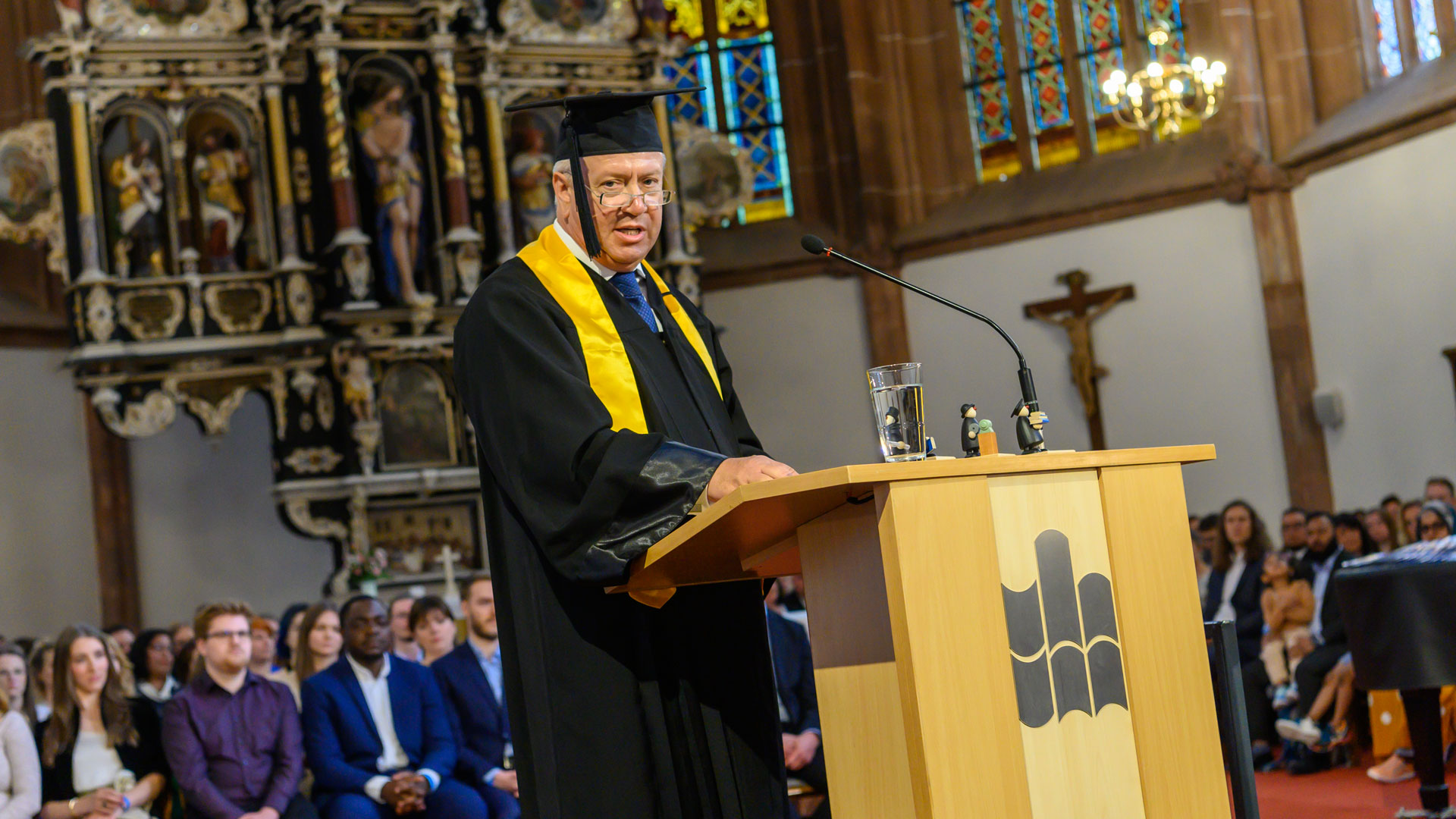
Keynote speaker Professor Peter Hehne, Honorary Professor of Criminalistics and Criminology at Mittweida University of Applied Sciences and former Chief Detective Superintendent at the Thuringian State Criminal Police Office (LKA), provided fascinating insights into his 44-year career as a criminal investigator in two different social systems.
He succeeded in translating his own experiences into words of encouragement for the graduates, whether these concerned staged flat burglaries or even untrue statements – which are not, however, lies: “Don’t assume there’s a hidden agenda behind every false statement. Stay open-minded and approachable; be optimistic, but at the same time keep a clear head,” because people tell untruths for various reasons. “The people for whom we solve crimes, and our love for the profession, are great driving forces. It is important that you, too, enjoy what you do. Do it conscientiously and as part of a team. Derive satisfaction from your work. That will make you successful.”
A visiting scholarship at the FBI National Academy in Quantico, Virginia (USA) in 1996 not only provided Hehne with professional development and sporting success from the weekly Challenge Run, but also an international network of colleagues – and, in the meantime, friends – that continues to this day. “Our time in Quantico, in the lecture theatre and on the Challenge Run, was our Yellow Brick Road – which you may recognise from my favourite children’s film, *The Wizard of Oz*. I hope that, like Dorothy, you can walk the Yellow Brick Road of your life with confidence. Set yourself goals in life and overcome obstacles.”
They are a special year group
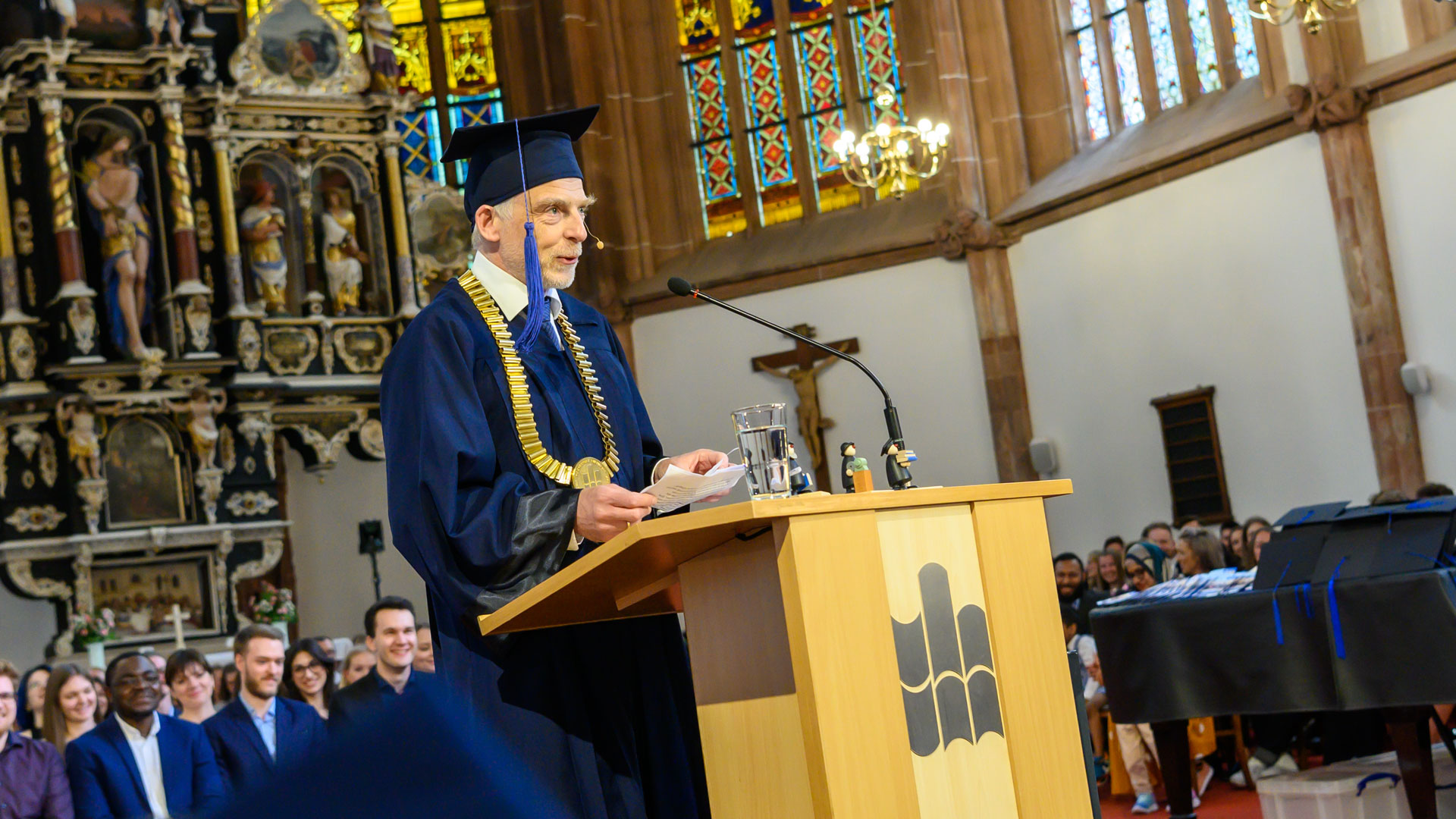
Before the congratulations and the throwing of hats, there was the official academic send-off by the Vice-Chancellor, Professor Volker Tolkmitt. He admitted that he tells every graduating class at every Graduation Ceremony (Feierliche Exmatrikulation): “You are a special cohort!”, but he assured them: “You are a special cohort because you have written your own story during your studies, because you have added your own chapter to the chronicle of our university family!” This chapter also includes the pride we take in the fact that, during the Covid-19 pandemic, “together we tried out many new approaches to teaching and learning, demonstrated flexibility and adaptability, and successfully overcame the challenges”.
Even if, after leaving Mittweida, your time in the lecture theatre, the laboratory and the students’ club takes on a nostalgic glow, the Vice-Chancellor said, “we ask you not just to remember, but to come back from time to time – as alumni or as a partner representing your company, as a lecturer, or as a researcher”. And finally: “I am formally removing you from the community of students, lecturers, researchers and academic support staff at Mittweida University of Applied Sciences… You remain part of the university family, but make sure you get out there and go out into the world!”

Outstanding dissertations
The Graduation Ceremony (Feierliche Exmatrikulation) is a good opportunity to recognise outstanding final-year projects. The Carl-Georg-Weitzel Prize, worth one thousand euros and named after the first director of the Mittweida University of Applied Sciences, was awarded today to two graduates from the Faculty Media Sciences.
The same faculty – but completely different topics: ‘Communication and recruitment for civic engagement in rural areas of Saxony’ is the title of Stefan Kirsten’s award-winning Master’s thesis. Kirsten studied ‘Media and Communication Studies’ and investigated how civic engagement can be strengthened. Based on his findings, he drew up a twelve-point practical guide for recruiting young people in organisations.
The second prize-winner, Vincent Ritter, is a graduate of the Bachelor’s degree programme in ‘Media and Acoustical Engineering’. In his thesis, ‘Virtual Reality (VR) Tools in the Practice of Room Acoustics Design’, Ritter set out to use VR headsets and headphones not only to visually represent real rooms, but also to enable the acoustic experience of the different sounds produced by real and simulated sources within the room. Ritter successfully implemented his ideas in practice using the Blaibach Concert Hall in the Bavarian Forest as a case study, with the aid of the Unity development environment, which is well known in the gaming sector.
Please pay
Two women and two men each graduated with the top mark of 1.0. The overall average was 1.9. HSMW is celebrating 22 double degrees, including six from Ukrainian graduates. A total of 161 international graduates are receiving a graduation certificate bearing the HSMW’s blue logo. That is a quarter of the total. The most common qualification awarded was the Bachelor’s degree: 359 in total, followed by Master’s degrees (140), diplomas (117) and certificates (9).
The Faculty Media Sciences produced the highest number of graduates: 162. This was followed by the Faculty of Industrial Engineering (151), the Faculty of Applied Computer Sciences and Biosciences (124), Faculty Engineering Sciences (97) and the Institute for Knowledge Transfer and Digital Transformation (IWD) (6). The Faculty of Social Sciences was not overlooked, but it deserves special praise, as it provided the largest group in the church today: 55 of its 84 graduates attended. Consequently, the chancel had a more female presence than might have been expected given that men account for around 57 per cent of all HSMW graduates.