This page was translated automatically using artificial intelligence (DeepL). The German version is binding. More information about automatic translation
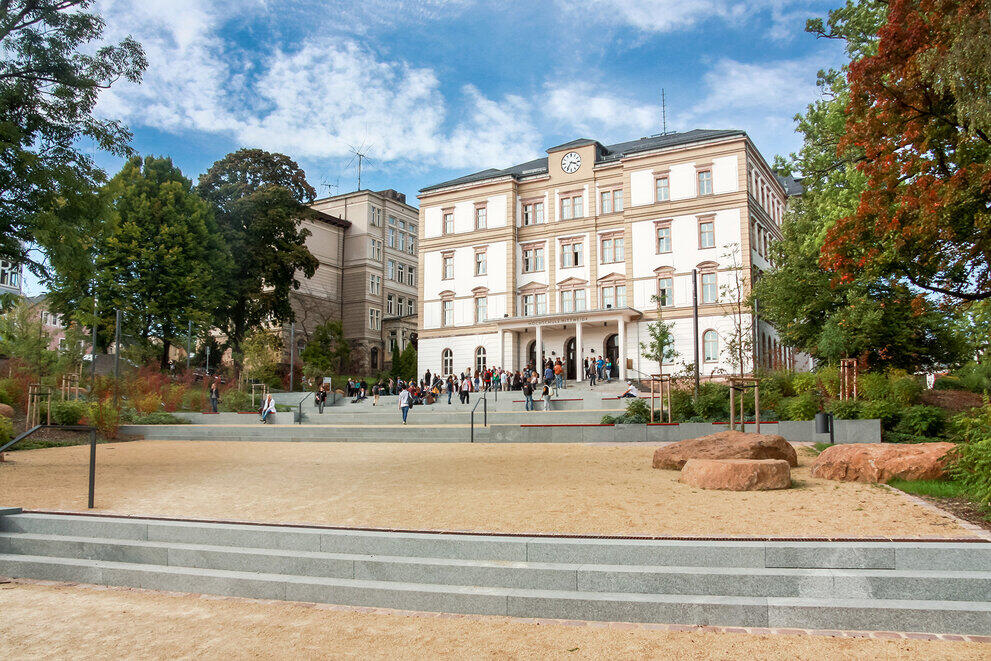
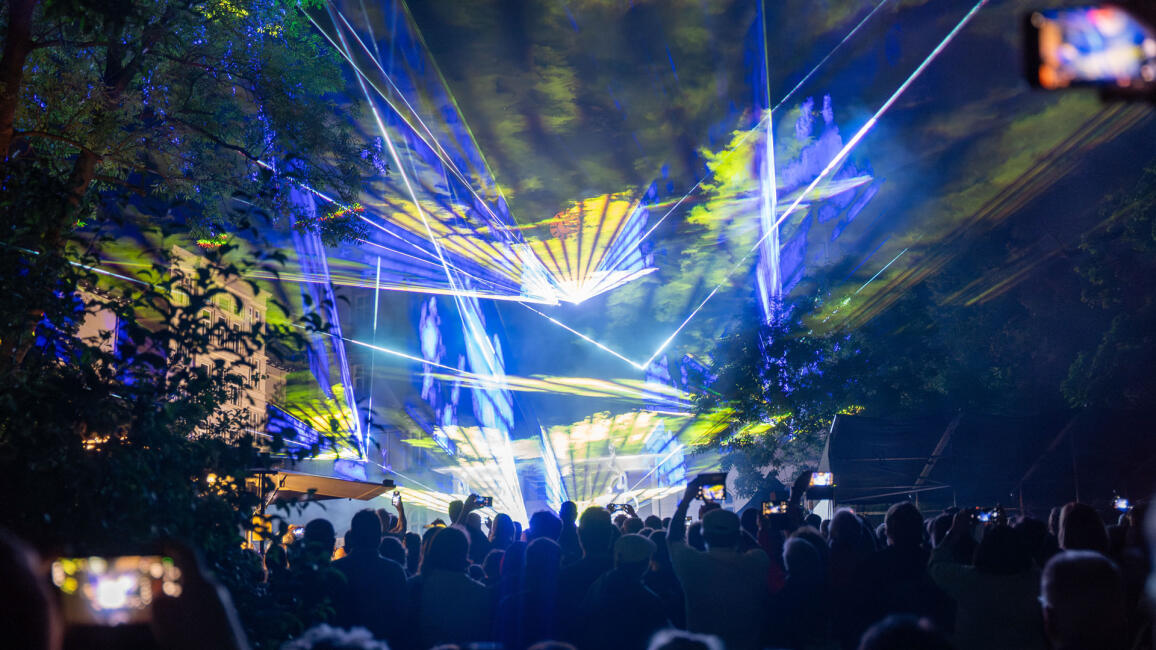
Mittweida had never seen anything like it before: a birthday celebration in the form of a huge open-air event on Technikumplatz, featuring the Firebirds, the Physikanten and a night-time laser show. Rock ’n’ roll, physics and light art – it all went down a treat for the 50th anniversary of the star of the show: laser research in Mittweida.
On Thursday 19 June, the Laser Institute at Mittweida University of Applied Sciences (LHM) celebrated ‘50 Years of Laser Technology in Mittweida’ together with the entire university and people from the local area – with free admission. Professor Alexander Horn, Director of the LHM, explains why they didn’t just celebrate amongst themselves: “We combine cutting-edge laser research with laser applications, many of which benefit people in their everyday lives. That is another reason why we are not celebrating in an ivory tower, but alongside the local community. It may come as a surprise, but lasers, for example, make artificial hip joints more durable and surfaces dirt-repellent. In the relatively new discipline of Biophotonics, we specifically harness the effect of light – which is essentially what a laser beam is – on biomolecules. It is a vital tool for the development of medicines. But laser expertise from Mittweida is also found in the aerospace sector.”
Around 1,400 people accepted the invitation and enjoyed an exciting, entertaining and lively evening in glorious summer weather. The impressive laser show, featuring nine projectors, also had an educational element: guests at Technikumplatz learnt a great deal about the history of Laser Technology and laser research at Mittweida University of Applied Sciences.
In the early 1970s, the first laser laboratory was established at what was then the Mittweida University of Applied Sciences. It was one of the first in Germany to focus on this relatively new and promising technology, and following reunification, it was one of the few research institutions in the new federal states that managed to hold its own.
Since the 1990s, laser research in Mittweida has enjoyed growing success in reunified Germany. Today, the Laser Institute at Mittweida University of Applied Sciences (LHM) ranks among the top ten laser research institutes in Germany – with more than 3.5 million euros in third-party funding annually.
In 2010, the HSMW was awarded the contract for the federally funded research building on the Schillerberg in Mittweida, worth 21 million euros, plus an additional 5 million euros for new large-scale equipment. It was the first-ever new research building at a University of Applied Sciences (UoAS) to be funded by the federal government.
At the birthday reception held on the afternoon of 19 June in the TV studio of Mittweida University of Applied Sciences, the history of laser research in Mittweida came to life. People who had witnessed events over the past 50 years took to the stage to share anecdotes. All six current professors at the LHM were also given the opportunity to take to the stage to present their research in short talks and offer a glimpse into the future. (The talks from the pitch will be published shortly in the ‘Fokus-Forschung’ series at irregular intervals.)
Professor Alexander Horn, Director of the LHM, said this afternoon: “The 50th-anniversary celebrations are an opportunity to look back on the significant achievements and, at the same time, to look ahead to future developments in this exciting field. They also provide a platform for strengthening collaboration between science, industry and education and for fostering new partnerships.”
The following speakers offered their congratulations: Saxony’s Minister-President Michael Kretschmer in a short video message. Rector Professor Volker Tolkmitt, the new State Secretary at the Saxon Ministry of Science, Professor Heike Graßmann, and the Mayor of Mittweida, Ralf Schreiber, spoke at greater length live in the studio.
The Vice-Chancellor of the HSMW traced the history of laser research and emphasised that the early successes laid the foundations for the second, and greater, success story in laser research following 1990. Tolkmitt said, ‘This brief look back […] also shows that this is not simply an anniversary of research, but […] demonstrates the curiosity and spirit of innovation at this university – the drive to explore new areas of research, to pursue them tenaciously, to develop them across generations, with a strong determination to breathe life into this identified field of research – and then to measure ourselves against the best. That is something that sets this university apart […]. That is the real reason to celebrate.”
State Secretary Professor Heike Graßmann had only just been introduced to the HSMW and the LHM a few hours earlier. She was very impressed and sounded thoroughly convinced when she said: “In this way, the Laser Institute has not only become an outstanding part of Mittweida University of Applied Sciences […]. It is […] one of the leading research institutions in Laser Technology in Germany and, crucially, it is also recognised worldwide for this. It has thus simultaneously […] secured its firm place in Saxony’s science and research landscape. Your commitment and your foresight […] have contributed to Saxony being a centre of cutting-edge research and technological excellence today. Through your projects and partnerships, you are raising the Free State’s profile in the international competition in science and technology.”
Since 2016, six professors, now joined by over 50 researchers, have been working in the LHM’s new research building on Mittweida’s Schillerberg, investigating the fascinating applications of lasers in industry, medicine and space travel. The LHM combines both: basic research – which is atypical for an UoAS – and application-oriented research – which is typical of such institutions – in close collaboration with industry. This is evidenced by numerous patents, a large number of research projects and numerous successful spin-offs.
It was precisely this economic impact of laser research at Mittweida University of Applied Sciences on the town and the region that the Mayor of Mittweida felt it was important to emphasise. He listed all seven spin-off companies and highlighted the sustainable and modern jobs they had created. “This will sustain us into the future,” said Ralf Schreiber, suggesting that the town could in future also call itself “Mittweida – University of Applied Sciences and Laser City”.
Research at the LHM is based on two pillars: on the one hand, laser nano- and microtechnology; and on the other, high-rate technology – that is to say, on the one hand, working on a scale of one millionth of a millimetre, and on the other, working at extremely high speeds of over one kilometre per second. One or both of these technologies can be found in all fields of laser technology, be it in laser-based additive manufacturing, laser pulse ablation, laser micro-machining, laser bionics, Biophotonics, ultra-fast measurement technology, or in digital optics and EUV imaging using extreme ultraviolet radiation.
In spring 2025, researchers at the LHM also succeeded for the first time in producing a metal component approximately two metres long using powder-bed-based 3D Printing. This was made possible by the latest development from the LHM: the macro-SLM process (Selective Laser Macro-Melting), which melts metal powder using a laser beam to build up the component layer by layer. This enables large-volume components to be printed from metal very quickly and cost-effectively.
The birthday celebrations were preceded on 18 and 19 June by a two-day specialist conference, the 14th Mittweida Laser Conference. The conference attracted over 120 experts from academia and industry, who presented their research findings and their practical applications in numerous talks and scientific posters. Highlights of the conference included the keynote speeches by Professor Markus Gräfe from Darmstadt Technical University, who spoke on quantum imaging using undetected light, and by Dr Anna Ziefuß from the University of Duisburg-Essen, who explained in her presentation how laser-generated nanoparticles enhance 3D Printing.
In addition to the scientific presentations, the conference also served as a platform for exchange between early-career researchers and established experts. At the networking evening on Wednesday, held at the Laser Institute building in summery temperatures, participants were not only able to renew existing contacts but also to initiate new collaborations in a relaxed and informal setting. This mix of technical input and personal discussions was also appreciated by the corporate exhibitors, who presented their products and services in the field of laser technologies. The Mittweida Laser Conference takes place every two years, alternating with its ‘sister conference’ at the Ernst Abbe University of Applied Sciences in Jena; the next one is expected to be held in autumn 2027.
Text: Helmut Hammer
Photos: Jacob Golde, Helmut Hammer