This page was translated automatically using artificial intelligence (DeepL). The German version is binding. More information about automatic translation
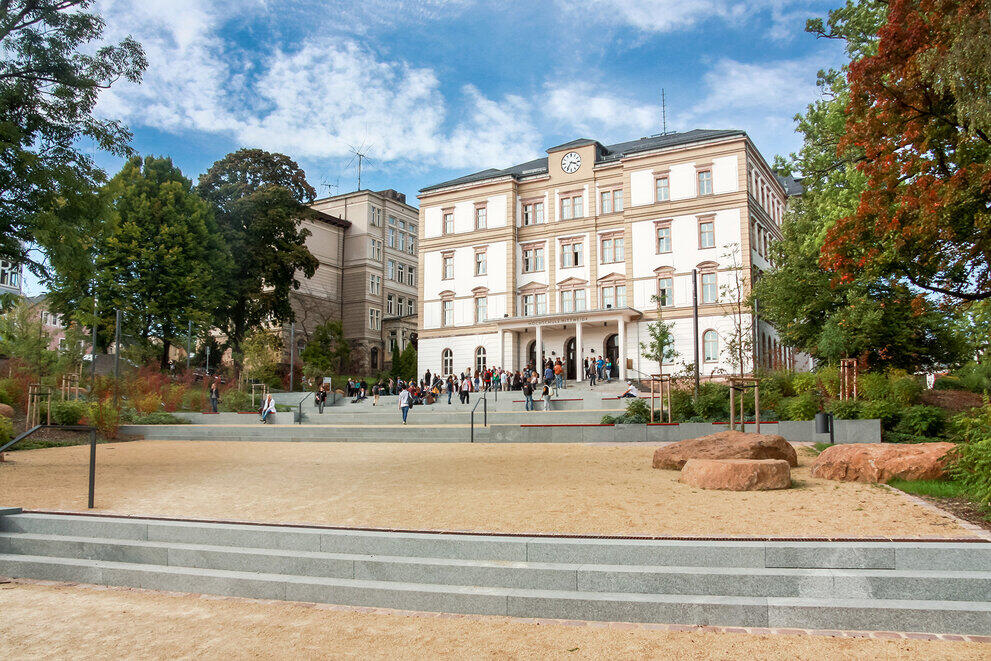
On 14 June 2023, the 10th Central German Forum on ‘3D Printing in Practice’ took place at the Leipzig University of Applied Sciences. The forum is organised annually by the Ernst Abbe University of Applied Sciences in Jena, Merseburg University of Applied Sciences, the Faculty Engineering Sciences at HTWK Leipzig and Mittweida University of Applied Sciences.
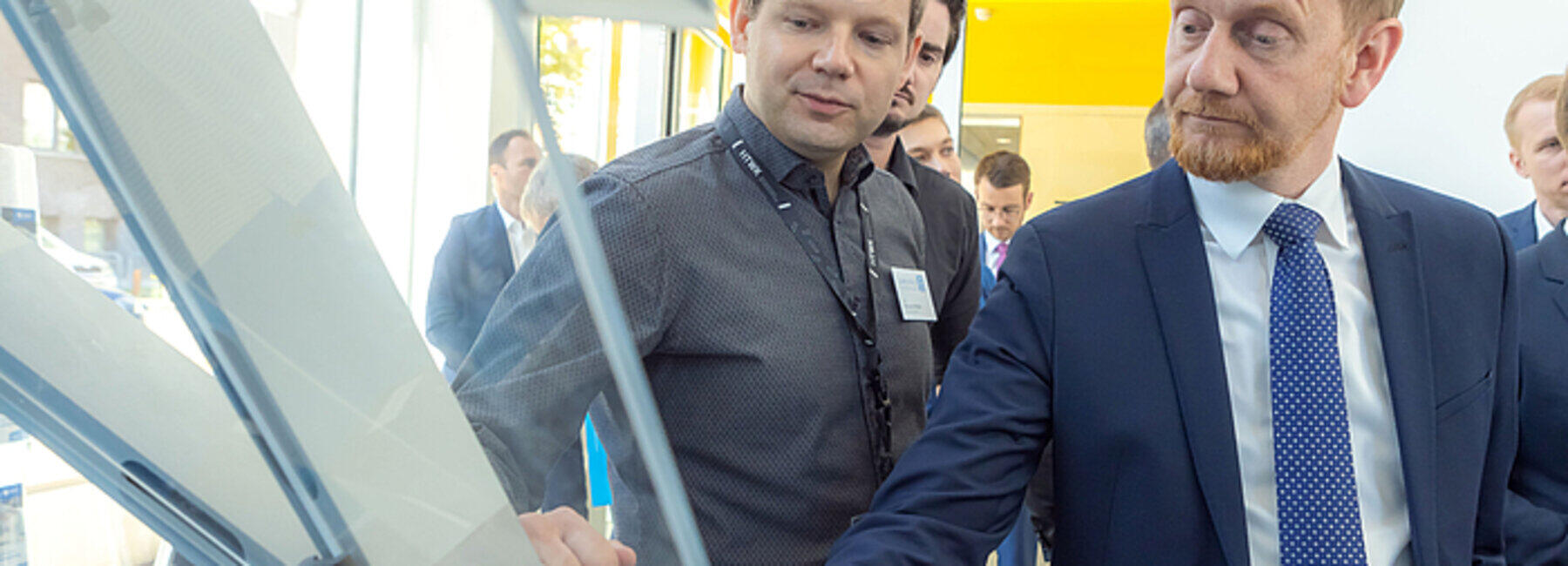
The Laserinstitut Mittweida University of Applied Sciences (LHM) was present with a joint stand alongside its project partner, the FLEX research group at HTWK Leipzig. They brought with them the InNoFa demonstrator, a two-by-three-metre section of a façade structure. This consists of 44 standardised hollow profiles and twelve additively manufactured, individually shaped aluminium node connections. Acrylic panels, each with their own unique geometry, replace the glazing elements in the model and ‘close off’ the façade. This façade segment is intended to demonstrate the benefits and potential of this innovative approach to companies in the construction sector. The demonstrator was developed in collaboration between FLEX and LHM as part of the Saxony5 transfer network. Meanwhile, not all the joints are now manufactured from aluminium using conventional selective laser melting (SLM); instead, the first stainless steel joints have already been installed, produced using macro-SLM, a newly developed process by the Laser Institute at Mittweida University of Applied Sciences.
At the stand shared by the two universities, Saxony’s Minister-President Michael Kretschmer also saw for himself the project partners’ strong research performance during a discussion with Prof. Alexander Stahr (FLEX, HTWK Leipzig) and Michael Pfeifer (LHM).
The FLEX research group at HTWK Leipzig is conducting research into resource-efficient, smart and efficient load-bearing structures, such as optimised façade and roof structures. This requires custom-made joints, which only makes economic sense when produced using additive manufacturing. As conventional 3D Printing processes are too costly, the LHM has developed the new Macro-SLM process. This process enables powder-bed-based 3D Printing of large-volume metal components. A coarse powder (particle size: > 200 µm) is used, which is fused using high-power laser energy. This enables the cost-effective, bespoke manufacture of the joints. Furthermore, the process also offers great potential for the additive manufacturing of significantly larger components. A demonstrator system with a build volume of four cubic metres is currently being developed at the LHM.
However, research into laser-based additive manufacturing at the Laser Institute of Mittweida University of Applied Sciences is not limited to the macro scale. For many years now, micro 3D printing has been one of the institute’s flagship areas of research. Research in this field is also continuing steadily, and the latest findings were presented in the form of a talk by Laura Römer at the forum.
Text: Michael Pfeifer Images: Swen Reichhold (1), Laser Institute at Mittweida University of Applied Sciences (2)
This article first appeared on the ‘Focus on Research’ page of Mittweida University of Applied Sciences.