
This page was translated automatically using artificial intelligence (DeepL). The German version is binding. More information about automatic translation
Publishing in Open Access
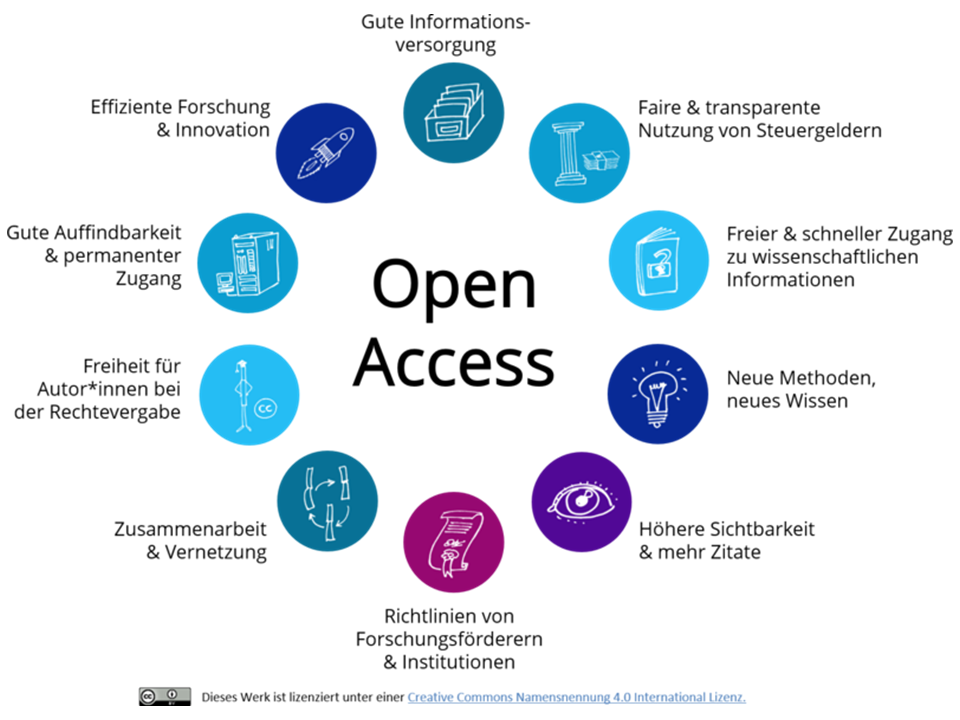
Open Access refers to free and unrestricted access to academic literature on the internet. The Open Access movement, which emerged in the 1990s as a result of the journal crisis and the rapid development of the internet, aims to make the results of publicly funded research freely accessible and reusable by all interested parties, without financial, legal or technical barriers.
Mittweida University of Applied Sciences promotes Open Access in accordance with the Berlin Declaration on Open Access to Knowledge in the Sciences and Humanities. Open Access not only enables worldwide, direct, rapid and free access to academic publications, but also increases the visibility and impact of researchers, allows authors to retain legal control over their own work, and at the same time transforms the markets for academic information – Mittweida University of Applied Sciences’ Open Access Strategy
As an active advocate for Open Access, the HSB supports the Open Access movement and assists researchers at Mittweida University of Applied Sciences with their publishing. The HSB offers the following services in the field of Open Access:
- identifies and connects authors with suitable journals
- provides advice on open access publications, contractual issues and terms
- plans and manages open access publication funds
- provides infrastructure for secondary publication on MOnAMi
Why publish via Open Access?
First things first: scientific research is largely publicly funded.
The current publication system, in which publishers place the results of such publicly funded research behind a paywall, means that even many researchers have no access, or only limited access, to this research, thereby hindering scientific progress. Open Access not only creates transparency and access for all, but also brings significant benefits to authors:
Open Access increases the visibility and citation frequency of research findings.
Through Open Access, anyone can read research findings without any barriers. Thanks to the removal of these barriers, research findings in open-access publications can be found quickly. This simultaneously increases the visibility of authors’ academic work and offers them the opportunity to network with more researchers within the academic community.Open Access enables authors to retain the rights and control over their own work.
In contrast to traditional publishing (closed-access publishing), open-access publishing allows authors to determine for themselves how others may use, distribute or adapt their works (see Creative Commons licences). This means that publications can then be easily and quickly disseminated and reused in accordance with the terms they have set.
On the other hand, the transformation of the academic publishing system presents a variety of challenges. Above all: whilst access to content is free of charge, publishing via Open Access usually incurs a fee. The HSB provides financial support to HSMW researchers through the Open Access Publication Fund and via publishing agreements.
The HSB’s Open Access team will be happy to provide initial guidance on choosing your publication venue or publication type (see, for example, Open Access publication routes).
Have you already published your research findings in non-open-access journals? You still have the option of making them freely available as ‘green open access’.

- Publication in open-access journals
- Subject to a fee (APC, Article Processing Charges)
- Beware of predatory journals!
Gold Open Access (or the ‘golden route’) refers to the initial publication of a paper in an open-access journal. This incurs publication costs in the form of APCs (Article Processing Charges).
The open-access model that does not require authors to pay APCs is known as Diamond Open Access.
Please be aware of so-called predatory journals when choosing a journal! You can use the web tools listed below to take precautions to avoid such dubious journals.
Web tools for Gold Open Access publishing
- Directory of Open Access Journals (DOAJ): a directory of quality-assured Gold and Diamond Open Access journals
- B!SON: Search tool for finding an open-access publication venue based on the content of a manuscript (provided by the TIB Hannover and SLUB Dresden)
- oa.finder: Search tool for open-access journals and APCs (provided by Bielefeld University Library, as part of the BMFTR-funded collaborative project open-access.network)
Funding opportunities
The Open Access Publication Fund is available to HSMW authors who have no, or insufficient, funds for open-access publication from faculty budgets, project funds or third-party funding.

- Free publication in open-access journals
- Free of charge for both readers and authors
- The simplest and fairest form of open access
Diamond Open Access is a ‘sub-type’ of Gold Open Access: Diamond Open Access refers to a publication model that enables authors to publish their research findings in open-access journals free of charge.
This means there are no costs for either authors or readers, and the model is therefore regarded as the simplest and fairest form of Open Access.
The model is funded by institutional funds, funding bodies or library consortia. This funding enables the completely free publication and reading of academic works. As an active participant, the HSB contributes to the funding of several academic publications.
Links for Diamond Open Access
- Diamond Discovery Hub (DDH): Directory of quality-assured Diamond OA journals

- Secondary publication (self-archiving) as open access in institutional or subject-specific repositories, e.g. MOnAMi
- Free of charge
Green Open Access, or the ‘Green Route’, refers to secondary publication in an institutional or subject-specific repository. This form of Open Access is also known as self-archiving and is also possible for Closed Access publications.
In the case of secondary publication, the legal framework and publishers’ requirements must be observed. The key consideration is whether simple or exclusive rights of use were granted for the initial publication. If only non-exclusive rights of use were granted to the publisher at the time of the initial publication (as is often the case with open-access publications), re-publication by the author is, in principle, possible. If, on the other hand, exclusive rights of use were granted to the publisher (often the case with closed-access publications), the possibility of secondary publication must be assessed on the basis of the publishing contract. The following conditions are particularly important to bear in mind:
- Embargo period (the period after which secondary publication is permitted, usually between 6 and 12 months, sometimes up to 24 months)
- Version for secondary publication (preprint, postprint or version of record)
- Repository for secondary publication
- Reference to the original publication
- Licences
Green route – how and where?
- The online tool Open Policy Finder (formerly Sherpa Romeo) provides an overview of available options and conditions for secondary publication.
- Academics at Mittweida University of Applied Sciences have the option to publish their academic work on MOnAMi (Mittweida University of Applied Sciences’ publication server) – Publishing on MOnAMi
- The ‘Open Access in Academic Disciplines’ page on open-access.network also lists subject-specific repositories that are suitable for Green Open Access.

- Open-access publication in non-open-access journals
- Subject to a fee
- The HSB supports this model exclusively within the framework of transformation agreements
Some non-open-access (closed-access) journals offer the option of making an article freely available as open access (‘hybrid open access’). The costs involved are often higher than those for the gold open-access format.
On the other hand, some publishers charge a PAR fee (Publish-and-Read fee) as part of transformation agreements; this fee also guarantees access to the full texts of journals under the subscription model.
The hybrid open access model is controversial and is viewed critically due to the often higher costs compared with the gold route and the risk of double funding (funding for both the subscription and publication). This model is therefore not supported by the DFG or cOAlition S, unless it involves transformative agreements.
At the HSB, publications using the hybrid model without transformative agreements are therefore not funded from the Open Access Publication Fund.
Funding option
PAR fees (= publication costs in covered journals) can generally be funded by the HSB, provided the conditions are met. Please inform us at an early stage if you are planning to publish in these journals → Link to the internal page
Please note:
Costs are also incurred if, within the framework of transformation agreements, you have deliberately opted against open-access publication (= opt-out publications). In this case, the HSB cannot offer financial support and the costs must be borne by the authors themselves.- APCs for hybrid open-access publication without transformation agreements are not eligible for funding from the Open Access Publication Fund.
Creative Commons licences
HSB provides only non-binding information and guidance to help users understand the legal aspects of Open Access. No warranty is given as to the accuracy or completeness of any information presented here.
Open Access and usage rights
Open Access is not just about free access to literature, but also about the free use of academic works (e.g. printing free of charge, using the full text in teaching, uploading to platforms). In contrast to traditional publishing (closed-access publishing), where the publisher is granted exclusive rights of use, authors of open-access publications grant the publisher only non-exclusive rights of use and can then determine for themselves how others may use, distribute or adapt their works.
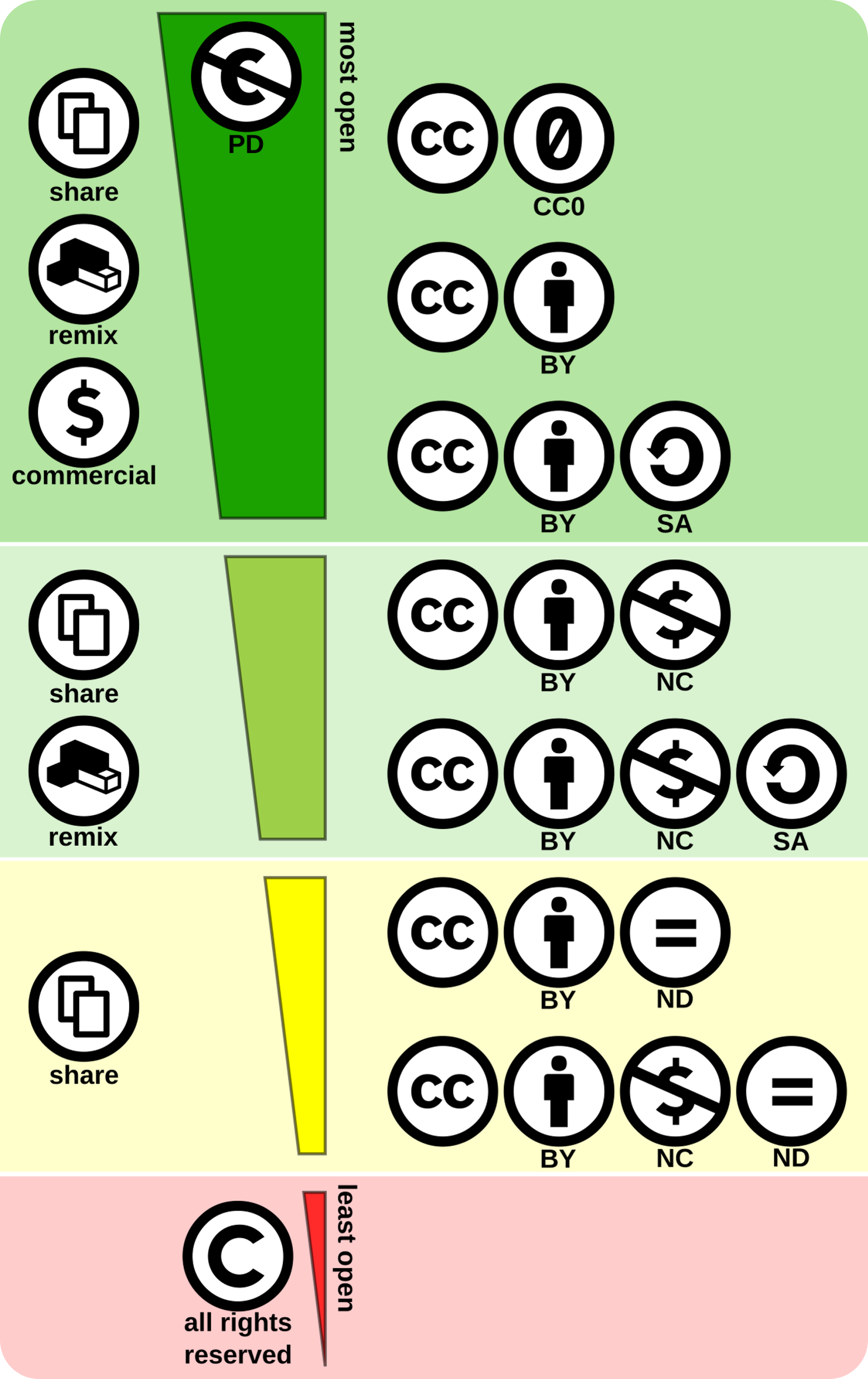
Creative Commons licences (CC licences) are used for this purpose in the academic sector. CC licences are globally recognised standard licences for granting rights of use for academic publications. They enable authors to grant rights of use in a straightforward manner, subject to their chosen conditions.
Video: Brinken, H., Hauss, J. & Rücknagel, J. (2021). Open licences for open science. open-access.network. DOI: https://doi.org/10.5446/52864 (CC BY 3.0 DE)
The individual elements of CC licences
- BY – Attribution
The author’s name must be credited. - NC – Non-commercial
The work may only be used for non-commercial purposes. - ND – No Derivatives
The adapted version of the work must not be distributed. - SA – Share Alike
Distribution is only permitted under the same licence as the original.
Six variants of the CC licences
- CC BY 4.0 – Recommendation from the HSB
Attribution is
mandatory Adaptation and redistribution permitted
Commercial use permitted - CC BY-SA 4.0
Attribution is
mandatory; commercial use is permitted
; adaptation is permitted
; redistribution is permitted only under the same conditions as the original - CC BY-NC 4.0
Attribution is
mandatory; adaptation, redistribution and use permitted only for non-commercial purposes - CC BY-NC-SA 4.0
Attribution is
mandatory; adaptation, distribution and use permitted
only for non-commercial purposes; distribution permitted only under the same conditions as the original - CC BY-ND 4.0
Attribution is
mandatory; redistribution of the modified version of the work is not permitted
; commercial use is permitted - CC BY-NC-ND 4.0
Attribution is
mandatory; distribution of modified versions of the work is not permitted
; use is permitted only for non-commercial purposes
Which licences should be selected?
- Of the CC licences, only CC BY 4.0 and CC BY-SA 4.0 are considered to be Open Access-compliant.
- CC BY 4.0 is considered the best choice, as it enables the widest possible dissemination and re-use of works and can increase the visibility of the work.
- You can find out more about the other advantages of CC BY 4.0 and why CC licences with NC and ND clauses are not recommended on the DEAL Consortium’s website, amongst other places.
Further links
- Creative Commons Germany
- Creative Commons FAQs
- Why CC BY is the best choice for open-access publications, by the DEAL Consortium
- Kreutzer, T. (2016). Open Content – A Practical Guide to Using Creative Commons Licences. German UNESCO Commission e. V., University Library Centre of the State of North Rhine-Westphalia, Wikimedia Germany – Society for the Promotion of Free Knowledge e. V.
- Fischer, G. (2022). How open should it be? What you need to know when granting CC licences. iRights.info, 1 March 2022 (accessed on 24 April 2026)
Predatory Publishing
Before submitting your manuscript to an open-access journal or deciding to take part in an international conference, please do ensure that the journal, publisher or conference is reputable.
After all, it could be a dubious journal or a fake conference!

Predatory Journals / Predatory Publishers
There are publishers that exploit the research findings of academics in order to make a profit through dubious business practices (predatory publishers). They aggressively solicit academics to publish their research papers and charge them publication fees. Scientific quality standards are not upheld in this process. In such predatory journals, there are neither peer-review processes nor adequate editorial scrutiny.
Predatory journals therefore harm the scientific community. By publishing in such journals, those affected not only lose money, which flows into dubious channels, but the reputation of researchers can also suffer serious damage!
Predatory Conferences (Fake Conferences)
This predatory model also takes the form of conferences. In the case of fake conferences (predatory conferences, bogus or fake conferences), researchers are often aggressively solicited via email and invited to a purported international conference. High participation fees are demanded. Once the fee has been paid, those affected hear nothing further from the organiser, or are informed at short notice that the conference will only take place virtually or on a significantly smaller scale. There is also a risk here that the conference papers submitted will be exploited by such unscrupulous organisers and published without review or adequate editorial processing.
How can I avoid these?
- To avoid such journals, publishers and conferences, you can take precautionary measures using the online tools listed below.
- It is also often very helpful to discuss the issue regularly with your academic colleagues, to stay in touch and to raise awareness.
If in doubt, please feel free to contact the HSB’s Open Access Team. For enquiries regarding predatory conferences, please contact the Research Department if necessary.
Useful web tools for quality assurance
The HSB generally advises against using lists that identify journals as ‘predatory journals’ (e.g. ‘Beall’s List’). Such lists are often out of date or, in some cases, use criteria that lack transparency.
Instead, you can check the journal using the following web tools:
- Is the journal listed on DOAJ, oa.finder or in recognised journal databases such as ZDB?
- Is the publisher listed as a member of OASPA or COPE?
- Use the checklist provided by the Think. Check. Submit initiative
- The criteria catalogue by Reimer and Halbherr (2021) provides further detailed guidance on identifying predatory journals.
- Is the publisher listed as a member of OASPA or COPE?
- Can publications from the selected publisher be found on DOAB?
- Use the checklist provided by the Think. Check. Submit initiative
- If you have not yet found a publication venue: On the ‘Open Access in Academic Disciplines’ page of open-access.network, you will find subject-specific information on the topic of publication.
- Think. Check. Attend provides comprehensive guidance and a checklist on the topic of predatory conferences.
- When checking the information on the conference website, please bear in mind that this is often falsified (for example: the names of renowned academics are listed as committee members, even though they are not actually involved in the conference at all).
- When submitting your paper, please check the conference’s journal series as listed above under ‘Journal articles’.
If you have any questions regarding fake conferences or predatory conferences, please contact the Research Office.
Further links
- Pseudo-journals: “Scientists should be familiar with journals in their field” (Forschung & Lehre, 23 July 2018)
- Predatory conferences are on the rise. Here are five ways to tackle them (Nature, Volume 632, 7 (2024))
- The trap of predatory publishers: How young scientists can protect themselves (Deutschlandfunk, 19 July 2018)
- Fake conferences: Researchers in the clutches of predatory publishers (Deutschlandfunk, 19 July 2018)
Mittweida University of Applied Sciences is an open access partner of various renowned publishers and, as such, benefits from special terms and conditions, but also has contractual obligations. The University is currently party to the transformation agreements and other arrangements listed below.
Open Access publications in journals covered by the publishing agreements can generally be funded from Mittweida University’s Open Access Publication Fund, provided that the funding criteria are met (subject to the availability of remaining funds in the Publication Fund).
An overview of publishing agreements
- Term: 2026
- Journals covered: List of journals
- under ‘Germany: Humanities and Social Sciences Journals’
- under ‘Germany: Economics Journals’
- Article types: Research articles, other article types such as book reviews
- Publication services for 2026: The relevant costs will be invoiced to the university library (dynamic pricing model based on previous licence and publication costs)
The transformation agreement with De Gruyter Brill guarantees read access to approximately 200 journal titles for HSMW members and external users – Digital resources
Information for HSMW staff and students:
Planning to publish?
Please register your publication using the online form (internal)
Funding opportunities
: Open-access publishing by HSMW authors in eligible journals is generally eligible for funding from the HSMW Open-Access Publication Fund. Further information (including funding conditions and the application form) can be found here: HSMW Open Access Publication Fund (internal)
- Term: 2024–2028
- Journals covered: List of journals (folder ‘included’)
- Article types: All article types that are subject to peer review and for which Elsevier charges an open access fee (designations: Full-Length Articles, Review Articles, Case Reports, Data in Brief, Microarticles, Original Software Publications, Protocols, Replication Studies, Short Communications, Short Surveys, Video Articles).
- Publication services for 2026:
- Gold OA journals:
- 15% discount on list prices for Gold OA journals from Cell Press and The Lancet
- 20% discount on list prices for Elsevier Gold OA journals
- Hybrid OA journals:
- Hybrid OA journals from Cell Press and The Lancet: €6,976
- Elsevier hybrid OA journals: €2,652
- In addition, a flat-rate service fee of €100 is charged per publication.
- Gold OA journals:
The DEAL transformation agreement with Elsevier guarantees read access to almost the entire Elsevier portfolio, including the Cell Press and The Lancet range of titles, for HSMW members and external users – Digital offering
Information for HSMW staff and students:
Planning to publish?
Please register your publication using the online form (internal)
Funding opportunities
: Open-access publishing by HSMW authors in eligible journals is generally eligible for funding from the HSMW Open-Access Publication Fund. Further information (including funding conditions and the application form) can be found here: HSMW Open Access Publication Fund (internal)
- Term: 2024–2026
- Journals covered: All Frontiers journals and partner publications
- Article types: All article types
- Publication services for 2026: 10% discount on list prices
Frontiers is an open-access publisher. From the moment of publication, all articles in its journals are made available in open access on a permanent basis, free of charge and worldwide.
Information for HSMW staff and students:
Planning to publish?
Please register your publication using the online form (internal)
Funding opportunities
: Open-access publishing by HSMW authors in eligible journals is generally eligible for funding from the HSMW Open-Access Publication Fund. Further information (including funding conditions and the application form) can be found here: HSMW Open Access Publication Fund (internal)
- Duration: 2024–2026
- Journals covered: List of journals
- Article types: Research papers/original articles (reviews, overview articles, multi-study reports, etc.). Other contributions such as book reviews, short articles, news items, conference reports, etc. are not included among the agreed article types.
- Publication services for 2026:
- Gold Open Access journals: 20% discount on list prices
- Hybrid journals: The relevant costs will be invoiced to the university library (dynamic pricing model based on previous licence and publication costs)
Under the transformation agreement with Hogrefe, HSMW members also have access to over 40 journal titles.
Information for HSMW staff and students:
Planning to publish?
Please register your publication using the online form (internal)
Funding opportunities
: Open-access publishing by HSMW authors in eligible journals is generally eligible for funding from the HSMW Open-Access Publication Fund. Further information (including funding conditions and the application form) can be found here: HSMW Open Access Publication Fund (internal)
- Term: until 2026
- Journals covered: List of journals
- Article types: Research articles, reviews, conference papers
- Publication services for 2026: HSMW members can publish in these journals via Open Access free of charge.
Under the transformation agreement with Trans Tech Publications, HSMW members also have access to 15 subscription journal titles.
Note for HSMW members:
Planning to publish?
Please register your publication using the online form (internal)
. Once your manuscript has been accepted, the HSB will verify your affiliation with the HSMW with the publisher to ensure that the open-access publication takes place in accordance with the agreed terms.
- Term: 2024–2028
- Journals covered: List of journals (folder ‘included’; excluding journals marked ‘Subscription-only’)
- Article types: Research Articles (Original Paper, Review Paper, Brief Communication); for hybrid journals, additionally Non-Research Articles (= Editorial Notes, Book Reviews, Letters, Reports)
- Publication services for 2026:
- Fully Open Access (Gold OA journals): 20% discount on list prices
- Hybrid OA journals: €2,600
- In addition, a flat-rate service fee of €100 is charged per publication.
Under the DEAL transformation agreement with Springer Nature, HSMW members also have access to almost the entire portfolio (approx. 2,800 titles).
Information for HSMW staff and students:
Planning to publish?
Please register your publication using the online form (internal)
Funding opportunities
: Open-access publishing by HSMW authors in eligible journals is generally eligible for funding from the HSMW Open-Access Publication Fund. Further information (including funding conditions and the application form) can be found here: HSMW Open Access Publication Fund (internal)
- Duration: 2024–2028
- Journals covered: List of journals (journals in the ‘Included’ folder marked ‘OA’ or ‘HOA’ in the ‘Revenue Model’ column)
- Article types: ‘Primary Research Articles’ and ‘Review Articles’
- Publication services for 2026:
- Fully Open Access (Gold OA journals): 20% discount on list prices
- Hybrid OA journals:
- Tier I: €3,150
- Tier II: €2,700
- Tier III: €2
,200 The exact tier categorisation of hybrid OA journals can be found in the above-mentioned list of journals.
- In addition, a flat-rate service fee of €100 is charged per publication.
Under the DEAL transformation agreement with Wiley, HSMW members also have access to almost the entire portfolio (approx. 2,000 titles).
Information for HSMW staff and students:
Planning to publish?
Please register your publication using the online form (internal)
Funding opportunities
: Open-access publishing by HSMW authors in eligible journals is generally eligible for funding from the HSMW Open-Access Publication Fund. Further information (including funding conditions and the application form) can be found here: HSMW Open Access Publication Fund (internal)
Further links
- What are Gold and Hybrid Open Access? → Open Access publication routes
- Are you looking for financial support for open-access publication? → HSMW Open Access Publication Fund
Open Access Publication Fund
HSMW provides the Open Access Publication Fund to offer financial support to HSMW researchers for open access publication.
At HSMW, publication costs are primarily to be covered from the budgets of the faculties and institutions (project and third-party funding, as well as budgetary funds). HSMW members have the option of receiving funding from the Open Access Publication Fund for their open access publications if no funds, or insufficient funds, are available for open access publication.
The Open Access Publication Fund is administered by the HSB. The fund has limited financial resources, and the amount of funding granted depends on the remaining funds in the publication fund.
The funding conditions and application form can be found here: HSMW Open Access Publication Fund (internal)
Publishing on MOnAMi
Academics at Mittweida University of Applied Sciences can publish their academic texts in electronic form free of charge on MOnAMi and make them freely accessible online. Academic works can be published and archived as first or second publications (= the ‘green route’ to open access, self-archiving).
MOnAMi (Mittweida University of Applied Sciences’ publication server)
Further information on publishing on MOnAMi can be found here: Publishing on MOnAMi (internal)