This page was translated automatically using artificial intelligence (DeepL). The German version is binding. More information about automatic translation
With the advancement of technical and digital developments in recent years, many innovations have been introduced to the market and existing systems have been brought up to date. This is happening not only in manufacturing and production, but also in the field of measurement technology and in-process measurement. Thanks to improved digital interfaces, measurement data is used for quality assurance purposes, with the data obtained being fed directly back into the production process.
Fundamentally, all stationary coordinate measuring machines share the characteristic that the object to be measured must be brought to the machine and measured in various clamping positions. Accessibility is limited by the traverse axes and the sensor used. This has led to the development of unconventional co-ordinate measuring machines with guides that are not arranged along Cartesian co-ordinate axes. Articulated arm systems are examples of this type of measuring machine.
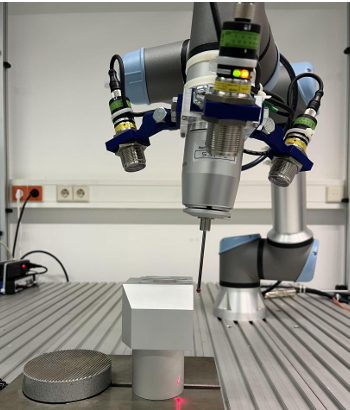
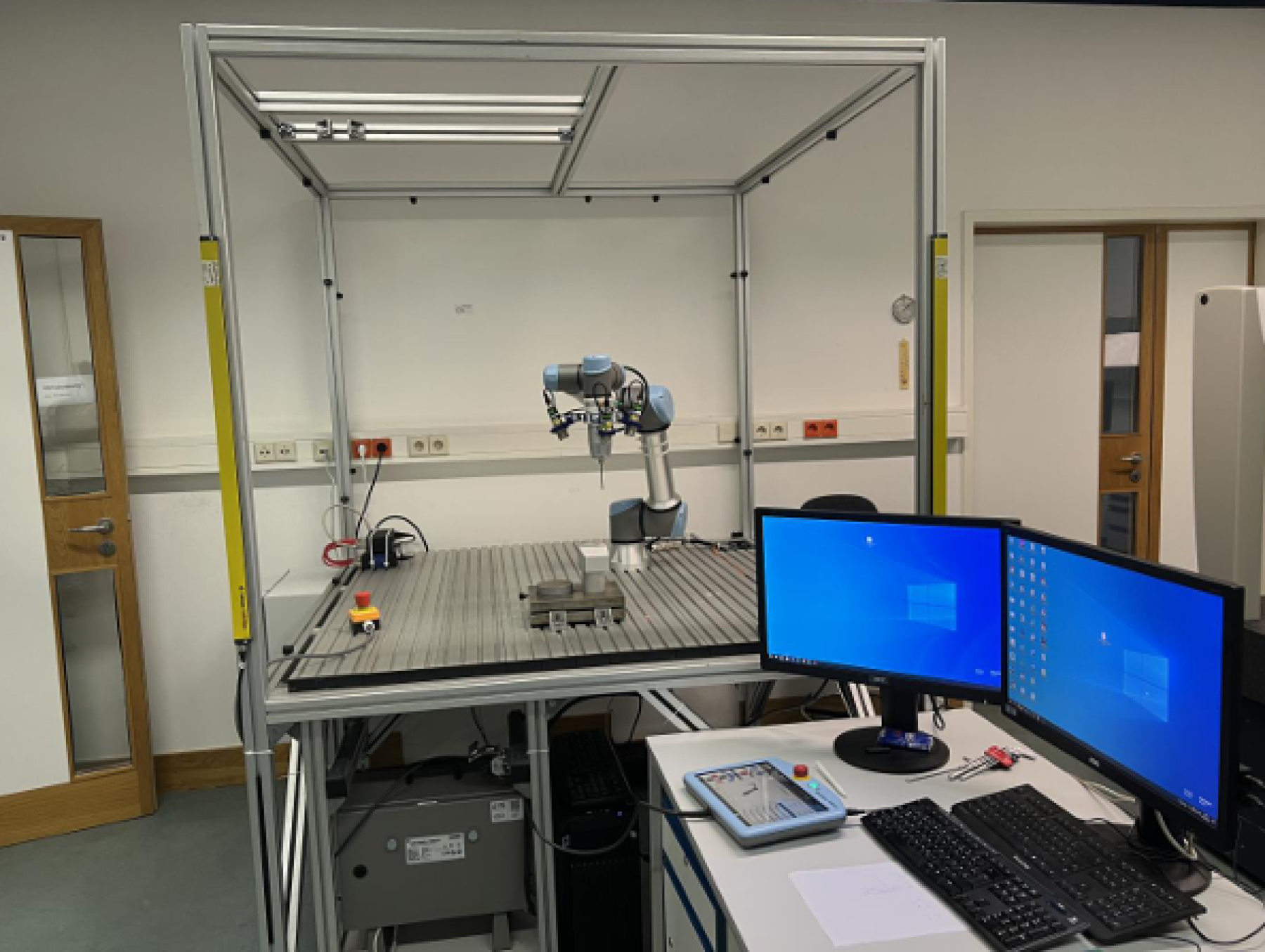
The aim of this project is to use industrial robots as a measurement system. As industrial robots do not have sufficient positioning accuracy to be used directly as a measurement system, a detailed analysis of all influencing factors and their compensation is essential. This enables acceptance and validation testing to be carried out on the resulting measurement system in accordance with DIN EN ISO 10360-12:2016.
The results achieved in the research project require further evaluation and are ideally suited to further research into product-oriented solutions within the context of robot-based data ecosystems. In particular, a wide range of opportunities is identified regarding the further digitalisation of industrial production in line with Industry 4.0 and the necessary quality control of products. The trend towards customised products also requires more frequent checks of their geometric specifications, which goes hand in hand with the concept of ‘Smart Quality’, which necessitates networked quality assurance throughout the product life cycle. By demonstrating the possibility of using collaborative robots (cobots) as measuring systems, this has led to initiatives for research professorships at Mittweida University of Applied Sciences in the field of cobot deployment. Through dialogue with measuring equipment manufacturers and internal partners, the findings have been used to draw up a preliminary research outline.
Project duration: 1 July 2021 to 31 December 2024