This page was translated automatically using artificial intelligence (DeepL). The German version is binding. More information about automatic translation
Sub-project: Systems for the intuitive use of robots in manufacturing
The PerspektiveArbeit Lausitz (PAL) project is a centre of excellence for the future of work in Saxony and Brandenburg. Its aim is to design innovative technologies and data-driven assistance systems in such a way that they can be implemented in businesses in a way that is people-centred, cost-effective and practical. The focus is particularly on small and medium-sized enterprises (SMEs) that face challenges such as a shortage of skilled workers, rising quality requirements and increasing complexity in production.
A key approach of PAL is the close integration of research and practice. Solutions are developed and tested in collaboration with companies, and then made available to other businesses via demonstration centres, workshops and guidance documents.
Priority Project 3: Systems for the intuitive use of robots in manufacturing
A key component of PAL is Priority Project 3, which addresses issues relating to the simple and intuitive use of robot technologies in manufacturing.
Current situation and objectives
Many companies, particularly small and medium-sized enterprises, face the challenge that automation is often perceived as complex, expensive and difficult to implement. At the same time, manual tasks such as welding or deburring frequently lead to high workloads and inconsistent quality.
Priority Project 3 addresses precisely this issue and aims to
- develop intuitive operating concepts for robots,
- lower the barriers to entry, and
- create human-centred automation solutions for manufacturing.
Approach: Intuitive robotics
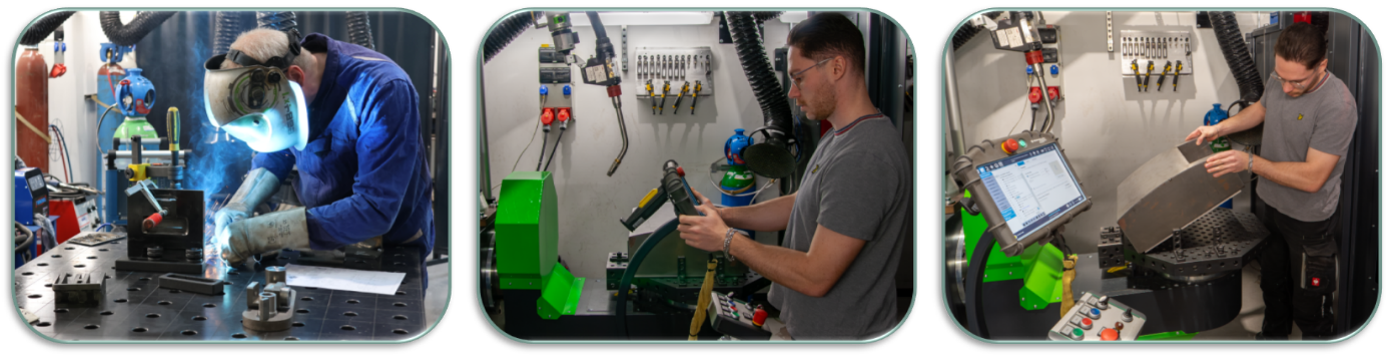
The project makes particular use of collaborative robots (cobots), which are characterised by their ease of use and flexibility. Rather than complex programming, the focus is on ‘learning by doing’: production staff can train the robots directly using teach-in procedures and adapt programmes (see Fig. 1).
The research is based on real-world manufacturing processes – in particular
- automated welding of small batches and
- robot-assisted deburring.
Results and findings
The findings from the project clearly show that intuitive robotics offers significant benefits for businesses:
Productivity and quality
- Reduction in process times whilst maintaining stable output
- Reproducible and consistent quality, particularly through automated motion sequences
- Improved process reliability for repetitive tasks
New opportunities
- Automation makes economic sense even for small batch sizes
- Flexible adaptation to changing components
Ergonomic perspective
A key finding is the change in work activities:
- New roles are emerging, e.g. set-up operators and machine operators (see Fig. 2)
- Tasks are shifting from physical labour towards control and monitoring duties
- Physical and monotonous strain is decreasing, whilst cognitive demands are increasing
It is clear that
robots do not replace humans, but rather provide targeted support.
Transfer into practice
The results of the practical project are being actively disseminated, for example through:
- Living Labs as demonstration centres
- practice-oriented guidelines
- Workshops and events held directly at companies
These formats enable companies to familiarise themselves with technologies in an accessible way, overcome reservations and make informed decisions regarding their own transformation processes.
Procedure for converting manual welding processes
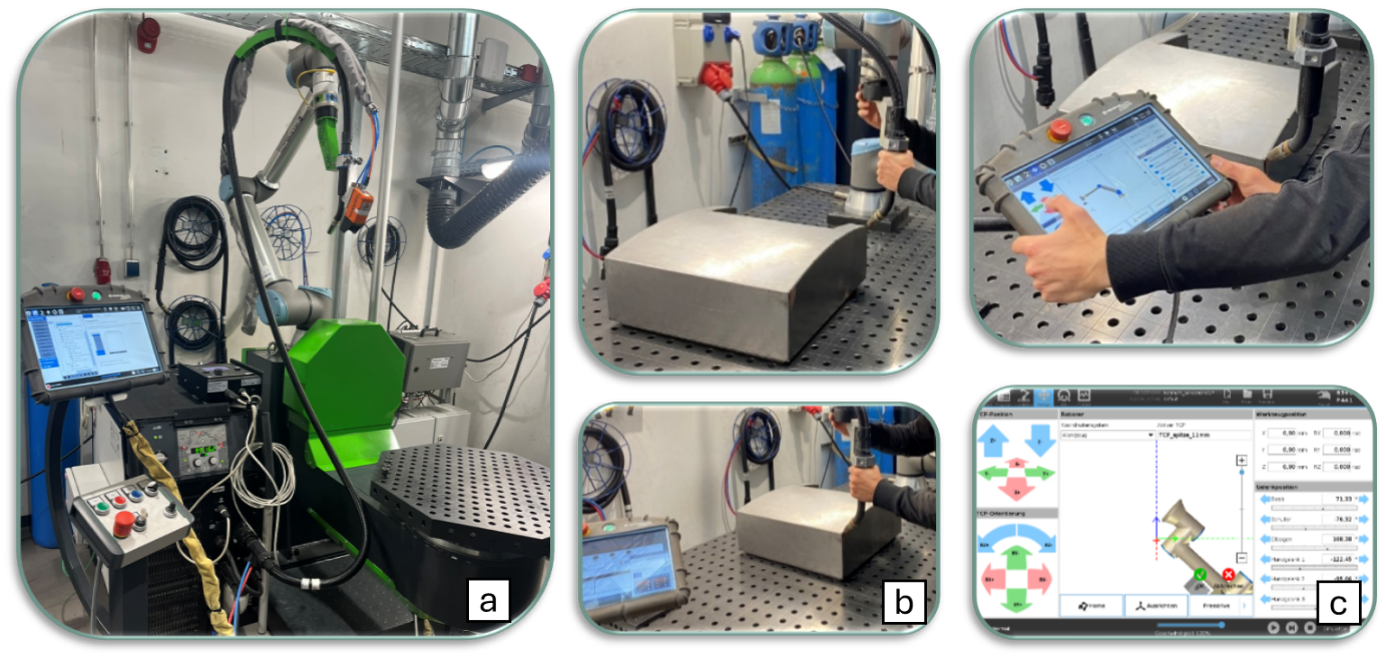
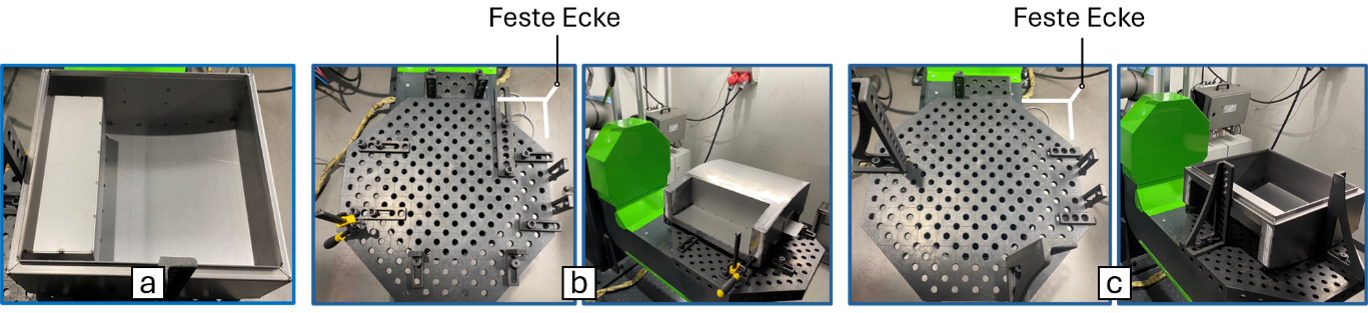
In collaboration with the project partner Caleg Schrank- und Gehäusebau GmbH, a demonstrator component made from DC01 (2 mm sheet thickness) was developed and manufactured (see Fig. 3a). This component features both straight and curved contours and measures 467 x 458 x 199 mm.

A procedure for automating this welded assembly has been developed (see Fig. 4). First, the current condition of the component is analysed and tolerances are recorded. The component is then checked to ensure its design is suitable for automation, and a suitable clamping fixture is manufactured (see Figs. 3b and 3c). The clamping fixture is based on the ‘fixed corner’ principle and comprises various clamping and stop elements. Preliminary tests are carried out to determine the optimum welding parameters. Finally, the components are welded automatically, the welds are evaluated using non-destructive and destructive testing methods, and a cost-effectiveness analysis is carried out.
Practical insights from the demonstrator component
1. Influence of component tolerances and gap dimensions
- The gap dimension is the dominant factor influencing weld quality
- Zero gap → Insufficient root penetration
- Large gaps → Burn-through and undercut in the cover pass
- Defined gap ranges enable process stability
For example, clear tolerance ranges were defined for the demonstrator:
- Butt joint PA: 1.0–1.2 mm
- Corner joint PB: 0.0–0.3 mm
- Corner joint PG: 0.0–0.6 mm
2. Importance of weld preparation
Initially, the components were welded using the standard seam preparation method for manual production. This resulted in irregularities and a higher amount of rework. The seam preparation was then adjusted to defined gap dimensions, which led to significantly better results:
- reduced irregularities and less rework
- slightly greater preparation effort with significant benefits
3. Teaching and usability
- Intuitive teaching options allow the system to be used without the need for robotics experts
- Torch angles can be adjusted by experienced welders with an accuracy of ±10°
- Reduced teaching time = the key to cost-effectiveness
Initially, the torch angles were set using a protractor during the teaching process. This resulted in teaching times of approximately 220 minutes. By using a swivel-tilt table and ‘practical teaching based on visual judgement’, the teaching time was reduced to 90 minutes.
4. Productivity effects
A cost-effectiveness analysis was carried out on the demonstrator component, comparing the manual welding time in the TIG process (33 minutes) with the automated process time in the MAG process. Automated production involves a teach-in time of 90 minutes and a welding time of 13 minutes. Disregarding the investment costs, the break-even point is reached with as few as five components.
Conclusion
Practical Project 3 demonstrates that the use of robots in manufacturing is not limited to large industrial companies. Thanks to intuitive operating concepts and practical development, automation is also becoming accessible to SMEs.
In this way, PAL is making an important contribution to shaping a sustainable, competitive and people-centred working environment in Lusatia.
Project duration: 1 November 2021 – 31 October 2026