This page was translated automatically using artificial intelligence (DeepL). The German version is binding. More information about automatic translation
Topics/Research and Teaching Profile
Prof. Löschner’s research group is currently conducting research in the following key areas
- high-rate laser processing, with the aim of making extremely high laser powers industrially viable for laser micro-machining and surface treatment through rapid beam deflection,
- laser bionics, which combines laser micro-machining with bionic surface functionalisation to transfer nature-inspired operating principles to technical applications,
- sensor-monitored adaptive laser processing with the prospect of AI support to enhance process quality and safety,
- and, more recently, laser safety with holistic laser protection concepts for the safe use of laser radiation, including protection against secondary hazards (e.g. secondary radiation, X-rays and particle emissions), as well as the provision of comprehensive qualification and training programmes.
The potential of high-repetition-rate laser technology is evident in a wide range of applications, particularly
when it comes to specifically
modifying the microscopic surface structure of large functional components. Typical examples of such applications include:
- Selective cleaning by material ablation (removal of oxide layers) in metalworking
- Micro-drilling for filter applications
- Structuring to reduce friction (shark skin effect) on profiles subjected to turbulent flow
- Production of tribologically or antibacterially effective adhesive/non-stick systems (‘sandfish effect’)
- Production of hydrophobic or hydrophilic interfaces (‘lotus effect’)
- Creation of optically functional structures (rainbow effect) for the design sector
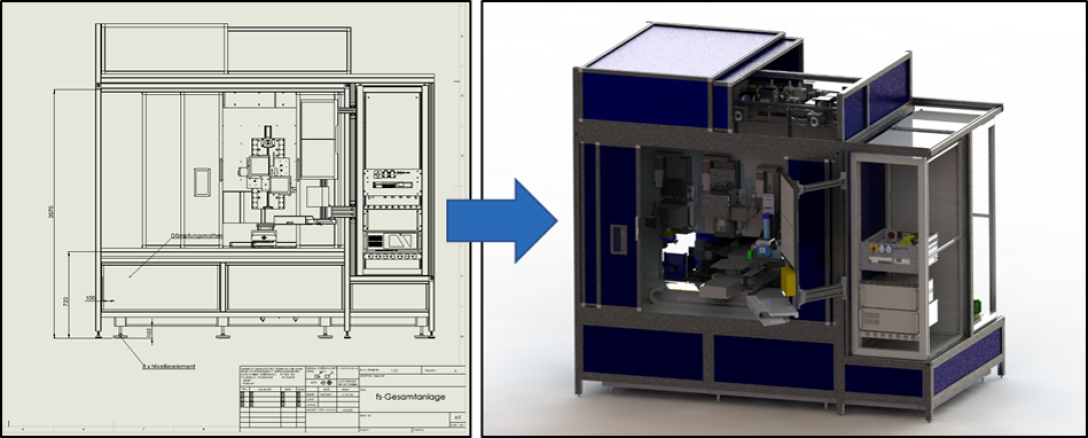
Our research and development work covers the entire field of laser process development. We establish the fundamental physical and technical principles (process understanding, laser-matter interactions, laser beam analysis, etc.) and carry out application-oriented studies to assess the feasibility in principle and to validate the newly developed laser processes. Excerpt from a software tool for analysing laser radiation In doing so, we consider high-rate technology in its entirety. We develop the necessary system and plant technology (e.g. fast, high-power-capable beam switching), programme bespoke software tools (e.g. scan field determination and 3D position calculation for workpieces to be processed) and design and implement suitable machine concepts. This includes, in particular, the appropriate design of the optical-mechanical setup (e.g. integrated measurement technology, beam guidance or workpiece handling) as well as the consideration of various safety aspects (e.g. process stability, machine safety, health risks from laser radiation, axis movements or particles released during operation). Following successful process development, the innovative high-rate laser application is transferred to an industrial application in collaboration with industry partners.
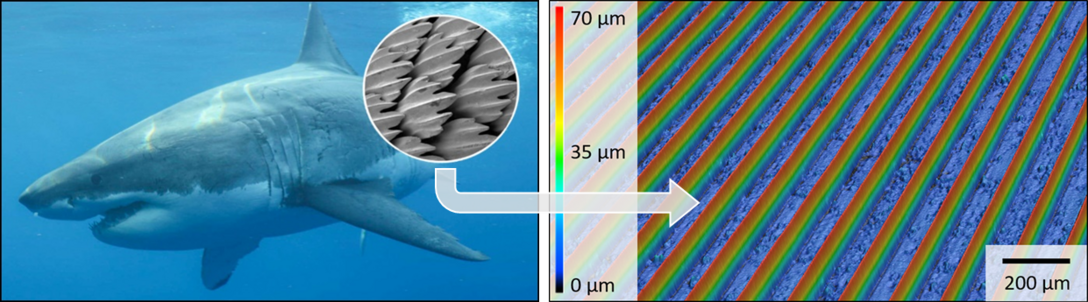
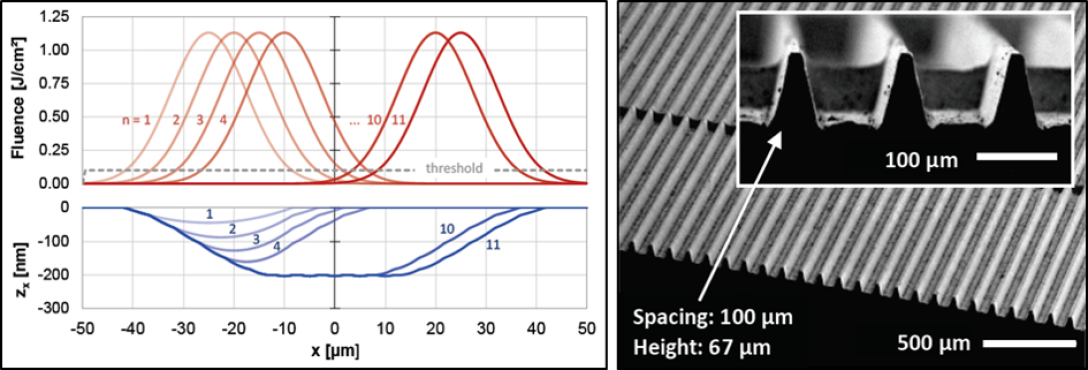
As we always keep science in mind alongside our engineering ambitions, we consistently publish the key findings of our publicly funded research projects in renowned national and international specialist journals, as well as presenting them in the form of talks and posters at various specialist conferences and trade fairs. Structural analysis in high-rate UKP laser profiling of aluminium. In recent years, numerous synergistic relationships and links have been established with other scientific institutions, such as the University of Liverpool, the University of Manchester, the University of Ljubljana, the Università Niccolò Cusano in Rome, McGill University in Montreal, the École de Technologie Supérieure in Montreal, Friedrich Schiller University in Jena, TU Bergakademie Freiberg, Jade University of Applied Sciences in Wilhelmshaven and TU Dresden. Furthermore, there are numerous collaborations with partners from industry, with whom we aim to establish high-rate laser processing as part of everyday technological practice.
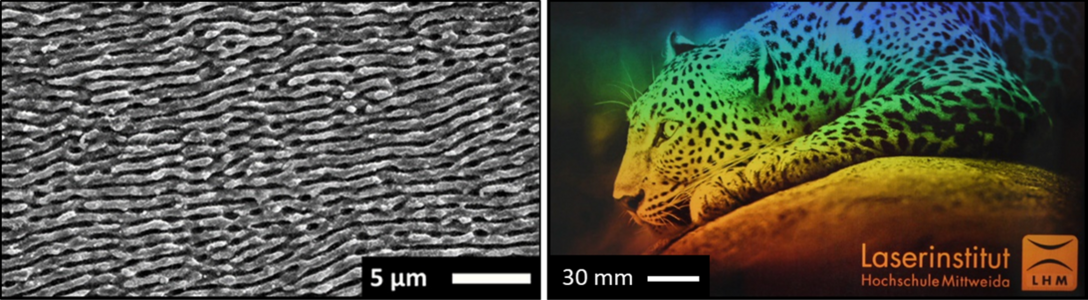
For our research and development work, we have access to the LHM’s extensive range of technical equipment. This includes a wide range of different laser sources, such as continuous-wave multi-kW fibre lasers, short-pulse (ns) laser systems and high-power ultrashort-pulse lasers in the fs and ps ranges. The laser processing systems we use are highly versatile and, where necessary, are adapted by our staff to meet the requirements of the process under development. This enables us to respond flexibly to the specific needs of individual research projects. In addition to laser process technology, we have a range of measurement and analysis equipment at our disposal, such as a scanning electron microscope, a laser scanning microscope, machine-integrated measurement systems (point and line sensors), high-speed cameras, thermal imaging cameras, spectrometers, beam analysis systems, sample preparation equipment, a contact angle measurement system and much more.
A more detailed overview of the LHM’s technical equipment can also be found at:
Link to the LHM – Laser Institute at Mittweida University of Applied Sciences