


Datenintegration für KI-gestützte Fertigungs- und ERP-Analysen bei Schilderwerk Beutha
2939
Matthias Baumgart

This page was translated automatically using artificial intelligence (DeepL). The German version is binding. More information about automatic translation
Prof. Dr.-Ing. Matthias Baumgart has been appointed to the post of ‘Digital Integrated Process Management’ at Mittweida University of Applied Sciences. He brings to his role his specialist expertise in computer science, Project and Process Management, and machine learning, as well as his many years’ experience in research management. Alongside his research and teaching activities, Prof. Baumgart is committed to innovative research projects, academic spin-offs and the promotion of early-career researchers, particularly within the context of collaborative PhD programmes. Matthias Baumgart completed his PhD (Dr. Ing.) at the Faculty of Computer Science at Chemnitz University of Technology. As part of his doctoral thesis, he explored machine-based methods for developing a methodological framework for the evaluation of scientific texts. The focus was particularly on the automated analysis of text data and the use of machine learning methods in structured evaluation and decision-making processes.
Matthias Baumgart began his professional career with an apprenticeship as a state-certified technical assistant in computer science, specialising in network technology. He subsequently studied Business Engineering at Mittweida University of Applied Sciences, graduating with a diploma in Business Engineering (FH). In addition, he completed a certificate programme in patent engineering at Friedrich Schiller University in Jena, as well as a Master’s degree specialising in ‘Project and Process Management’ at Mittweida University of Applied Sciences. Both during and after his studies, Matthias Baumgart gained extensive practical experience in the fields of computer science, project management, and research and technology transfer. From 2014 to 2024, Matthias Baumgart headed the Research Department at Mittweida University of Applied Sciences.
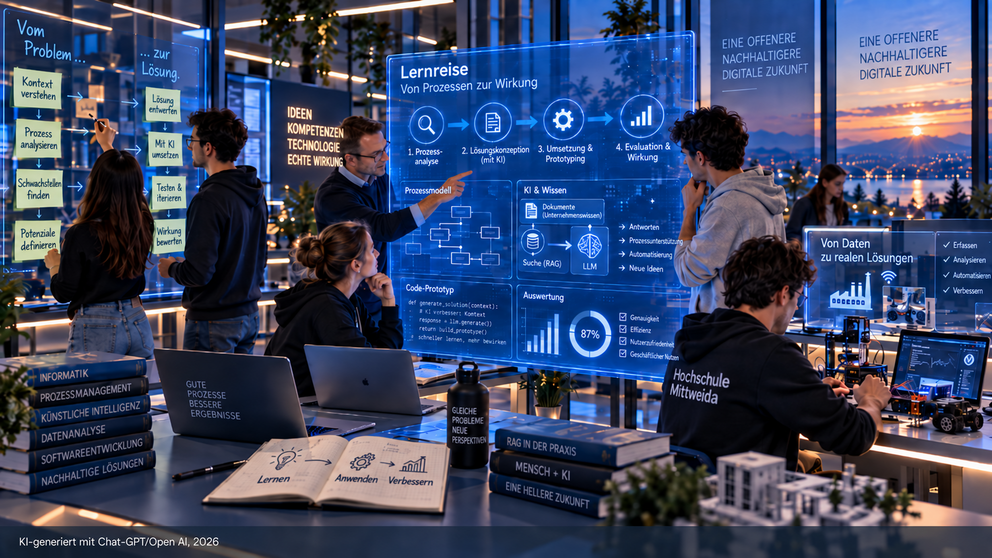
The course focuses on combining computer science, digital process management and modern artificial intelligence methods with specific real-world problems. Students are expected not only to understand and analyse digital processes, but also to learn to identify opportunities for optimisation, select appropriate technical methods and develop solutions independently. In doing so, theoretical principles are combined with practical applications, enabling students to follow and shape the entire process – from analysing a problem, through designing a solution, to its technical implementation.
Particular emphasis is placed on an application- and project-oriented approach to teaching and learning. Topics such as process automation, process optimisation, machine learning, data analysis and Software Development are taught using real or real-world scenarios and tested in practice. Students learn to use data and digital technologies in a targeted manner, to systematically examine complex processes, and to evaluate ML and RAG-based methods in terms of their potential applications and limitations. Through work on specific projects, the programme fosters not only technical expertise but, in particular, analytical thinking, problem-solving skills and the ability to independently develop and evaluate digital solutions.
‘For whatever one must first learn before one can carry it out, one learns by carrying it out.’
— Aristotle, Nicomachean Ethics, Book II
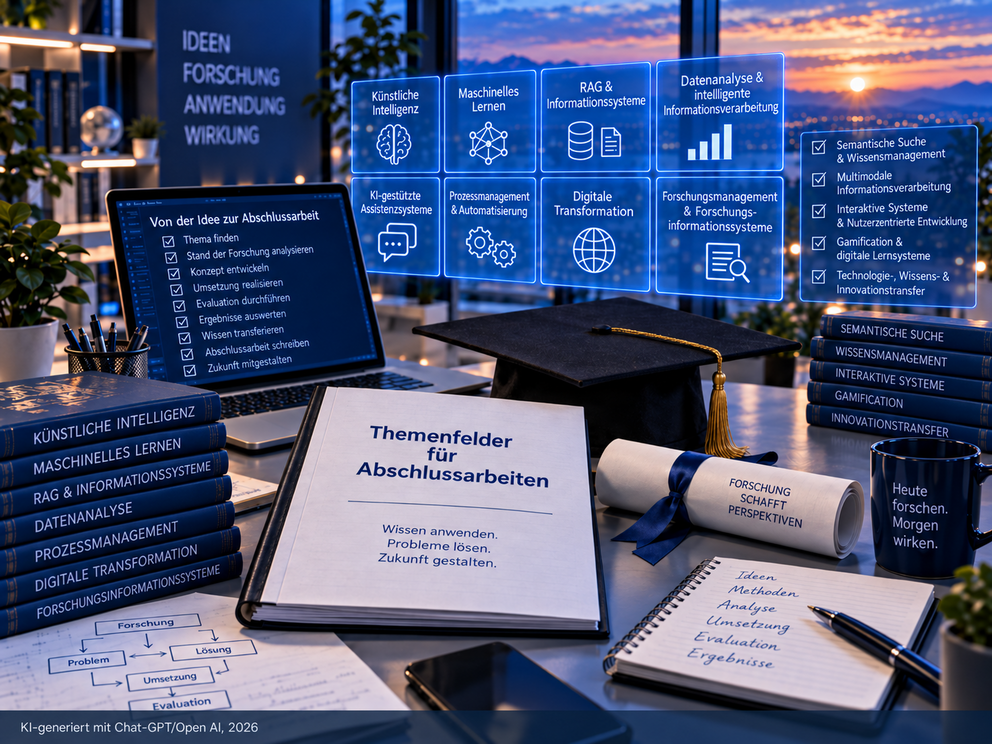
Theses offer the opportunity to combine one’s own interests with current issues in research and practice. Students can either take up existing topics from the chair’s research areas or contribute their own ideas and work together to develop them into a suitable academic research question.The focus is on projects that involve not only theoretical analysis but also design, development, testing or evaluation. In doing so, technological, organisational and economic perspectives can be integrated:
Proposals for your own research topics are expressly welcome. The key requirement is that these can be developed into a clearly defined research question of academic merit with a recognisable practical application.
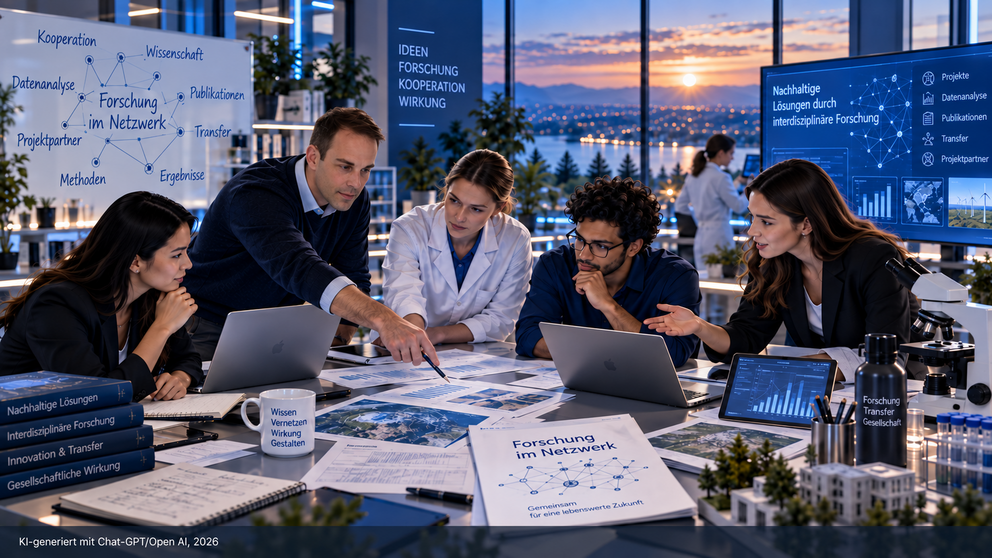
Digital Integrated Process Management focuses on the question of how digital technologies can be used to understand complex processes, develop them in a targeted manner and support them intelligently. The starting point is a systematic examination of existing processes: processes are analysed, interrelationships are made visible and opportunities for more efficient design are identified. Building on this, digital methods are employed to automate processes, link them together and adapt them to changing requirements.
Artificial intelligence and data-driven methods play a key role in this. Data is understood not merely as the output of digital processes, but as the basis for analysing processes, recognising patterns and deriving new courses of action. Machine learning, automated data processing and intelligent analytical methods open up new possibilities for mapping complex interrelationships and further developing digital processes. This ranges from the analysis of human activities and movement data to the development of digital models and technical applications.
The research combines these methodological approaches with specific application scenarios. The focus is on solutions that do not view digital processes in isolation, but take into account the interplay between people, data, software and technical systems. This gives rise to application-oriented concepts for process optimisation, automation and intelligent decision support, which combine scientific methods with practical requirements from research, business and society.
“I see research as a collaborative endeavour. It becomes particularly powerful when different perspectives, skills and experiences come together. Cooperation creates the space in which ideas can be turned into viable solutions.”
— Prof. Dr.-Ing Matthias Baumgart
Bringing expertise together, broadening perspectives
Research thrives on the exchange of different perspectives and expertise. That is why we work closely with other departments. Through joint projects, teaching programmes and research initiatives, we combine our specialist areas of focus and develop new approaches at the intersections of computer science, digitalisation, media and other fields of application.
Beschreibung Professur 1
Partner 2
Academic research in dialogue with the professional world
Close collaboration with businesses, public bodies and other partners in the field is a key part of our work. Together, we translate scientific findings into concrete application scenarios, develop new approaches and address current issues arising from the field. This generates impetus for research projects, courses, theses and long-term collaborations.
Datenintegration für KI-gestützte Fertigungs- und ERP-Analysen bei Schilderwerk Beutha
KI@EINS Projekte
Plattformübergreifende Mitarbeiterapp für den SAXONIA-Verbund
Machbarkeitsstudie zur Konzeption und Entwicklung einer Fahrphysik für schwere Nutzfahrzeuge und Anhänger in interaktiven Echtzeitumgebungen
Einsatz von Tutorials zur Prozessautomatisierung und -optimierung
Efficient Real-Time Point Cloud Rendering in Unity Using Incremental Spatial Sorting
Teaching Sustainability through Gamification: An Empirical Study with Student Perspectives in Vocational Education
Development and Evaluation of a Feature for a University Application to Increase Motivation and Reduce the Dropout rate of Students in Higher Education
E-Sport an Hochschulen. Eine Studie zur Nutzungsintention digitaler Spiele von Studierenden im Hochschulsport
E-Sport an Hochschulen. Eine Studie zur Nutzungsintention digitaler Spiele von Studierenden im Hochschulsport
Thank you very much for your interest in our work and in the topics of Digital Integrated Process Management. It is particularly where different disciplines, technologies and application perspectives come together that new approaches to the design and further development of digital processes emerge.
If you are interested in our research, would like to contribute your own research questions, or wish to develop and test digital solutions together with us, we look forward to hearing from you. Whether it’s process optimisation, automation, data analysis or the use of artificial intelligence – we are open to new ideas, collaborative research approaches and practice-oriented projects. Interdisciplinary questions are particularly welcome.
We can only look a short way ahead, but we can already see much of what needs to be done.
— Alan Turing, Computing Machinery and Intelligence, 1950
New ideas emerge where different perspectives come together. Research becomes more impactful when knowledge is shared and developed collaboratively. Do you have an idea, a research question or an interest in collaborating? Please feel free to get in touch.