This page was translated automatically using artificial intelligence (DeepL). The German version is binding. More information about automatic translation
Facts and figures
Blockchain and Distributed Ledger Technologies (DLT)
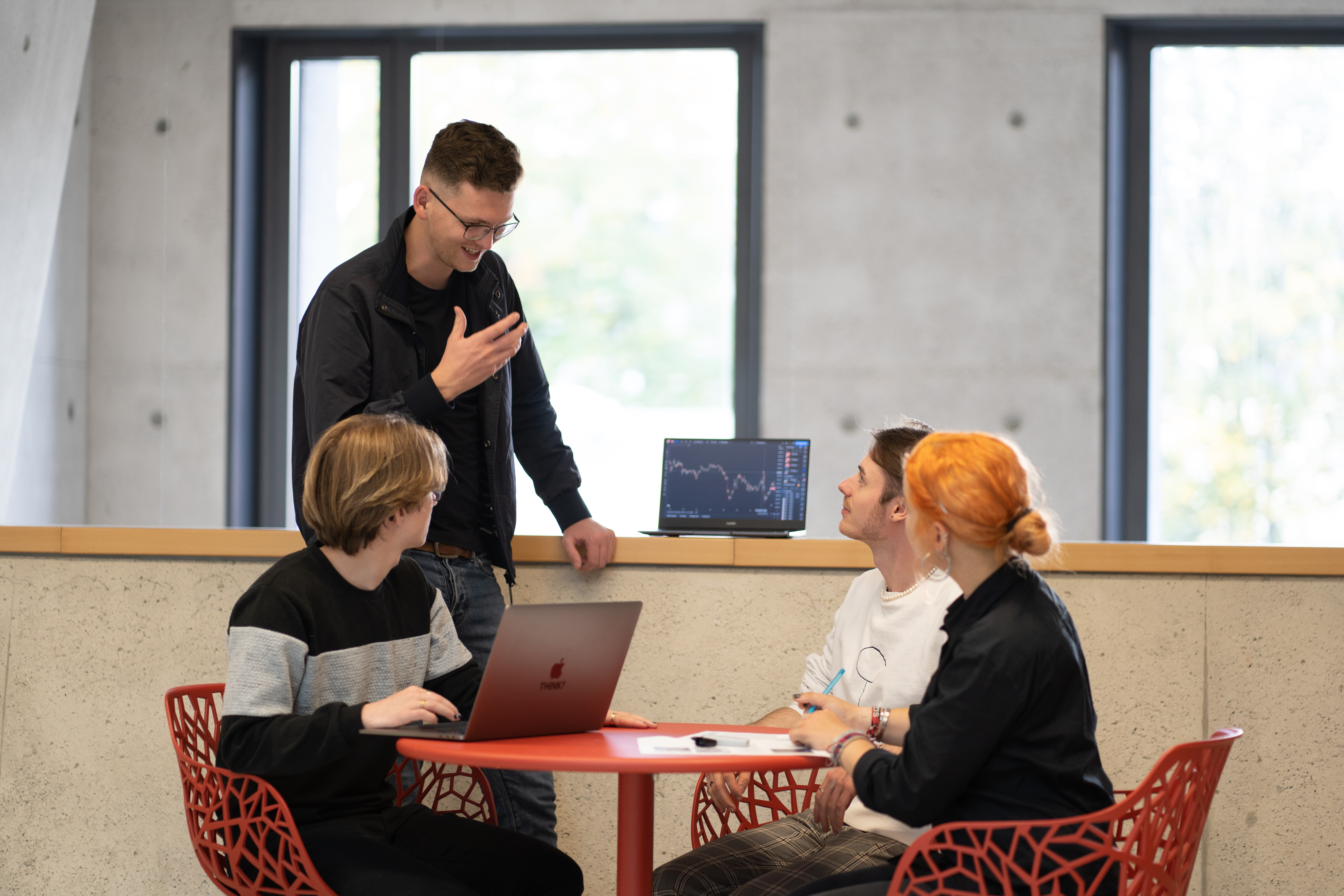
Mittweida is no newcomer to the world of blockchain, but one of Germany’s leading centres of research in this field. Whilst others are still debating the theory, here at the Blockchain Centre Mittweida (BCCM) you’ll be working right at the cutting edge of the technology.
The degree programme is consistently interdisciplinary. You’ll not only learn how to write smart contracts, but also gain an understanding of the legal framework and the economic incentives behind decentralised networks. In Mittweida, you’ll benefit from a network spanning academia and industry that opens doors to real-world innovation projects and turns theory into practical application.
An overview of the course content
During the first two semesters, you’ll delve deeply into the architecture of blockchain systems. You’ll build up your expert knowledge in cryptography, the Internet of Things and complex Software Development. You’ll have the freedom to refine your specialisation and choose exactly the areas that interest you from modules such as IT law, game theory or digital innovation management. The third semester is a real highlight. You’ll spend 20 consecutive weeks on a research module or a practical project. Here, you’ll apply your knowledge to real-world problems and gain valuable experience before writing your Master’s thesis in the fourth semester.
Blockchain I
Blockchain II
Compulsory electives (4 out of 7):
- Blockchain Technical Applications
- Foundations of Modern Cryptography
- Internet of Things
- Software-Defined Radio
- Introduction to Game Theory
- Non-Technical Applications of Blockchain
- Fundamentals of IT Law and Law in the Context of Blockchain and DLT
- Entrepreneurship and Digital Innovation Management I
- Communication Skills for International Students
Blockchain III
Blockchain IV
Compulsory Elective II (4 out of 9):
- Blockchain Technical Applications
- Cryptanalysis
- Supply Chain Management
- Advanced Graph Theory and Network Algorithms
- Architecture of Complex Software Systems
- Artificial Intelligence – Theory and Foundations
- Non-Technical Applications of Blockchain
- Risk Management and Venture Capital in Business
- Ethics and Values of Digital Innovation
- Digitalisation and Society
- Entrepreneurship and Digital Innovation Management II
Research module/compulsory
placement Duration: 20 weeks
Research seminar
Master's thesis
Blockchain and Distributed Ledger Technologies (DLT) in Mittweida
In summary – Blockchain and Distributed Ledger Technologies (DLT) in Mittweida

A full-time Master’s degree programme at the interface between cryptographic computing and the digital economy.

(120 Credits)


Once you’ve graduated, you’ll be part of a highly specialised group of professionals who are in demand worldwide. You’ll work as a blockchain architect, develop financial solutions as a smart contract developer, or advise companies on digitising their processes as a DLT consultant. Careers as a security auditor, cryptography expert or founder of your own tech start-up are also typical paths taken by our graduates.
Application and Admission
Applicants must hold a first professional university degree comprising 180 ECTS credits (Bachelor’s degree). A specific field of study is not required. Prior knowledge of computer science is an advantage, but not essential.
Language skills:
Applicants who did not obtain their university entrance qualification at a German-speaking institution must provide evidence of German and English language proficiency at level B2 of the Common European Framework of Reference for Languages. This can be demonstrated, for example, by taking the ‘German as a Foreign Language’ (TestDaF) test at the preparatory college of Mittweida University of Applied Sciences, achieving an average of TDN 3 in all four sections, or by providing an equivalent certificate.
The application period for the winter semester begins on 15 April and ends on 15 July. You can register at hs-mittweida.de/bewerben. Once you have submitted all your documents, you can enrol. Once you have enrolled, your place at Mittweida is secured. For international applicants, the application deadline is 15 May, to allow sufficient time to apply for a visa.
Excellent study conditions, modern facilities and some of the most affordable rent prices in Germany for a university town mean you can focus fully on your studies. Tutorials are on hand to help with subject-specific queries, the SAXEED start-up network guides you on your journey towards developing your own business idea, and the Social Support Service provides assistance with specific life situations, such as childcare or caring for relatives. The campus also has plenty to offer: two music festivals a year, an active esports team and a vibrant student community. International students, for example, are closely connected through the Cosmopolitan Club.



Related degree programmes


Frequently Asked Questions
Moving to Mittweida or the surrounding area (e.g. Chemnitz) is definitely worth it. The degree programme involves intensive project work and, thanks to the Blockchain Centre Mittweida (BCCM) based right on campus, offers you unique opportunities to network with local companies and research teams – opportunities you’d easily miss out on if you were just commuting.
There are no school-style holidays during your degree. Instead, there are lecture-free periods. During these, you can study, write assignments, undertake work placements – and treat yourself to a bit of a break now and then.
In the 2026/2027 winter term, in addition to public holidays, the following periods are lecture- and exam-free:
- 21 December to 3 January,
- from 22 February. Exception: The Faculty of Social Sciences begins its lecture-free period on 29 February.
In the 2027 summer term, with lectures starting on 22 March, the dates are:
- 25 March to 2 April,
- 7 May,
- 17 May,
- from 2 August. The Faculty of Social Sciences will also hold an examination week from 23 to 27 August.
Put simply, a blockchain is a decentralised, tamper-proof database that stores information in a chain of data blocks. As this data is stored synchronously across countless computers in the network, there is no need for a central authority (such as a bank or government agency) to process transactions securely and transparently.
A solid B2 or C1 level is very important, as global blockchain development, white papers, programming documentation and technical terminology are almost exclusively in English. However, the modules on the degree programme are taught in German.
A Master’s degree is worthwhile if you wish to specialise deeply in this highly innovative technology, take on leadership responsibilities in IT projects, or pursue an academic career (including a PhD). In the field of blockchain, the Master’s degree will give you a massive knowledge advantage in a highly competitive market of the future.
Highly personalised. As well as flexible compulsory-option modules, it is primarily the application-oriented project work and your Master’s thesis that determine your specialisation. You can focus entirely on the technical aspects (smart contracts, cryptography) or on the business use cases, as you wish.
An excellent career path that is also extremely lucrative. Tech companies, financial institutions, logistics giants and government bodies around the world are desperately seeking highly qualified blockchain architects, consultants and security experts who can integrate this technology securely into existing systems.