This page was translated automatically using artificial intelligence (DeepL). The German version is binding. More information about automatic translation
When an object becomes digital evidence
What forensic science students learnt about 3D scanners, scanning strategies and the limitations of digital models during a joint workshop with the Design Section of the Faculty of Engineering.
A silicone hand lies on the table. It does not move, and that is precisely the point. For as the students scan it one after the other using three different 3D scanners, it becomes clear that good digital models are not created by powerful technology alone. They are created through the right combination of equipment, object, approach and experience.
Two departments, one shared digital interface
Forensics and engineering utilise 3D digitisation for different purposes. In forensics, it provides the digital basis for reconstructions, surveys, and the examination and documentation of objects and evidence. In engineering, 3D data serves, amongst other things, as a basis for design, additive manufacturing and the precise reproduction of parts for which no drawings are available. The digital model thus becomes a digital template in its own right.
There is close collaboration between the Design Group and the Forensics Group, which was initiated by NextGen. The project brings together not only individual members, but also the faculties and departments from which they come, and the specialist knowledge they represent. This fosters links between disciplines that often operate in isolation from one another in day-to-day work.
Working at this interface are, amongst others, NextGen team members Hagen Bankwitz from the Design Group and Marie Luise Heuschkel (the author) from the Forensics Group. Our collaboration has already given rise to the CrimeCave project, a modular, mobile photogrammetry system that captures forensic images more precisely, more quickly and free from motion artefacts, thereby improving the identification of perpetrators and the quality of court-admissible expert reports whilst conserving resources. The collaboration continues with the joint use and testing of 3D digitisation technologies.

A workshop with three scanners and lots of questions
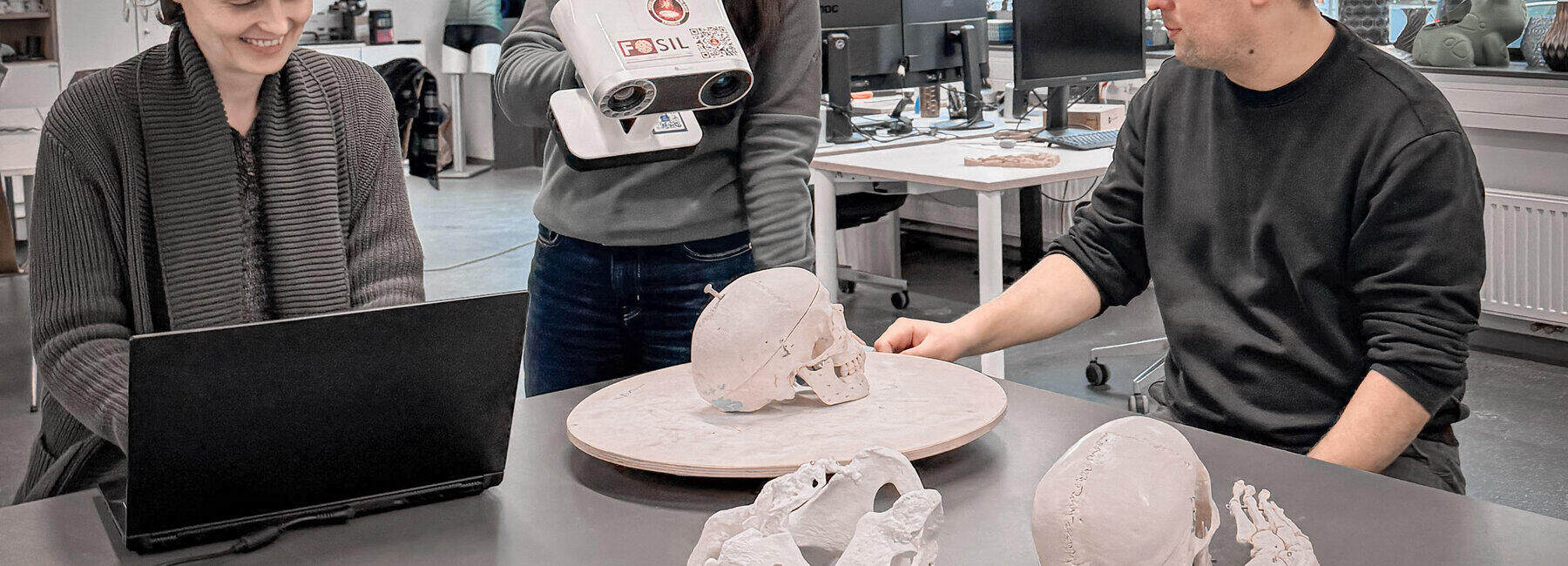
A prime example of this interdisciplinary collaboration is the workshop on 3D digitisation using handheld scanners. In the workshop, initiated by Marie Luise Heuschkel, forensic science students had the opportunity to try out various 3D handheld scanners. There were three scanners from Artec to choose from: the Artec Leo, the Artec Eva and the Artec SpaceSpider.
All three devices capture the surface of an object in three dimensions. To do this, they project a pattern onto the surface and calculate the geometry based on changes to the pattern, combined with the captured image data. “Basically, all the scanners work in a similar way, but the scanning method and the end result differ,” summarised Luna Sonntag, one of the participating students. In practical use, the differences were particularly evident in terms of resolution, field of view, portability and ease of use.
The students worked with objects of varying sizes, surfaces and complexity: an anatomical skull model, a lifelike silicone hand, a miniature car and a drive housing. Claudius Petzold, a research assistant at the Faculty of Engineering and an experienced user who combines additive manufacturing and 3D scanning in practice, supported the workshop with valuable insider tips. His advice was drawn from practical experience and helped the students to quickly gain a confident grasp of the technology and its practical applications.
The focus was not merely on operating the equipment. The real question soon became:
Which scanner is suitable for which application? How much detail is required? Is an autonomous, wireless device needed, or a scanner with higher precision and a smaller field of view? After all, quality and precision come at a price. It is therefore always crucial to consider the specific requirements of a particular application.
Three scanners, three ways of working
To allow for a direct comparison, the same silicone hand was first scanned using all three devices. The test object had to remain as still as possible during the scanning process. As described at the outset, it was precisely this stillness that made all the difference. Even the slightest movements can cause the individual scans to be misaligned, thereby complicating subsequent processing. Furthermore, for all three scanners, the working distance from the object is fixed within a specific range; if the scanner loses its orientation, the scanning process must be interrupted and the position re-established.
Artec Eva:
The Artec Eva allowed us to work the fastest, partly because it did not lose its orientation during practical use, meaning the scan was not interrupted. The device proved particularly suitable for the silicone hand, as the task did not require detailed scans; the aim was simply to capture the shape.
Particularly fine structures, such as the fingertips, posed challenges, especially for Leo and Space Spider. Although the Eva did not capture every single detail, it reliably recorded the contours and structure of the hand even in these areas. Consequently, missing areas mainly in the data sets for Leo and Space Spider had to be checked and retouched in the software afterwards.
Artec Leo:
The Artec Leo operates autonomously and does not require a cable connection to a laptop whilst scanning. This makes it extremely versatile, for example when the object cannot be moved and must instead be scanned on site.
However, the equipment adds extra weight, which makes holding the scanner in your hand for long periods more tiring. The comparatively generous capture area also requires a suitable strategy: small objects can often be scanned more effectively with the Leo when placed alongside a larger object, so that the system can find sufficient reference points.
Artec Space Spider:
In comparison, the Artec Space Spider produced the most detailed results, but this required particularly slow and controlled work. Only in this way could the software reliably map the new scans.
A second test with the Space Spider involved a small toy car. This revealed further typical challenges. The windows produced reflections that made precise scanning difficult. A matting spray could have reduced the shine on these areas.
The subsequent merging of the upper and lower halves of the vehicle in ArtecStudio, the software supplied with the scanners, also required meticulous work. Both partial scans had to be precisely aligned, as even minor deviations led to visible inaccuracies in the assembled model. The Space Spider therefore delivers the most detailed results, but requires a particularly meticulous approach.
Scanning means: observing, deciding, adapting
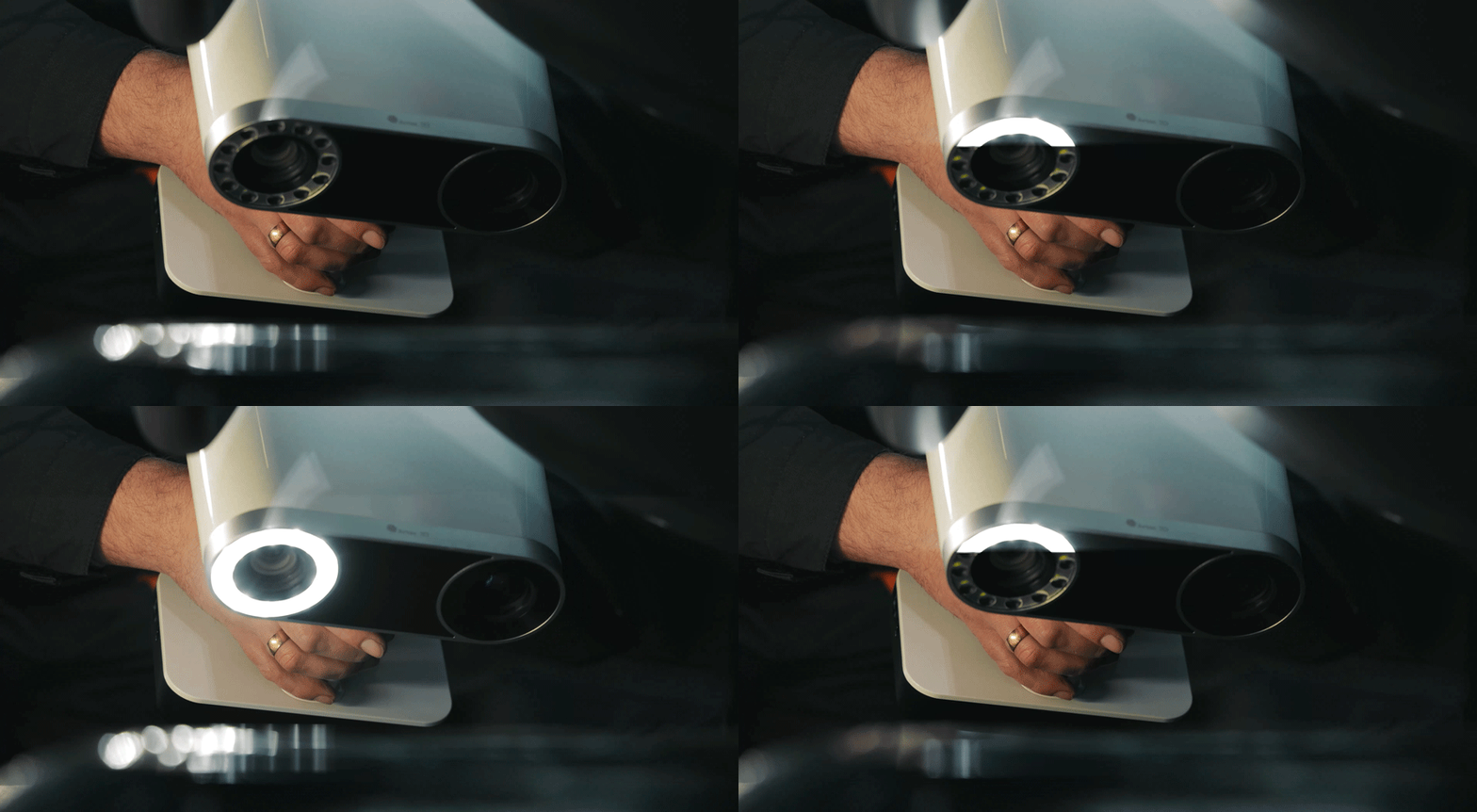
The scanners provide immediate feedback during the process. Colour scales indicate whether the distance to the object is within the optimal detection or measurement range: blue indicates that the distance is too great, whilst red indicates that it is too small. A further colour mode highlights which areas have already been scanned and where information is still missing.
Although this re-registration is helpful, it does not replace the judgement of the person operating the scanner. Depending on the object, it may be advisable to
- to scan the object in a single pass,
- create several scan sections,
- rotate the object,
- use a turntable, or
- walk around the object yourself.
In addition, there are numerous setting options. The effects these have on the object as a whole cannot be deduced from the manual alone. It requires observation, experience and a willingness to test different approaches in practice. It was precisely this practical knowledge that Claudius Petzold shared in the workshop, drawing on his day-to-day work with additive manufacturing and 3D digitisation.
From scan to 3D model
After the scan, the work continued in Artec Studio. The students first removed unwanted areas that had been captured during the scan but did not form part of the actual object. The scan sections then had to be correctly positioned and aligned within the coordinate system.
When multiple scan passes are used, the position and orientation of the individual captured frames are determined and transferred into a common coordinate system (registration), resulting in a consistent, coherent point cloud or a cohesive scan set.
The final step involves processing the registered data into a complete 3D model (fusion). Artec Studio version 18 was used in the workshop. The newer version 20 can automate certain steps to a greater extent. However, precisely because not all processes had yet been automated in the workshop, the individual decisions and their consequences became particularly apparent.
Experience, observation, adaptation: the true skill
The aim of the workshop was not merely to impart technical skills. The students were to learn that reliable 3D digitisation requires routine and experience, whilst at the same time offering scope for curious, creative learning.
The key lies in the combination of trial and error, observation, drawing conclusions and adaptation. This is precisely where a fundamental aspect of forensic work comes to the fore: it is not enough simply to know a method. One must be able to assess how it is applied under specific conditions, what its limitations are, and how the results can be integrated with other methods and bodies of knowledge.
3D digitisation is therefore not an end in itself. Its value lies in enabling robust investigation, measurement or reconstruction where digital data is utilised.
Digital objects as the basis for forensic work
"In a forensic context, 3D scans can help to document objects and traces accurately. They make it possible to digitally preserve crime scenes or items of evidence and analyse them in detail at a later date. This allows, for example, conclusions to be drawn about the course of events or traces to be assessed objectively,"
explains Marie Witthuhn, another participant, describing the benefits.
“3D digitisation makes it possible to digitally preserve crime scenes or items of evidence and analyse them in detail at a later stage. This allows, for example, conclusions to be drawn about the course of events or traces to be objectively evaluated.” Possible areas of application include, amongst others:
- the reconstruction of crime scenes and the testing of forensic hypotheses,
- the digital examination and measurement of objects,
- the documentation and analysis of skeletons,
- the preparation of soft-tissue facial reconstructions, and
- the creation and use of digital reference objects.
Cooperation as a space for learning and research
The workshop demonstrated just how beneficial the exchange between forensics and design can be. The specialist groups contribute different perspectives, equipment and experience. Forensics formulates specific questions regarding objects and traces. Design and additive manufacturing complement technical expertise in the capture, processing and further use of digital models.
In this way, a scanner becomes more than just a recording device. It becomes a tool for interdisciplinary work. And a physical object can serve as the basis for a digital model that enables new investigations, reconstructions and insights.