This page was translated automatically using artificial intelligence (DeepL). The German version is binding. More information about automatic translation
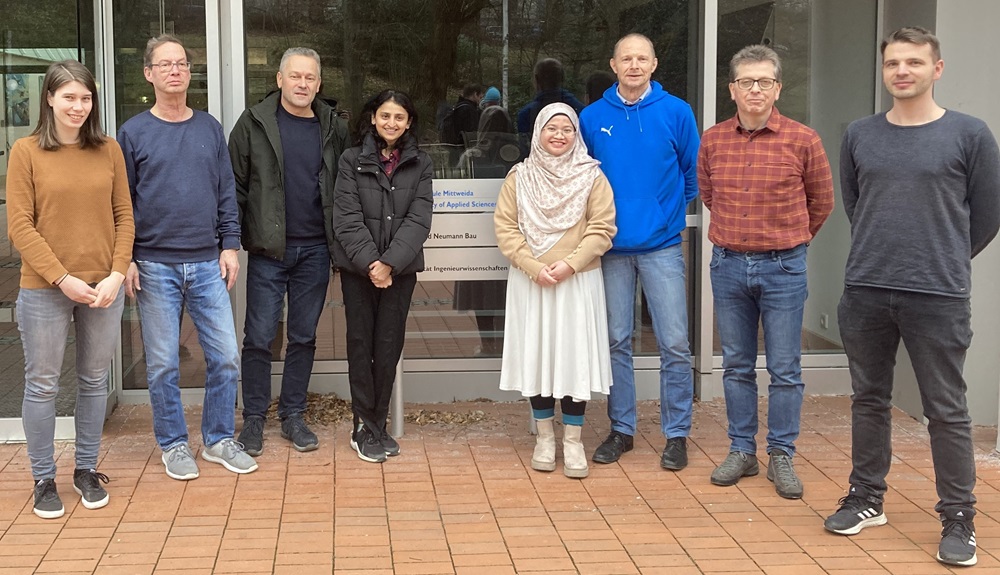
The young interdisciplinary “KAP” research group at Mittweida University aims to develop a clean technology route for the pre-treatment of plastics prior to their metallisation. The English translation of KAP is “Plastic Metallisation using Laser-induced Activation and Computer-aided Process Modelling”. By combining expertise in laser technology, electroplating technology, materials characterisation and computer simulation, the group aims to develop a new process in which the toxic hexavalent chromium used in the current pre-treatment can be replaced, thereby making the new process more environmentally friendly.
Project description
Metallised plastic components (primarily ABS: acrylonitrile butadiene and PA: polyamide) are used in many everyday products, such as those in the electronics, medical technology and automotive sectors, as well as in the household sector. Currently, the metallisation of plastics requires a resource-intensive process (involving palladium and nickel compounds) and a complex pre-treatment procedure. For example, large quantities of water and energy, as well as toxic chromium(VI) acid, are required. The project undertaken by the early-career research group aims to replace the costly and environmentally harmful pre-treatment process for plastic metallisation with a sustainable process using laser activation (LIG: laser-induced graphene and PLD: pulsed laser deposition) of the plastic surface and a subsequent electroplating process. Furthermore, the laser activation and electroplating processes are to be visualised and simulated using models. This alternative pre-treatment process makes a significant contribution to sustainability, as it eliminates the need for wet chemistry and energy-intensive pre-treatment processes, whilst also reducing the volume of pollutant-laden wastewater and non-recyclable sludge produced. Furthermore, the computer-aided process models enable considerable savings in time and resources. The project aims to raise awareness of sustainable business practices among early-career researchers. In addition, these researchers will receive further training relevant to their day-to-day professional practice.
Our Teams
The electrodeposition of various metal layers onto laser-activated plastics for different applications is the main objective of Team 1, led by Prof. Frank Köster and Scott Dombrowe. Before the laser-activated substrate can be coated, any contamination on the surface must be removed to ensure good adhesion. Various environmentally friendly processes, such as atmospheric plasma, will be used for pre-treatment. Subsequently, various single-layer coatings – such as copper, nickel, gold and tin – as well as multilayer coatings – such as copper-nickel and copper-nickel-gold – will be deposited using commercial electrolytes under constant current, pulsed current and electroless conditions on plastics for decorative and technical applications. The deposition parameters, such as current density, convection and process time, will be evaluated and optimised. In addition to carrying out the experiments, the project manager is also responsible for the overall organisation of the project. This includes writing reports, planning and chairing meetings, and managing internal data.
The main objective of Team 2, led by Prof. Weißmantel and Laura Dienelt, is the activation of plastics using laser-induced graphene (LIG) and coating via pulsed laser deposition (PLD). Both processes functionalise the plastic surface, as an electrically conductive layer is created by the LIG and PLD processes. This layer should enable direct galvanic metal deposition. This means that the wet chemical substrate pretreatment currently used for plastic metallisation can be omitted, and the full range of plastics can be utilised. The quality of the graphene formation is optimised by adjusting laser parameters such as wavelength, laser pulse fluence and scanning speed. PLD is also used to coat plastics with metals, depositing thin, homogeneous layers. The process conditions are analysed and optimised to ensure high conductivity and adhesion of the layers for subsequent process steps. The structures produced will be characterised by Team 3 and compared with simulations from Team 4 to further improve the processes.
Team 3, led by Prof. Frank Hahn and Nurul Amanina Binti Omar, is characterising the physical and chemical properties of the graphene layer produced by pulsed laser deposition and the metal coatings deposited onto the graphene by Team 2. We use Raman spectroscopy to identify the presence of graphene on the surface of the polymer and to measure its thickness, and reflection high-energy electron diffraction (RHEED) to obtain structural information about the graphene nanolayer. The deposited metal coatings are characterised using, amongst other methods, SEM for surface morphology, EDX for chemical composition, four-terminal sensing for electrical conductivity measurements, a colorimeter to determine the CIELAB colour space, a glossmeter for measuring the reflective gloss of the metal surface, kaloMAXX for tribological properties, and a coating adhesion test to determine their adhesive tensile strength. The experimental results will be compared with the simulated results from Team 4 to validate the models used.
Team 4, led by Prof. Klaus Dohmen and Niyati Ajay Dave, focuses on simulating and modelling how materials are produced in order to improve and optimise the process. We use advanced computational methods and Python-based tools, utilising libraries such as NumPy, Matplotlib and SciPy to develop efficient workflows and ensure reliable results. One of our key activities is the simulation of the Pulsed Laser Deposition (PLD) process to model thin film layers. By adjusting settings such as laser power, pulse frequency and substrate motion, we ensure that the simulations are realistic and reflect real-world conditions. We also create visualisations of the electric potential in graphene to understand its electronic properties. We also visualise the electric potential in graphene to gain deeper insight into its electronic properties. For the electroplating process, we developed a simulation to analyse critical parameters such as resistance, electrical conductivity, current density, electric field and potential distribution. Using numerical methods to solve the Laplace equation, we modelled the steady-state potential distribution, which plays a crucial role in the controlled deposition of conductive layers on graphene.
English version
Many everyday products, such as automotive and electronic components, medical devices and public infrastructure, are manufactured using metallised plastics. The Plating on Plastic (PoP) process is complex and requires substantial quantities of raw materials, such as water and electricity. Furthermore, only a few types of plastic, such as acrylonitrile butadiene styrene (ABS) and polyamide (PA), are suitable for this process due to the good adhesion between the plastic and the metal. Furthermore, hexavalent chromium, which is toxic and harmful to the environment, is used in the pre-treatment of plastics. Under the REACH (Registration, Evaluation, Authorisation and Restriction of Chemicals) regulation, chromium(VI) compounds are banned in Europe and may only be used with special authorisation. The aim of this project is to replace the carcinogenic conventional wet-chemical pre-treatment process for the metallisation of plastics with a novel and sustainable process. In the first step, the plastic surface is activated using a laser-induced graphene (LIG) or pulsed laser deposition (PLD) process to produce an electrically conductive layer. Thanks to this conductive layer, it is possible to electrodeposit single or multilayer metal layers for functional or decorative purposes. Another objective of this project is to simulate both the laser and electrodeposition processes using a mathematical model. Through computer-aided process modelling, predictions can also be made regarding the properties of the layers as a function of process parameters. Overall, the innovative laser-activated and computer-simulated pre-treatment of plastics is a clean technology, as no toxic chemicals are required and no wastewater is produced. In addition to the technical objectives of the project, the project staff will also receive further training in the areas of teaching, social, environmental and management skills.