This page was translated automatically using artificial intelligence (DeepL). The German version is binding. More information about automatic translation
Sub-project: Cobot-based welding process
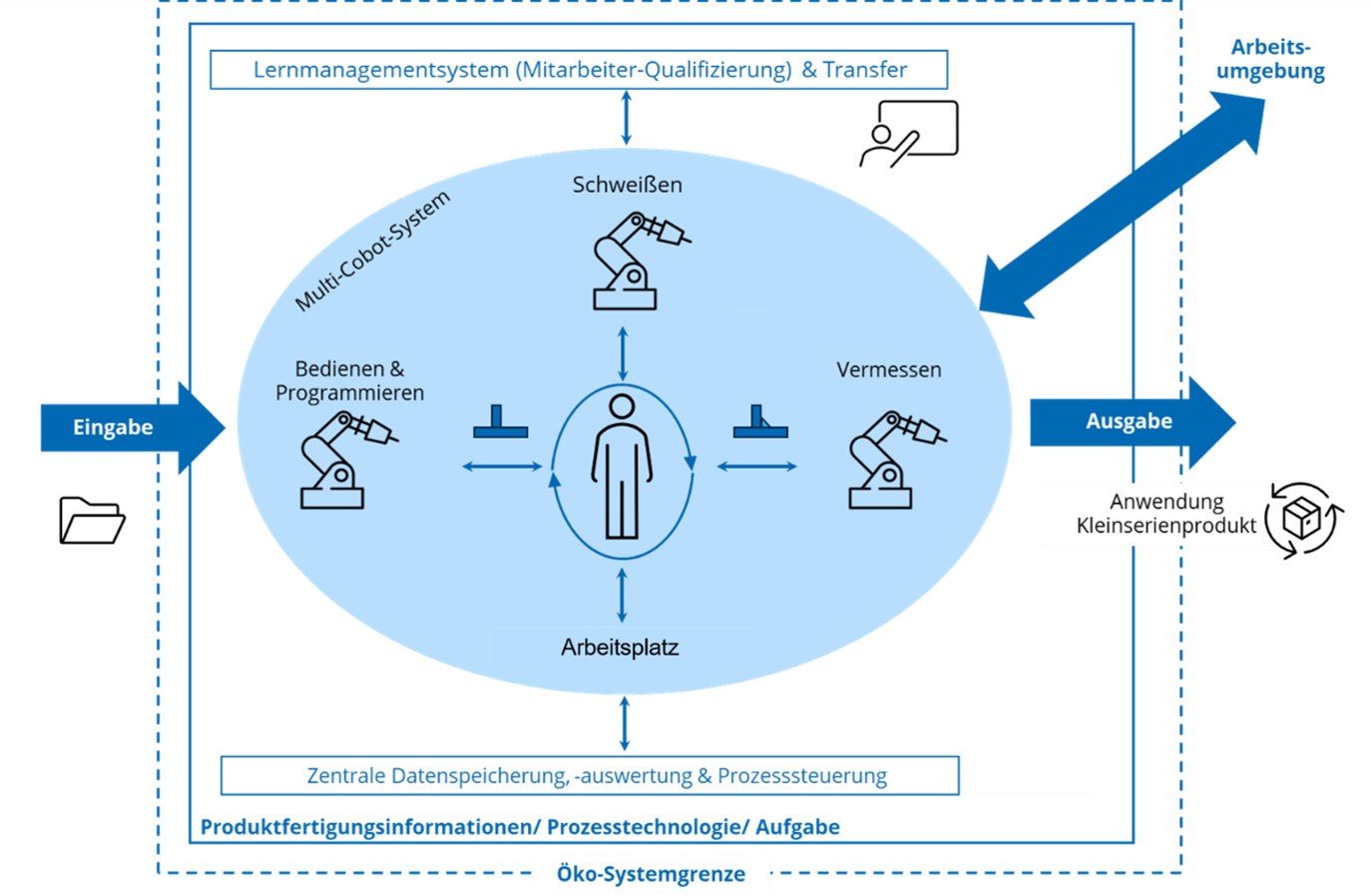
The MultiDATBot project is developing an innovative, human-centred data system for multi-cobot applications in small-batch production environments. The focus is on the automation and networking of intelligent measurement, operation and welding processes, as well as quality control, using collaborative robots.
The aim is to present data in an intelligent, comprehensible and practical manner in order to sustainably improve collaboration between humans and collaborative robots. The approach combines didactic concepts with modern methods of data collection and analysis to enhance transparency and decision-making capabilities within the process. Central to this is the user-centred design of a system that makes complex data intuitively accessible and actively contributes to process optimisation.
Within the MultiDATBot project, the welding process represents a key component in the integration of process chains. Particularly in small-batch production with a high degree of product variation, automated welding using collaborative robots offers significant potential, the effectiveness of which is largely determined by component quality, process stability and cost-effectiveness. Through its integration into a multi-cobot system, the welding process is to be viewed not merely as an isolated manufacturing step, but as a key link between several processes that are closely interlinked with humans, robotics and an intelligent data ecosystem.
Current situation and objectives
Small-batch production at many SMEs is characterised by manual or semi-automated welding processes and relies heavily on experience. Particularly with small batch sizes and frequent product changes, traditional automation solutions reach their limits, whilst at the same time there is often a lack of structured data collection to systematically evaluate process parameters, factors affecting quality and malfunctions. Furthermore, small-batch production in SMEs is often characterised by tolerances in component preparation and positioning.
The aim of the project is therefore to develop a data-driven measurement and welding system as part of a multi-cobot approach. This is intended to actively support operators, make process knowledge – particularly regarding geometric constraints – accessible, and enable end-to-end, user-friendly programming. At the same time, the focus is on linking process data with didactic concepts in order to effectively combine learning and working, and to establish a data ecosystem for this purpose.
Approach
The combination of measurement and welding processes is intended to enable a holistic approach. To this end, an integrated operating and programming system is being developed that allows welding tasks to be easily configured and adapted from a geometric perspective. The integrated measurement process is designed to specifically support position determination and correction prior to welding and to enable precise alignment of the torch.
Through user-integrated, data-driven process control, the operator is to be actively involved in decision-making and optimisation processes. At the same time, the workstation is designed with a didactic approach to support learning processes and enable the systematic acquisition of knowledge.
Furthermore, aspects relevant to welding automation are examined and welding parameter windows are developed. In particular, correlations between process parameters and weld quality are systematically investigated, and the effects of component tolerances and positional deviations are considered. In addition, the measurement process following welding is intended to serve geometry-based quality assurance by identifying and evaluating deviations.
The concept developed in the project and its technical developments will be further implemented in the form of a demonstrator.
New possibilities
The data-driven multi-cobot system is intended to open up new prospects for manufacturing. In particular, the data ecosystem, with its continuous process data acquisition, is intended to lay the foundation for further analysis and enable the use of machine learning or predictive quality assurance. Furthermore, this includes, in particular, the possibility of adaptive process control, in which parameters are dynamically adjusted to different components or conditions. The integration of learning and production is also expected to create new approaches to the training of skilled workers and the continuous improvement of processes.
Transfer
A key component of the project is the transfer of the developed solutions into industrial practice. Prototype demonstrators are intended to serve as a basis for testing concepts under realistic production conditions and making them tangible for companies. Small and medium-sized enterprises in particular can benefit from the approaches developed, as these are specifically designed for flexible and cost-effective small-batch production.
At the same time, the educational concepts enable the transfer of these solutions into educational and training environments. This allows the use of data-driven, collaborative production systems to be taught in a targeted manner.
Project duration: 1 January 2026 – 31 December 2028