This page was translated automatically using artificial intelligence (DeepL). The German version is binding. More information about automatic translation
Sub-project: Cobot-based measurement
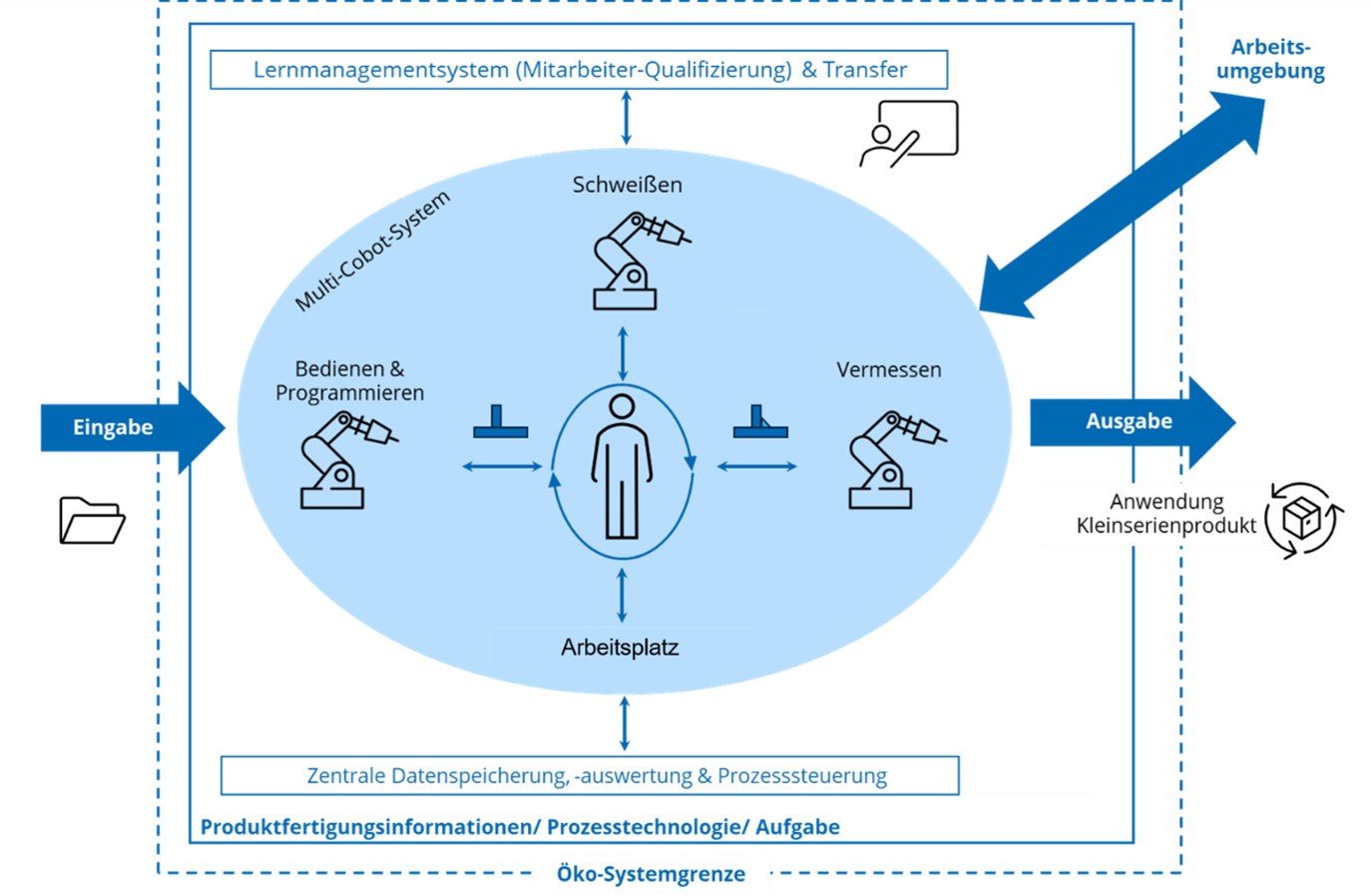
The MultiDATBot project is developing an innovative, human-centred data system for multi-cobot applications in small-batch production environments. The focus is on the automation and networking of intelligent measurement, operation and welding processes, as well as quality control, using collaborative robots.
The aim is to present data in an intelligent, comprehensible and practical manner in order to sustainably improve collaboration between humans and collaborative robots. The approach combines didactic concepts with modern methods of data collection and analysis to enhance transparency and decision-making capabilities within the process. Central to this is the user-centred design of a system that makes complex data intuitively accessible and actively contributes to process optimisation.
In small-batch production, quality assurance is carried out predominantly manually through random measurements taken by employees – a process known as operator self-inspection. The measurement results obtained in this way depend on the operator and therefore vary. An intuitive, cost-effective, operator-independent and automated measurement system could be of assistance here, but does not yet exist. Compared with manual spot-check measurements carried out by operators with an accuracy of a tenth of a millimetre, collaborative systems offer advantages: lower costs, operator-independent measurement quality, and immediate data availability for controlling the process chain and for quality assurance. There are as yet no known instances of cobots being used as a measurement system for this purpose. Similarly, there is no approach for enabling cobots to work together in multi-cobot systems. In particular, data transfer between cobots for tracking real-time-controlled work steps has not yet been developed. Employees remain the key players. They are familiar with manufacturing processes and influencing factors. They face new challenges regarding adaptation, utilisation and data analysis. With this in mind, training programmes are to be developed in a participatory manner and jointly validated using functional demonstrators.
3D coordinate measuring machines have been used for flexible data acquisition and analysis in production metrology for over three decades [3], [4]. The use of robots represents an extension of hand-guided, flexible articulated-arm systems. The robots used to date have served as part-handling systems for various, mostly optical, sensors, without themselves functioning as active measuring systems. The use of collaborative robots (cobots) as active measuring systems is not yet known. Standards currently exist for general robot safety (e.g. ISO 10218, ISO/TS 15066) as well as for 3D coordinate measuring systems (ISO 10360 et seq.). However, there are no corresponding standards to establish cobots as fully-fledged measuring systems in quality-critical manufacturing processes.
New possibilities
The data-driven multi-cobot system is intended to open up new prospects for manufacturing. In particular, the data ecosystem, with its continuous process data acquisition, is intended to lay the foundation for further analysis and enable the use of machine learning or predictive quality assurance. Furthermore, this includes, in particular, the possibility of adaptive process control, in which parameters are dynamically adjusted to different components or conditions. The integration of learning and production is also expected to create new approaches to the training of skilled workers and the continuous improvement of processes.
Transfer
A key component of the project is the transfer of the developed solutions into industrial practice. Prototype demonstrators are intended to serve as a basis for testing concepts under realistic production conditions and making them tangible for companies. Small and medium-sized enterprises in particular can benefit from the approaches developed, as these are specifically designed for flexible and cost-effective small-batch production.
At the same time, the educational concepts enable the transfer of these solutions into educational and training environments. This allows the use of data-driven, collaborative production systems to be taught in a targeted manner.
Project duration: 1 January 2026 – 31 December 2028