
Prof. Dr.-Ing. Uwe Mahn

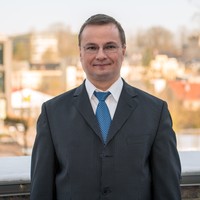
Prof. Dr.-Ing. Uwe Mahn holds the Chair of Design, specialising in component analysis and numerical simulation. His work encompasses FEM applications ranging from strength and safety assessment, through dynamics and acoustics, to forming and flow simulation. The focus is on application-oriented solutions to industrial problems and the transfer of scientific findings to industry. He has been Vice-Rector for Research at Mittweida University of Applied Sciences since 2017.

This page was translated automatically using artificial intelligence (DeepL). The German version is binding. More information about automatic translation

Faculty Engineering Sciences

Chair of Design – Component Analysis/FEM Research Group

Prof. Dr.-Ing. Uwe Mahn
FakultƤt Ingenieurwissenschaften
Visitor address
Leisniger Straße 7
09648 Mittweida
18-007
Postal address
Mittweida University
FakultƤt Ingenieurwissenschaften
Technikumplatz 17
09648 Mittweida

Teaching and Research

  • Advanced Engineering Mechanics
  • Strength of Materials
  • FEM
  • Machine Design
  • Metal Forming (sub-fields: solid forming and forming machines)

  • FEM
  • Mechanical Engineering

  • Design, strength assessment and damage analysis of safety components
  • Finite element simulation, including fracture mechanics, dynamics and acoustics
  • Flow simulation using Computational Fluid Dynamics (CFD)
  • Simulation of forming processes
  • Linear roller guides
  • Assemblies and design of machine tools
  • Digital product and process development

  • Component and damage analyses
  • FEM and CFD simulations
  • Optimisation of products and manufacturing processes through simulation
  • Simulation and further development of forming processes
  • Development and evaluation of new machine and component concepts
  • Application-oriented research and development projects in cooperation with companies

FEM

The aim of the FEM module is to impart specialist and methodological skills in the use of the finite element method (FEM). The module builds on students’ existing knowledge in the fields of engineering mechanics, engineering thermodynamics, strength of materials and CAD. The module covers both the theoretical principles of FEM and its practical application to a range of technical problems. The aim of the course is to enable students to independently plan, carry out and evaluate calculation tasks using FEM in a targeted manner.

  • Fundamentals of the FEM and its place amongst numerical methods for solving field problems
  • Basic functions of FEM software, geometry-based modelling and meshing, meshing strategies (free and structured meshing)
  • Solving static design problems using the FEM
  • Meshing techniques and definition of boundary conditions, including plane modelling of spatial problems (plane stress state, plane strain state, rotational symmetry) and modelling of symmetric problems
  • Dynamic analyses using the FEM (modal analysis, harmonic analysis, transient excitation)
  • FEM calculations in mechanical acoustics
  • Transient temperature fields and the associated displacement and stress fields
  • Non-linear problems in the FEM: definition of contacts and connections, non-linear material behaviour – in particular plasticity – and large deformations, using stability problems as an example

Mechanical Engineering

Using machine tools as an example, the module develops specialist skills in the structural design of machines, as well as in the dimensioning of drive systems, frames and guideways. To this end, the module imparts extensive specialist knowledge of the structural design, function and calculation of machine tools, taking into account current norms and standards, and develops skills in the metrological analysis of machine components.

  • Definition of a machine, a machine tool and their classification within mechanical engineering
  • Basic functions and construction of typical machine tools such as lathes, milling machines and forming machines
  • Machine bed components, their installation on the foundation, and the dimensioning and design of machine bed components
  • Metrological investigation of the dynamic properties of machine frames using experimental modal analysis
  • Classification of machine drives into main, secondary and auxiliary drives 
  • Design of machine tool main drives (motor selection, determination of required gear ratios)
  • Hydrostatic, hydrodynamic and rolling element guides, and their design
  • Design of machine tool main spindles
  • Metrological assessment of the accuracy of feed drives using a laser interferometer
  • Layout and design of forming machines, particularly presses
  • Specifications, requirements specifications and acceptance testing of machines

Career

November 2018 – present

Vice-Rector for Research

September 2015 – October 2018

Dean of the Faculty of Engineering

September 2012 – August 2015

Dean of the Faculty of Mechanical Engineering

January 2008 – present

Professor of Design Engineering (CAE Techniques and FEM)

October 2005 – December 2007

Project Engineer, ā€˜New Technologies’, ESKA Automotive GmbH

July 2000 – September 2005

Research Assistant at Chemnitz University of Technology

2008

Appointment

Mittweida University of Applied Sciences (FH)

2004

PhD

Chemnitz
University of Technology (TU Chemnitz) Thesis topic: "Extending the operational limits for clamping highly loaded, elongated workpieces"

2001–2005

Teaching post

Chemnitz University of Technology for the subject area
ā€˜Machine Tools – Properties Analysis’

2000

Degree

Chemnitz
University of Technology: Bachelor of Engineering (Dipl.-Ing.) in Mechanical Engineering, specialising in machine tools and applied mechanics

Would you like to know more?

Be inspired

Projects and Publications

Entwicklung eines zerstörungsfreien In-situ Prüfverfahrens für die gebundenen Schichten des Oberbaus von Straßen mittels opto-akustischer Messtechnik TP2

  • Term: 2026/06/01 – 2028/12/31
  • Financed by: EuropƤischer Fonds für Regionale Entwicklung (EFRE)
  • Funding code: 100784664
  • Project managers: Uwe Mahn
2924 Uwe Mahn

VIVA-SAX: Validierung von Innovationen und Verwertung in Sachsen

  • Term: 2025/01/01 – 2028/10/31
  • Financed by: EuropƤischer Fonds für Regionale Entwicklung (EFRE)
  • Funding code: 100760048
  • Project managers: Uwe Mahn
2809 Uwe Mahn

FE-Berechnung von vier Stück Adaptern zur Aufnahme von Bremsenkomponenten an bestehenden Radträgern

  • Term: 2024/09/01 – 2024/09/30
  • Financed by: HELLA GmbH & Co KGaA
  • Project managers: Uwe Mahn
2808 Uwe Mahn

FE-Berechnung eines Doppelmantel-DruckbehƤlters

  • Term: 2024/03/18 – 2024/04/30
  • Financed by: AMS Technology GmbH
  • Project managers: Uwe Mahn
2784 Uwe Mahn

Substained University Grid Saxony5 -Wissen nachhaltig vernetzt, Teilvorhaben Hochschule Mittweida

  • Term: 2023/01/01 – 2027/12/31
  • Financed by: Bundesministerium für Bildung und Forschung
  • Funding code: 03IHS214D
  • Project managers: Uwe Mahn
2435 Uwe Mahn
J. Reuter, U. Mahn

Numerische  Simulation und Optimierung der Vernetzungsstrategien für additiv gefertigte WƤrmeübertrager mit Gyroidstrukturen

Presented on: 14. SAXSIM - SAXON SIMULATION MEETING. Chemnitz, 25.03.2025, 2025
21548 konferenzpaper
J. Reuter, U. Mahn

Numerische Strömungssimulation und Entwicklung eines mittels Mikro-SLM gefertigten Wärmeübertragers mit Gyroid-Struktur

Presented on: 25. Nachwuchswissenschaftler*innenkonferenz. 19. und 20.06.2025 an der Hochschule Merseburg, 2025
21549 konferenzpaper
U. Mahn

Neuartige Gestaltungsmƶglichkeiten durch additiv generative Fertigung zur Optimierung des thermischen Bauteilverfahrens
Appeared in: 3D-Druck in der Anwendung - 8. Mitteldeutsches Forum Rapid Technologien, 2021, P. 33 – 41
17708 sammelbandbeitrag
What is the HSMW?

Find out more

Mittweida University of Applied Sciences is a boundless testing ground aimed at driving business and society forward. How? Through academically trained specialists and straightforward collaboration, which enables regional businesses to benefit directly from our findings – or to gain new insights through joint research projects that can be put into practice straight away. We enable students to test their limits by developing their own skills and exploring new horizons.

6.350
Students
590
dedicated staff
100
Partner universities worldwide
161
Years at HSMW
Find out more