This page was translated automatically using artificial intelligence (DeepL). The German version is binding. More information about automatic translation
Project description
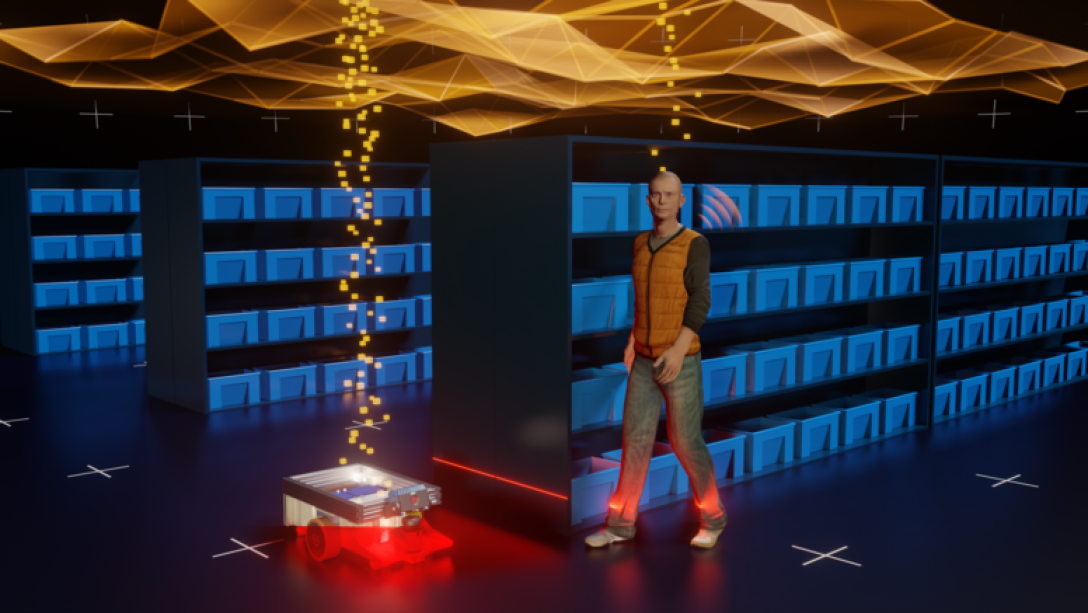
Mobile autonomous and semi-autonomous systems are the subject of wide-ranging debate, yet are already a reality in production. These systems will play a central role in the future, as demonstrated, for example, by the growing number of driverless transport vehicles (DTVs) in industry. This gives rise to entirely new challenges affecting both machine-to-machine communication and human-machine interaction. Accident statistics relating to intralogistics involving forklift traffic demonstrate that safety-related factors are of paramount importance in this context. In this project, Chemnitz University of Technology and Mittweida University of Applied Sciences aim to combine their expertise in the individual disciplines of driverless transport vehicles and tactile warning systems and, through a research collaboration, methodically address the existing system limitations from multiple angles. The core of the task is to develop and implement technologies for those posing a risk – including the control software for modern autonomous or semi-autonomous vehicles – and technologies for those at risk – such as tactile warning systems – from a cross-system perspective.
An important component in making the complexity of these and similar systems manageable, whilst still being able to translate ideas into concrete products as quickly as possible, is the development of virtual commissioning methods. This enables system states and interactions to be examined in detail across multiple development stages and system variants, without all components already being physically and fully in place.
The problem
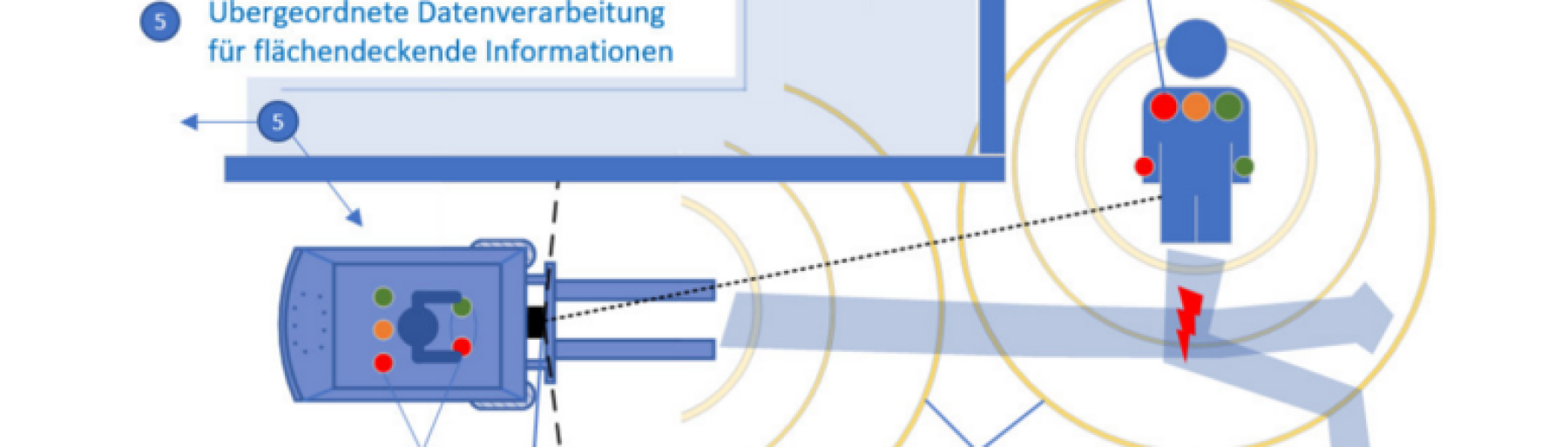
- Autonomous guided vehicles (AGVs) must not endanger people or elements of the infrastructure. Accordingly, they must be equipped with an environmental detection system that reliably identifies potential hazards, whilst also operating quickly enough to ensure the AGV’s efficient operation.
- Commissioning or training these systems is a very time-consuming process due to the complex scenarios in which an AGV may find itself.
- People are often particularly at risk in production environments. Concentrating on a specific task in particular often leads to a failure to take environmental information into account – including warning signals from production systems, industrial trucks, vehicles and the like.
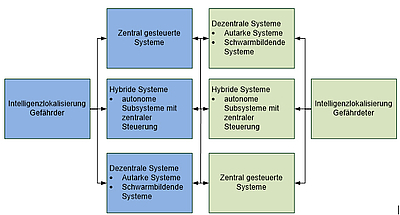
With regard to possible solutions, the relevant systems can interact with one another in various configurations of ‘distributed intelligence’. The respective advantages and disadvantages for each operational scenario must be understood prior to implementation in order to ensure reliably functioning solutions.
Objective
The three key research questions
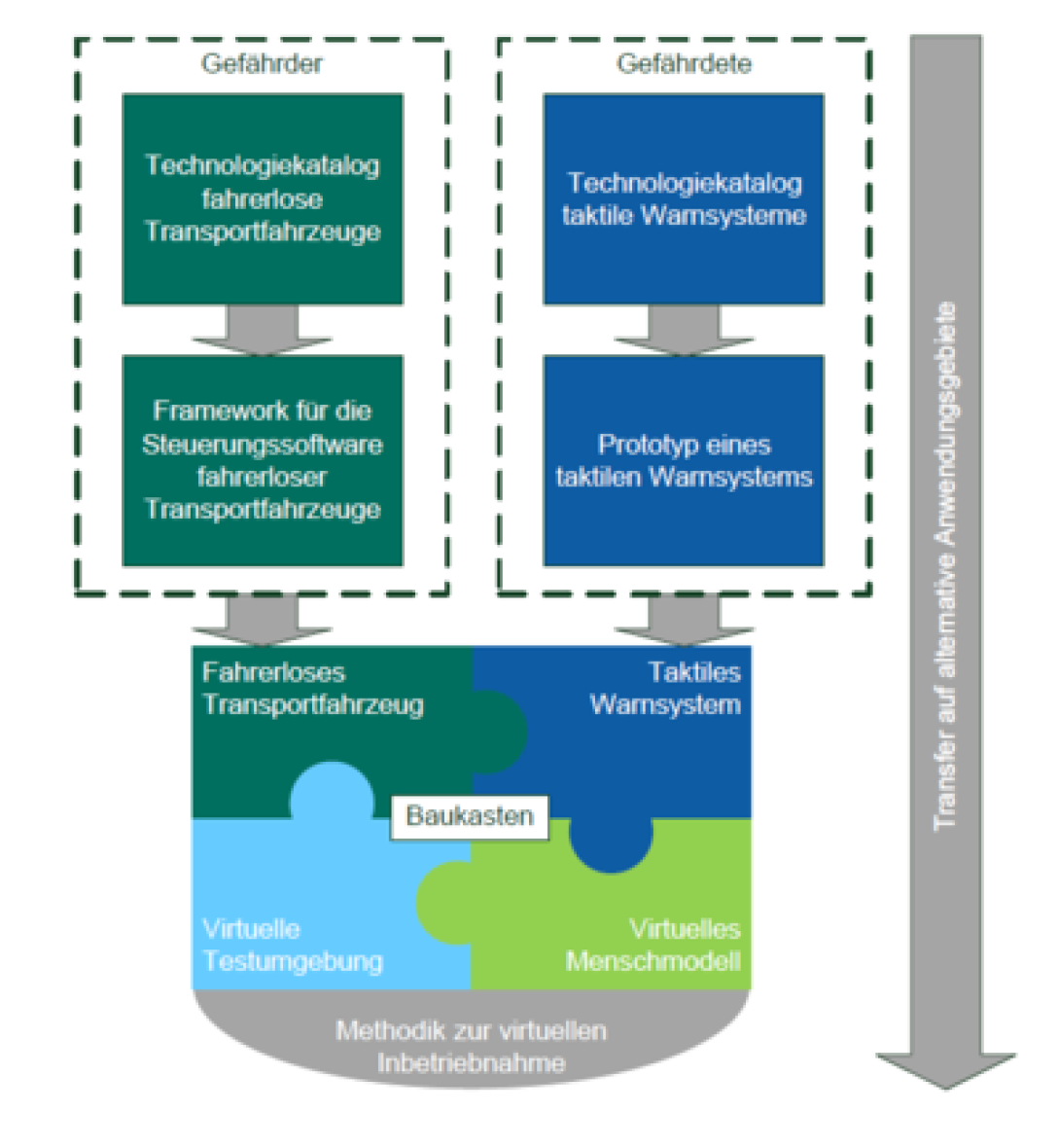
Three key tasks for the scientific and technical project arise from the project brief
- How must autonomous and semi-autonomous transport vehicles be designed in terms of software, and what boundary conditions must be taken into account in order to put them into operation using virtual technologies?
- What technical options are available for designing a natural human–technology interaction using tactile, visual and acoustic feedback?
- How must a virtual test environment be methodologically designed to ensure that all relevant boundary and influencing parameters are taken into account, and how can driverless transport systems and tactile warning systems be put into operation together within the test environment?

Our partner organisation
Chemnitz University of Technology is working on developing a flexible and adaptable framework for the control software of autonomous guided vehicles (AGVs). The framework is being developed on the premise that it can be commissioned virtually. This makes it possible, with minimal additional effort, to consider the human operator and warning system components flexibly as a single unit. Compared with traditional commissioning, this allows more tests to be carried out in a shorter time, thereby improving the overall reliability of the results.
Further information on the project can be found at: https://followme-ils.com