This page was translated automatically using artificial intelligence (DeepL). The German version is binding. More information about automatic translation
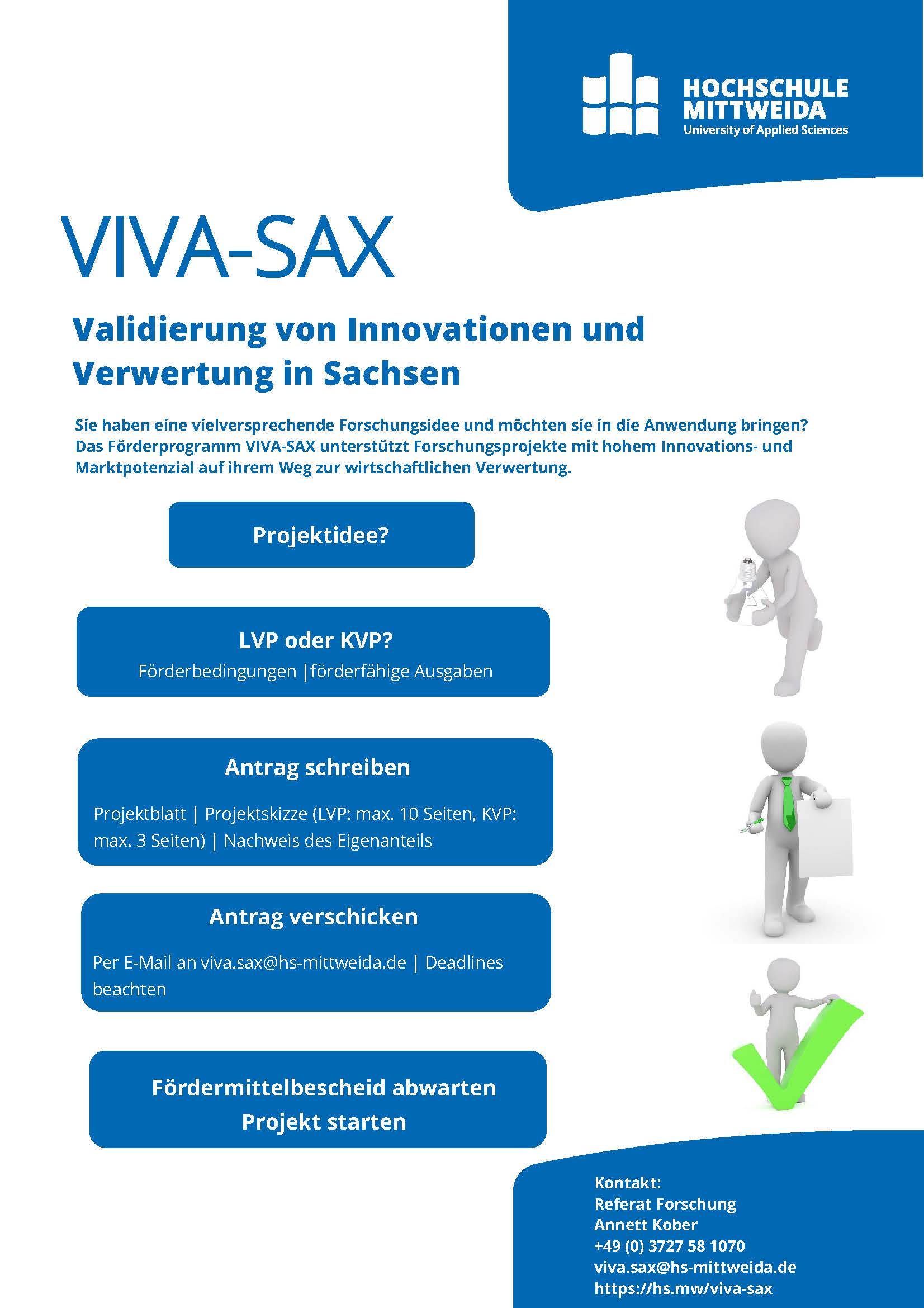
Any ideas?

How will my idea be funded?
Two funding streams are available:
- Long-term validation projects (LVP):
funding of up to €100,000 (including a 10% own contribution),
maximum duration of 12 months - Short-term validation projects (KVP):
funding of up to €10,000 (including a 10% own contribution),
flexible duration
- Validation of research findings with commercialisation potential
- Technology Readiness Level (TRL) 3–4 → Scaling up to TRL 5
- Support for licensing and spin-offs to facilitate commercialisation
| Long-term validation projects (LVP) up to €100,000 | Short-term validation projects (KVP) up to €10,000 |
|---|---|
| Target group: HSMW professors with research projects offering high innovation and market potential | Target group: HSMW professors with research projects that can be made market-ready through minor measures |
| Eligible costs: staff, materials, external services, equipment/facilities/instruments, registration of own intellectual property rights; 12 .5% of the grant amount earmarked for market and feasibility analyses | Eligible costs: materials, external services, intellectual property rights; no obligation to carry out a market analysis, but this is encouraged |
Next submission deadline: early 2027 Project must commence no later than 3 months after receipt of the funding notification A maximum of one application per funding round may be submitted per professorship. Applicants are required to present their project to the Transfer Committee as part of a pitch. | Flexible duration; Project must start no later than 3 months after receipt of the funding notification A maximum of one application per funding round may be submitted per professorship. |
The templates will be made available after you have logged in. Please use the templates provided and submit the following documents: Project outline (LVP) (length: 6.5–10 pages) with the following structure:
Proof of funding for the applicant’s own contribution (10%) | The templates will be made available after you have logged in. Please use the templates provided and submit the following documents: Project outline for continuous improvement (CIP) (length: 2–3 pages) with the following structure:
Proof of funding for the own contribution (10%) |
| Submission in Word and PDF format by email | Submission in Word and PDF format by email |
An overview of TRL levels:
- TRL 1: Basic research – initial scientific findings
- TRL 2: Technology concept – initial ideas for applications emerge
- TRL 3: Experimental proof of concept in the laboratory
- TRL 4: Technical validation on a laboratory scale
- TRL 5: Validation in a relevant environment (e.g. pilot trial)
- TRL 6: Prototype tested in a relevant environment
- TRL 7: Demonstration of the system under real-world conditions
- TRL 8: System fully developed and tested
- TRL 9: Market-ready – technology is fully operational
The VIVA SAX funding programme supports the development of research results from TRL 3 or 4 to TRL 5 in order to create marketable solutions. Further information is available to HSMW members in the third-party funding guide.
Reimbursement principle: The grant covers 90 per cent of the verified eligible costs.
Ineligible: Staff costs that are already funded from public budgets, as well as in-kind contributions involving no cash outlay (e.g. existing staff or materials), cannot be counted as own resources.
Collaboration with external partners or industrial companies is generally permitted, but there are certain requirements that must be observed:
1. Outsourcing of services: Outsourcing services to companies is permitted; however, contract research and collaborative projects with companies are expressly excluded.
2. Results of validation projects: The results achieved as part of the validation project must be freely accessible and must not be validated exclusively for the benefit of a specific company.
3. Testing at companies: It is possible to test a technology at a company; however, the company must not thereby gain preferential access to the use of the technology.
These rules also apply even if the cooperating company does not itself receive any funding.
Please use the templates provided and submit the following documents:
1. LVP project outline (length: 6.5–10 pages) with the following structure:
- Brief description of the project concept o Description of the proof of concept and degree of innovation
- Validation objectives, project implementation & intellectual property rights
- Market analysis, commercialisation & exploitation strategy
- Description of the applicant & the team
- Work plan including milestones
- Cost plan
2. Project outline for KVP (length: 2–3 pages) with the following structure:
- Brief description of the project idea
- Objectives & planned outcomes
- Project implementation & milestones
- Cost planning
3. Proof of funding for the own contribution (10%)
In what format should the documents be submitted?
- Word and PDF formats
- Please send applications by email.
- Contact person: Ms Annett Kober
1. Kick-off meeting (project launch)
- Presentation of the project and the planned exploitation strategy
- Review of the work plan and milestones
- Introduction to administrative and funding requirements
- Setting the date for the ‘Business Model Canvas’ workshop
2. Presentation of the interim progress report (halfway through the project)
- Presentation of progress to date and challenges
- Alignment with the validation objectives and adjustment of the strategy
- Initial assessment of market opportunities and areas of application
- Outlook on potential follow-up funding (e.g. EXIST programmes)
3. Final meeting (end of project)
- Final assessment of the validation results
- Finalisation of the commercialisation strategy (licensing or spin-off)
- Clarification of the next steps for commercial implementation
- Preparation of a final report and statement of expenditure
4. Status meeting (1 year after project completion)
- Review of progress in the commercialisation of the results
- Assessment of the project’s success based on criteria (e.g. pilot customer, patent, funding)
- Discussion of further support options (SAXEED, transfer office)
- Identification of new funding or financing opportunities
Who assesses the applications?
The selection of validation projects is carried out by a Transfer Committee (comprising representatives from the five faculties and the business sector) chaired by the Vice-Rector for Research.
How does the selection process work?
- Once submitted, the applications are reviewed by the committee members and assessed using a matrix.
- The highest-rated LVP applications are presented via a pitch at the Transfer Committee meeting; the pitch is also taken into account in the overall assessment. The results are discussed at the Transfer Committee meeting.
- Projects with particularly high potential receive a funding recommendation.
- Rejected applications may be revised and resubmitted.
Transfer Committee for the 2026 funding period:
Chair:
Prof. Uwe Mahn (Project Leader)
Members:
Prof. René Ufer (Faculty of INW)
Prof. Matthias Baumgart (Faculty of CB)
Prof. Thoralf Gebel (Faculty of WI)
Prof. Isolde Heintze (Faculty of Social Work)
Prof. Ulrich Buser (Faculty Media Sciences)
Maik Kästner (IHK)
Hagen Grüttner (ANTACON GmbH)
Advisory roles:
Dr Katrin Fritzsche (Research Department)
Marion Mattern (SAXEED Project Management)
Co-ordination:
Annett Kober (Research Unit)