
This page was translated automatically using artificial intelligence (DeepL). The German version is binding. More information about automatic translation
When the vest taps you on the shoulder …
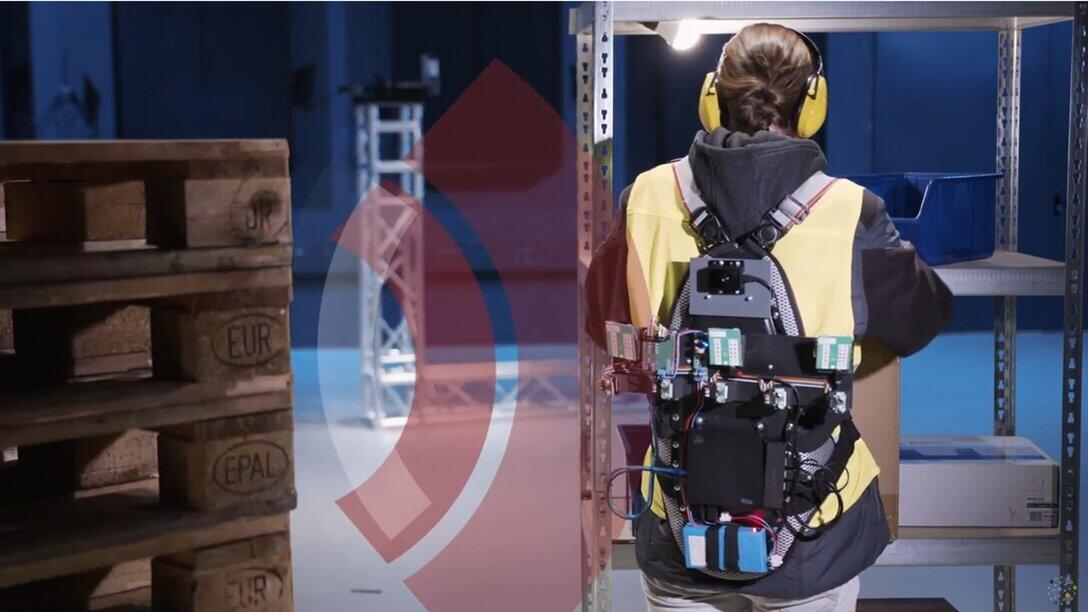
Venue: A warehouse belonging to a logistics company in Saxony. Day-to-day operations are in full swing: forklift trucks are moving pallets and containers, staff are packing parcels, signal lights are flashing, gates are opening and closing, accompanied by warning horns, whilst autonomous transporters move pallets between them. Right in the middle of it all are the new trainees in their first week, wide awake, excited and a little overwhelmed by the whole situation. That morning, their trainer gave them a yellow high-visibility vest, fitted with all sorts of electronics, and instructed them to wear it all day.
And then it happens: standing with his back to the main aisle, one of the trainees takes a step backwards and thus finds himself right in the path of an approaching pallet transporter. The young man stops, glances over his shoulder and sees the pallet transporter. He quickly moves out of its path, just in time to escape this dangerous situation unharmed. Later, he will say that the vest tapped him on the shoulder, prompting him to instinctively look towards the vehicle.
To ensure that this becomes a reality, Prof. Michael Kuhl and his colleagues at the Chair of Systems Electronics at Mittweida University of Applied Sciences have been working for several years, together with other research and industry partners, on a vibrotactile warning system with multi-sensor analysis.
Vibrotactile signals are defined as signals that reach a person via the sense of touch – for example, via the aforementioned ‘pat on the shoulder’. This is perceived as an intrusion into one’s personal space and is therefore more effective than conventional visual and audible signals. For evolutionary reasons, a tactile signal is difficult to mentally block out and, even over a prolonged period, the body adapts to it only very slightly.
Whilst conventional warning systems usually analyse the signals from just one sensor, the new system combines a time-of-flight 3D camera with, currently, three separate radar sensors. These can, in some cases, also detect objects or people that are obscured from view, whilst the camera’s main strengths lie in its spatial resolution and the number of objects it can detect simultaneously. The combination of the two signals and their analysis thus ensures more comprehensive protection and can issue direction-specific warnings to both the person at risk and the source of the hazard – for example, the forklift truck driver.
The new system is intended for use in companies with their own logistics departments and on-site transport, though applications are also conceivable in production facilities where moving machinery poses a potential hazard, or in rail and freight transport.
Whilst the early stages of development focused primarily on technical implementation, feasibility and acceptance studies, and the analysis of sensor signals, the current focus is on miniaturisation and the transition to a product line in collaboration with Chemnitz University of Technology and a number of industrial partners in Saxony. These partners cover virtually the entire potential product chain, ranging from 3D camera manufacturers and electronics development partners to providers of logistics software and suppliers of industrial trucks.