This page was translated automatically using artificial intelligence (DeepL). The German version is binding. More information about automatic translation
30 years of single-molecule FRET: Mittweida is researching the future of Biophotonics
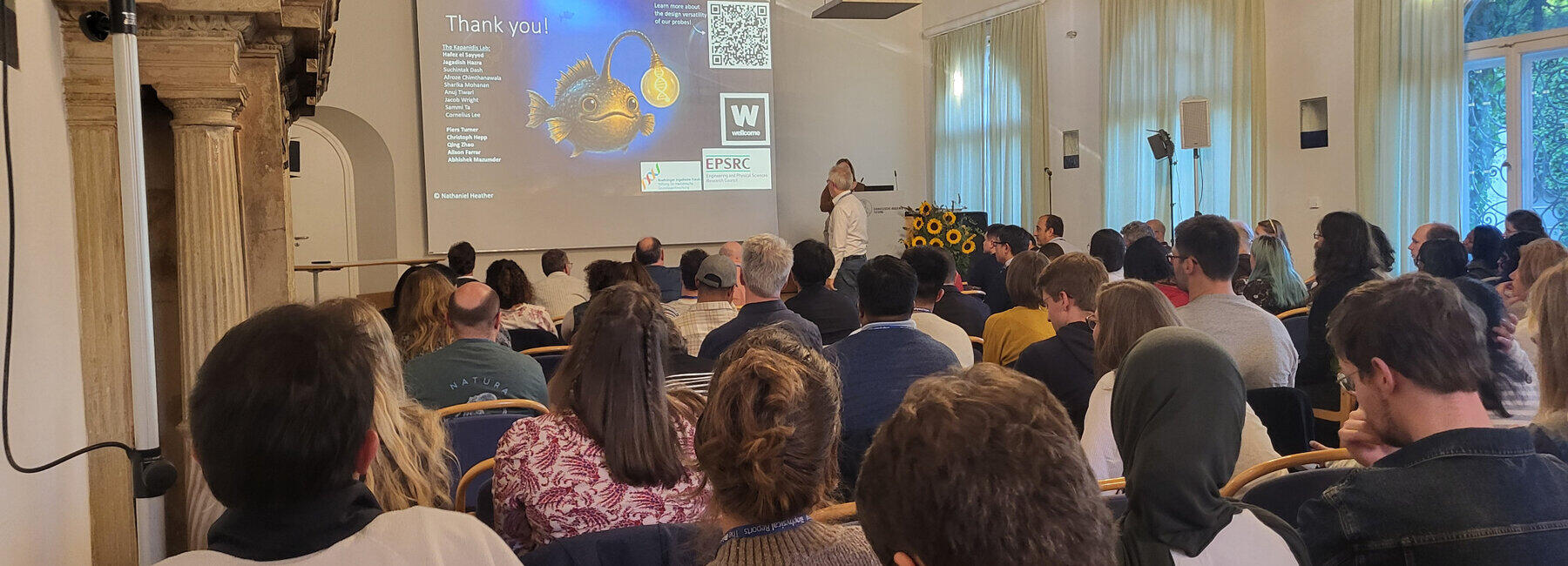
At the end of September, the international community of experts in single-molecule FRET spectroscopy gathered in Tutzing on Lake Starnberg for the anniversary conference ‘Single-Molecule FRET: The Next 30 Years’ (FRET3). The occasion marked the 30th anniversary of the first published single-molecule FRET experiments, which laid the foundations for numerous modern applications in biophysics, structural biology and Biophotonics.
FRET (Förster Resonance Energy Transfer) is a Biophotonics method that enables researchers to visualise structural changes at the nanometre scale in biomolecules such as RNA or DNA. By using very low concentrations (pM) and very small observation volumes (fL), even individual molecules (single-molecule FRET) can be studied. This allows biological processes to be observed in unprecedented detail.
Mittweida University of Applied Sciences was well represented at the conference by Professor Richard Börner and the early-career researchers Mara Henschel and Vanessa Reimann. The conference brought together researchers from all over the world to discuss current developments, challenges and future prospects for this method.
Whilst Professor Börner presented current research approaches to the structural biology of RNA in an invited talk, the focus was particularly on the contributions of the two PhD students. During the poster sessions, Vanessa Reimann presented her work on metal-ion- and temperature-dependent RNA 3D structuring, whilst Mara Henschel presented new findings on the folding of ribosomal RNA at the single-molecule level (smFRET).
For both researchers, the conference provided an opportunity to discuss their research findings with leading experts from the international FRET community, to gain valuable insights for their PhD projects and to establish new scientific contacts.
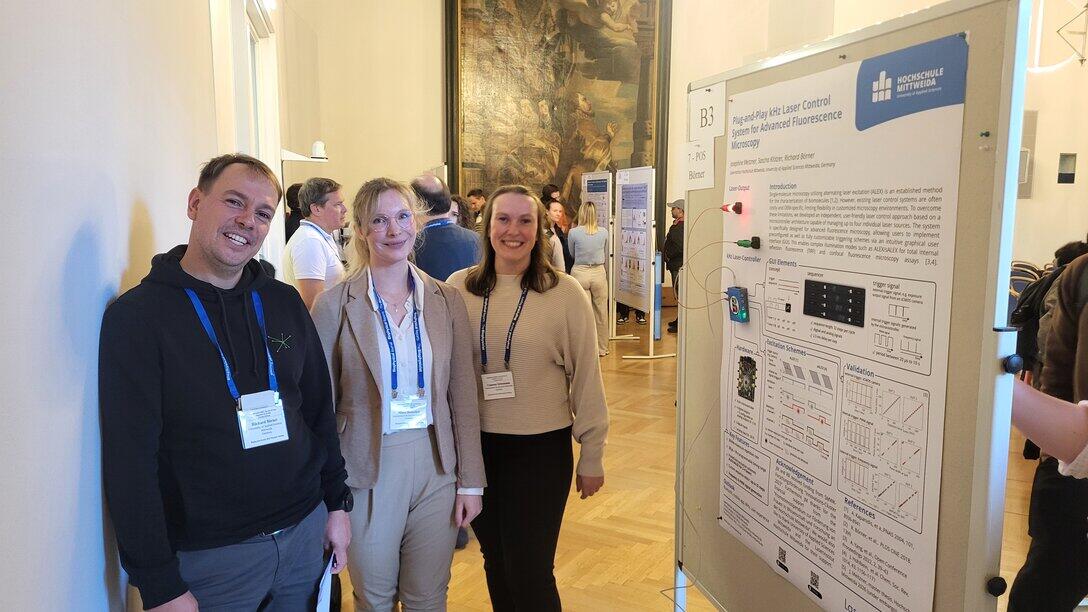
Female physicists are networking: Josephine Meitzner represents Mittweida in Kaiserslautern
Just a few days later, Mittweida University of Applied Sciences was once again represented at a major specialist event. The 28th German Conference for Women Physicists took place at the Rhineland-Palatinate Technical University of Kaiserslautern-Landau. The event offered female physicists at all stages of their careers a platform for scientific exchange and networking.
Josephine Meitzner attended on behalf of Mittweida University of Applied Sciences. The graduate in Physical Engineering presented her poster entitled ‘Plug-and-Play kHz Laser Control System for Advanced Fluorescence Microscopy’ (German: “Plug-and-Play laser control system in the kHz range for fluorescence microscopy”), which was based on her recently completed Master’s thesis at the Laser Institute of Mittweida University of Applied Sciences.
In addition to technical discussions, the conference provided insights into various fields of research and academic career paths. Particularly valuable was the exchange between female students, PhD candidates, researchers and professors, who shared their experiences from different stages of their academic careers.
Josephine Meitzner is currently conducting research into a DNAzyme:RNA complex as part of her “PhD scholarship to promote women in science and research at Mittweida University of Applied Sciences”, in collaboration with Ingrid Span at FAU Erlangen-Nuremberg, thereby continuing her scientific journey at the LHM.
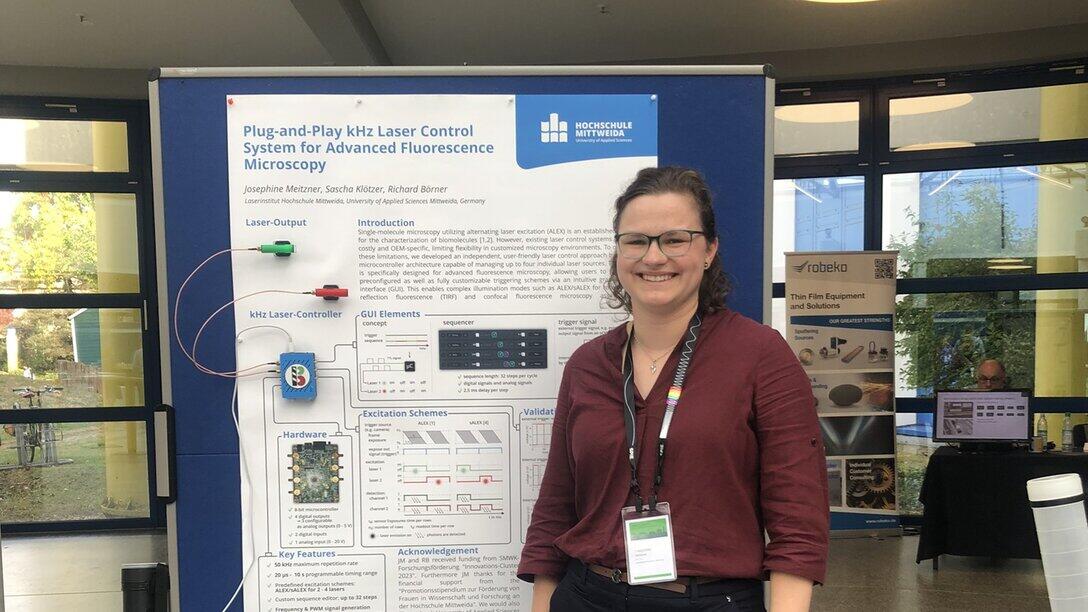
Research through exchange
For Mara Henschel, Vanessa Reimann and Josephine Meitzner, the conferences provided a valuable opportunity to present their research, receive feedback from experts in the field and make new contacts. At the same time, their contributions demonstrate the diversity of the research projects undertaken by early-career female researchers at Mittweida University of Applied Sciences, and how they are helping to shape current developments in their fields and can subsequently incorporate these into teaching at the university.



Prof. Richard Börner’s research group would like to thank the German Research Foundation (DFG) for funding the time-resolved confocal fluorescence microscope ‘MicroTime 200’ (MT200; PicoQuant GmbH). Furthermore, the group would like to thank the European Union and the Free State of Saxony for their financial support under the ESF+ doctoral fellowship programme (2023) as well as the funded projects NFG Lana-Sax (ESF Plus; grant reference 100649226) and BioLaSax (DFG; grant reference 8223702). Thanks are also due to the Laser Institute at Mittweida University of Applied Sciences and Mittweida University of Applied Sciences for their financial support. The projects are co-funded, amongst other sources, by tax revenue based on the budget adopted by the Saxon State Parliament.